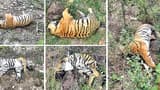
The Supreme Court has sought responses from Karnataka and the Centre after five tigers died from poisoning in MM Hills. The court urged the Centre to frame a policy with states to curb human-animal conflicts and prevent such tragic incidents.
New Delhi: The Supreme Court has raised serious concern over the death of five tigers at the MM Hills Wildlife Sanctuary in Karnataka and has sought a response from the state government. The apex court also directed the Union Ministry of Environment, Forest and Climate Change (MoEFCC) to formulate a comprehensive policy, in consultation with all states, to curb rising instances of human-animal conflict.
Tragic Deaths Linked to Poisoned Carcass
The case stems from a Central Empowered Committee (CEC) report presented to a three-judge bench led by Chief Justice of India BR Gavai by amicus curiae and senior advocate P. Parameshwaran. The report confirms that a tigress and her four cubs died after consuming a poisoned cattle carcass deliberately laced with toxins by local villagers. The villagers, it said, were retaliating against repeated cattle kills by wild animals.
Human-Wildlife Conflict Intensifying
The CEC identified the incident as a clear manifestation of escalating human-wildlife conflict. Many stray cattle from surrounding villages reportedly enter the sanctuary, attracting predators like tigers. However, the sanctuary lacks effective patrolling and monitoring, primarily due to under-equipped and undertrained forest staff.
Related Articles

Contractual Forest Guards Equipped
Advocate Parameshwaran informed the bench that most forest guards in the sanctuary were employed through contractors and lacked basic resources, including weapons and scientific surveillance tools. This shortfall in staffing and equipment has left the sanctuary vulnerable to cattle intrusions and poaching activities.
Court Calls for Comprehensive Policy
The bench asked Additional Solicitor General Aishwarya Bhati to ensure the MoEFCC takes initiative by engaging with all states and stakeholders. Bhati assured the court that the ministry would act accordingly.
CEC Recommends Stronger Measures
In its report, the CEC emphasised the need for:
- Enhanced patrolling and staff training
- Deployment of camera traps and surveillance tech
- Community engagement to mitigate conflict
- Swift response mechanisms for carcass detection
- Strict enforcement against wildlife poisoning
It added that the Western Ghats, where MM Hills is located, is one of India’s most critical tiger habitats, both ecologically and from a conservation management standpoint.