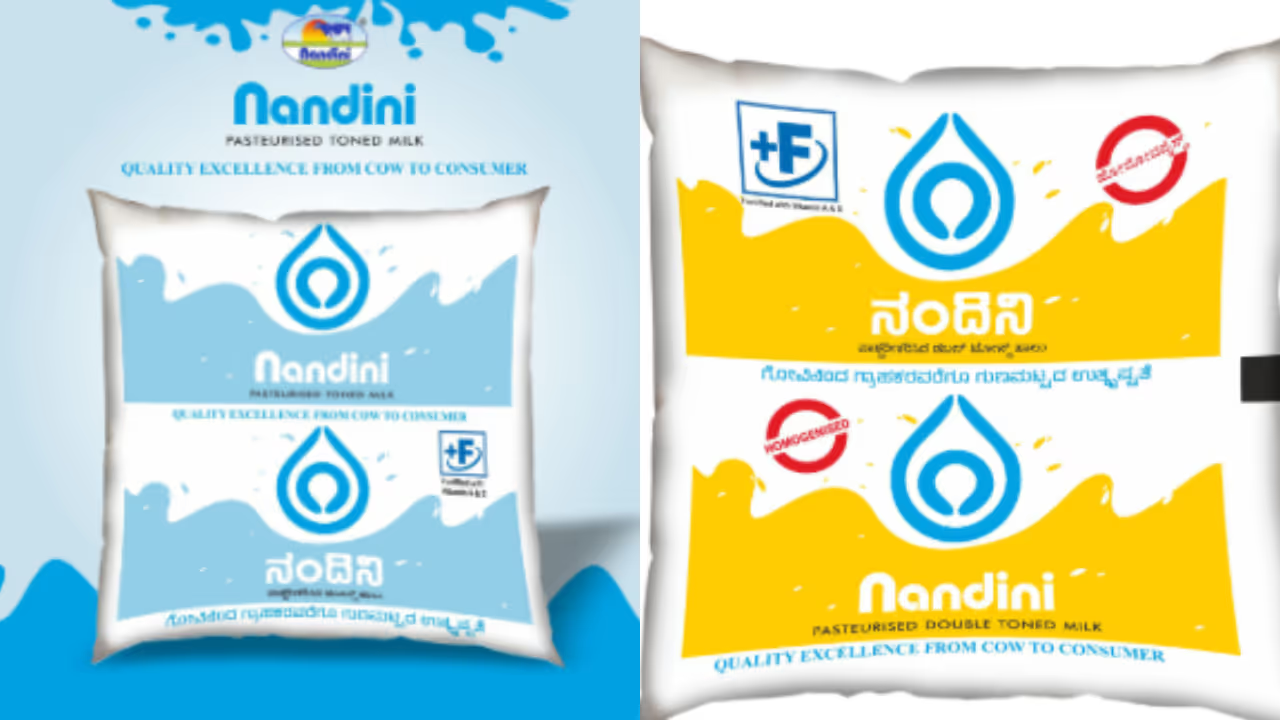
Nandini milk prices have increased in Karnataka, with some varieties becoming costlier by ₹12 per litre despite the announced ₹8 hike. Curd prices have also risen by ₹14 per litre. Here's why the revised rates vary across milk varieties.
Consumers in Karnataka will have to pay more for Nandini milk and curd from November 1, following the state government's decision to increase milk prices by ₹8 per litre. However, the revised rates vary across milk varieties depending on their fat and Solids-Not-Fat (SNF) content.
While some varieties have become costlier by ₹8 per litre, premium varieties such as Shubham and Samruddhi have seen a price increase of ₹12 per litre. The price of Nandini curd has also gone up by ₹14 per litre.
The decision has drawn criticism from opposition leaders, who have questioned the additional burden on consumers and demanded that the increased revenue directly benefit dairy farmers.
Related Articles

Nandini Milk Price Hike: Revised Rates From November 1
The revised prices of different Nandini milk varieties are as follows:
- Toned Milk: Increased from ₹46 to ₹54 per litre, a hike of ₹8.
- Homogenised Toned Milk: Increased from ₹47 to ₹56 per litre, a hike of ₹9.
- Homogenised Cow's Milk: Increased from ₹50 to ₹58 per litre, a hike of ₹8.
- Special Toned Milk: Increased from ₹52 to ₹64 per litre, a hike of ₹12.
- Shubham Milk: Increased from ₹52 to ₹64 per litre, a hike of ₹12.
- Homogenised Shubham Milk: Increased from ₹53 to ₹65 per litre, a hike of ₹12.
- Samruddhi Milk: Increased by ₹12 per litre.
- The price of Nandini curd has also increased by ₹14 per litre.
Why Have Some Nandini Milk Varieties Become Costlier by ₹12?
The price revision varies according to the fat and SNF content of each milk variety. Regular toned milk, commonly sold in blue packets, generally contains around 3% fat. Varieties such as Shubham and Samruddhi have a higher fat content, ranging from around 4.5% to 6%.
The Karnataka Milk Federation (KMF) has linked the revised prices to the fat and SNF content of the milk, stating that varieties with higher levels of these components require higher payments to farmers.
Higher Fat Content Means Higher Returns for Farmers
The government has defended the price increase, stating that the additional revenue is intended to benefit dairy farmers. It has also maintained that the revision is not aimed at generating profits for the government or KMF.
Ministers have cited the rising cost of cattle feed and fodder, particularly amid drought conditions, as one of the reasons for the decision. They have argued that higher procurement prices are necessary to support farmers and sustain milk production.
₹12 Milk Price Hike and ₹14 Curd Increase Draw Criticism
The price revision has attracted criticism from opposition leaders. Former Legislative Council member Bharati Shetty alleged that the government was placing an additional financial burden on consumers under the pretext of supporting dairy farmers.
The BJP Mahila Morcha has also threatened to stage a protest at Freedom Park in Bengaluru against the price increase.
Yatnal Says Increased Milk Revenue Should Reach Farmers
BJP MLA Basanagouda Patil Yatnal said he had no objection to an increase in milk prices if the additional amount directly benefited dairy farmers. However, he questioned whether the entire increase would reach farmers or whether individuals within KMF would benefit from it.
Meanwhile, ministers Zameer Ahmed, Sharanaprakash Patil and Basavaraj Rayareddy have defended the government's decision, pointing to the rising expenses faced by dairy farmers, particularly the cost of cattle feed and fodder.