
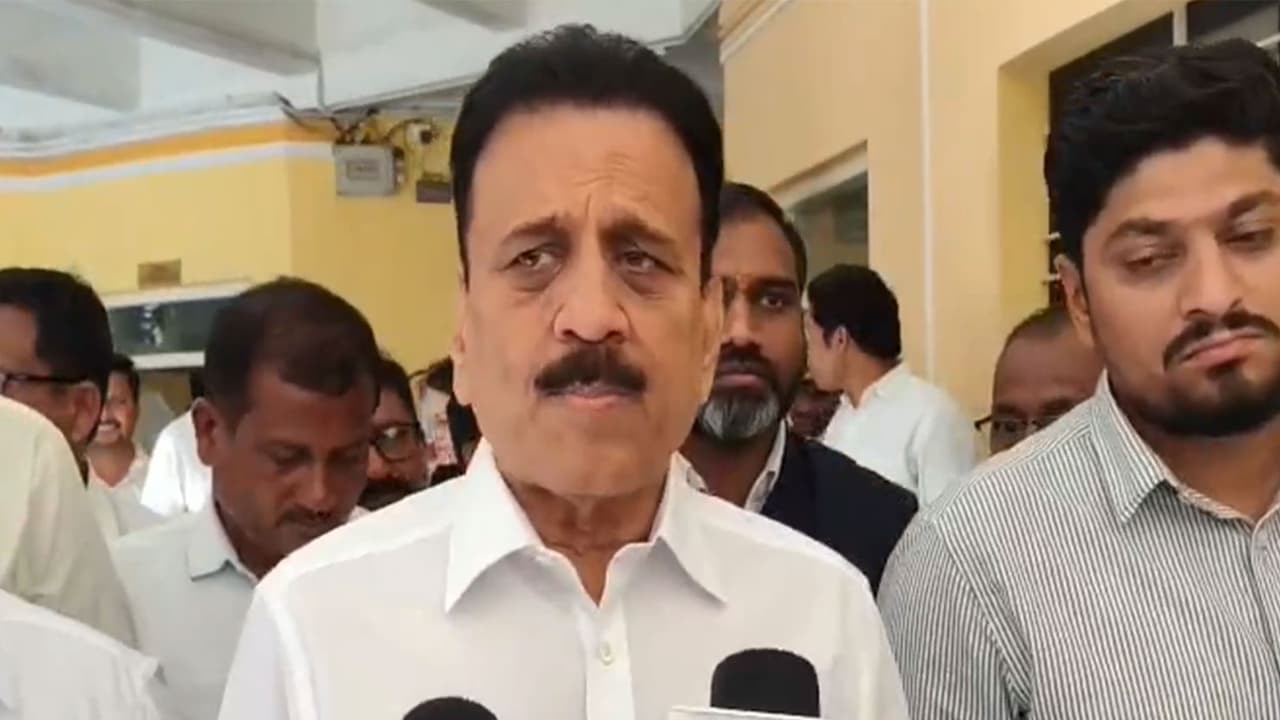
Maharashtra Minister Girish Mahajan questions Sonia Gandhi's article on the Iran-Israel conflict, asking why India should comment. He advocates for non-intervention, while Gandhi criticized the government's silence on the assassination of Iran's leader.
Maharashtra Minister Girish Mahajan on Tuesday questioned Congress Parliamentary Party Chairperson Sonia Gandhi's article on the Iran-Israel conflict, asking why India should comment on the issue. He emphasised India's peaceful existence and suggested the topic is best left to international policy. "Why do we have to speak about that? Sonia ji should understand that what is our connection to it... We are living in peace here, so what is the need... It is an international policy." He also questioned why India needs to intervene in international matters that do not directly affect its domestic peace.
Speaking to the media, Mahajan said, "Why should we speak against anyone? Should we abuse America? Should we abuse Iran? Why? I do not understand. Is it must politics be involved in everything? Our work is going on well, everyone lives peacefully in our country, they are living so. So why should we intentionally go and add fuel to the fire in between?"
Mahajan on Evacuation of Maharashtra Citizens
He also spoke about the people of Maharshtra who are in the West Asia conflict zone. He said, "I still have all the records, the list with me. I have spoken to 100-150 people since morning. Yesterday, I also spoke to 300 to 400 people. I mean, I spoke with groups, and that is how many people are there. So I think in one or two days, as the situation becomes normal or we get a bit of a chance, we will bring them back."
"We are in contact with the central government as well. We are also in touch with our Foreign Affairs Secretary. We have also given them a letter since yesterday regarding the disaster situation, and talks are ongoing. The Chief Minister is paying full attention to this. I think in 2-3 days, as soon as the situation stabilises a bit, we will bring those people back here," he added.
Sonia Gandhi Criticises Government's Silence
Sonia Gandhi on Tuesday criticised Prime Minister Narendra Modi's government, stating that the government's silence on the "targeted assassination of Iran Supreme Leader Ayatollah Ali Khamenei is "not neutral but an abdication." Sonia Gandhi, in her opinion piece in the Indian Express, said India's lack of response "signals tacit endorsement of this tragedy."
"On March 1, Iran confirmed that its Supreme Leader, Ayatollah Seyed Ali Hosseini Khamenei, had been assassinated in targeted strikes carried out the previous day by the United States and Israel. The killing of a sitting head of state in the midst of ongoing negotiations marks a grave rupture in contemporary international relations. Yet, beyond the shock of the event, what stands out equally starkly is New Delhi's silence," Sonia Gandhi said in her opinion piece. "Initially, ignoring the massive US-Israeli onslaught, the Prime Minister (Narendra Modi) confined himself to condemning Iran's retaliatory strike on the UAE without addressing the sequence of events that preceded it. Later, he uttered platitudes about his 'deep concern' and talked of 'dialogue and diplomacy', which is precisely what was underway before the massive unprovoked attacks launched by Israel and the US," she added.
Conflict Background: US-Israel Strikes and Iran's Retaliation
On February 28, the US and Israel conducted coordinated airstrikes across multiple Iranian cities, targeting military command centres, air-defence systems, missile sites, and key regime infrastructure. These strikes resulted in the death of Iranian Supreme Leader Ayatollah Khamenei and four senior military and security officials, with large explosions reported in Tehran and other major cities.
In response, Iran retaliated by launching ballistic missiles and drones at US assets and allies across the region, including Israel, Bahrain, Kuwait, Qatar, Saudi Arabia, the United Arab Emirates, and Jordan, further widening the conflict in the Middle East and heightening risks for civilians and expatriates alike. (ANI)
(Except for the headline, this story has not been edited by Asianet Newsable English staff and is published from a syndicated feed.)