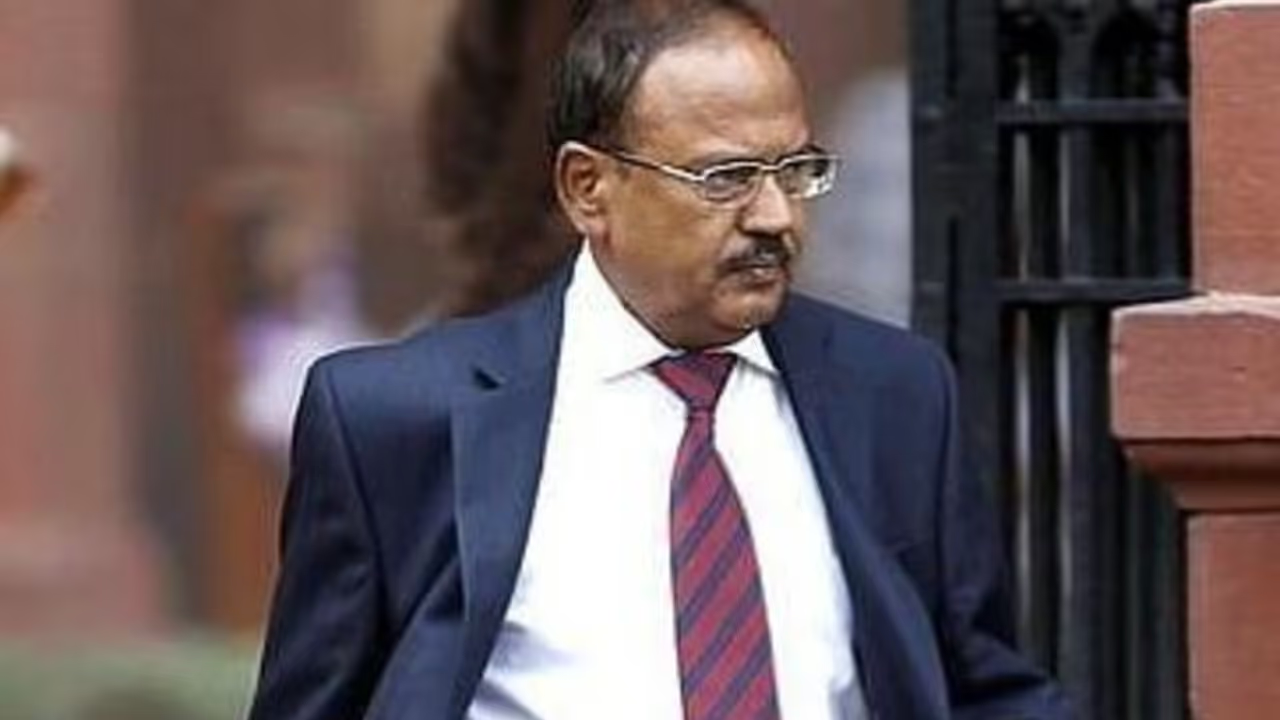
NSA Ajit Doval reveals why he avoids mobile phones and the internet, offering rare insight into his security-first mindset, secret communication systems and decades of intelligence experience.
At a time when smartphones are almost an extension of the human hand, India’s National Security Advisor Ajit Doval has revealed that he largely stays away from both mobile phones and the internet. Speaking at the inaugural session of the Viksit Bharat Young Leaders Dialogue 2026 at Bharat Mandapam, Doval was asked directly by a young participant whether it was true that he avoids digital technology in his daily life.

He confirmed it without hesitation.
“It is true that I do not use the internet,” Doval said. “I also do not use a phone, except for family matters or for speaking to people in other countries, which is necessary.”
Related Articles

The response instantly drew attention, not just for its content but for what it revealed about the mindset of a man responsible for safeguarding India’s national security.
‘There Are Other Means of Communication’
Doval explained that avoiding smartphones does not mean avoiding communication. Instead, he relies on systems that are not part of everyday public life.
“I manage my work that way. There are many other means of communication as well, and some additional methods have to be arranged that people are not aware of,” he said.
The carefully worded statement, delivered without theatrics, hinted at secure channels developed over decades of intelligence experience—systems designed to minimise risk in an era of cyber surveillance and digital espionage.
Who Is Ajit Doval?
Ajit Doval is India’s National Security Advisor and the fifth person to hold the post. A retired Indian Police Service (IPS) officer from the Kerala cadre, he has spent decades working in intelligence, internal security and counter-terrorism.
Born in Uttarakhand in 1945, Doval joined the IPS in 1968. Early in his career, he earned a reputation for fearlessness and sharp operational thinking. He went on to become the youngest police officer to receive the Kirti Chakra for bravery, one of India’s highest gallantry awards.
Years on the Frontlines of Internal Security
Over the years, Doval worked extensively in some of India’s most sensitive conflict zones. His career includes deep involvement in counter-insurgency operations in Mizoram, Punjab and the Northeast, regions that shaped India’s internal security doctrine in the late 20th century.
Between 1971 and 1999, he handled multiple aircraft hijacking cases, gaining first-hand experience in crisis negotiation and counter-terror response.
In 1999, he emerged as a key figure during the IC-814 hijacking crisis, serving as one of the negotiators in Kandahar—an episode that remains one of India’s most complex security challenges.
Undercover in Pakistan
One of the lesser-known chapters of Doval’s career involves his time spent working undercover in Pakistan. Those years, often referenced but rarely detailed publicly, contributed to his deep understanding of cross-border threats, intelligence tradecraft and covert operations.
This background also explains his instinctive caution around open digital platforms.
Architect of Key Security Decisions
As National Security Advisor, Doval has been closely involved in some of India’s most consequential strategic decisions. These include the 2016 surgical strikes, the 2019 Balakot airstrikes, and managing the tense Doklam standoff with China.
His approach to security—discreet, calculated and deeply risk-aware—has shaped India’s modern national security posture.
No Social Media, No Official Accounts
Doval’s distance from digital platforms is not just personal—it is institutional.
Last year, the government’s fact-checking agency exposed a fake Facebook post falsely attributed to him, which warned citizens of an impending cyberattack from Pakistan. The Press Information Bureau (PIB) stepped in to clarify that Ajit Doval does not have any official Facebook account and that the post circulating with his name and photograph was entirely fabricated.
The incident served as a reminder of the dangers of misinformation—and perhaps reinforced why India’s top security official prefers to stay offline.
A Philosophy Rooted in Experience
Ajit Doval’s avoidance of mobile phones and the internet is not about rejecting technology. It is about control, caution and consequence—values forged over decades in intelligence and counter-terror operations.
In an age of constant connectivity, his words at Bharat Mandapam offered a rare glimpse into a different way of working—one where silence can be security, and distance from the digital world can be a deliberate strategic choice.