
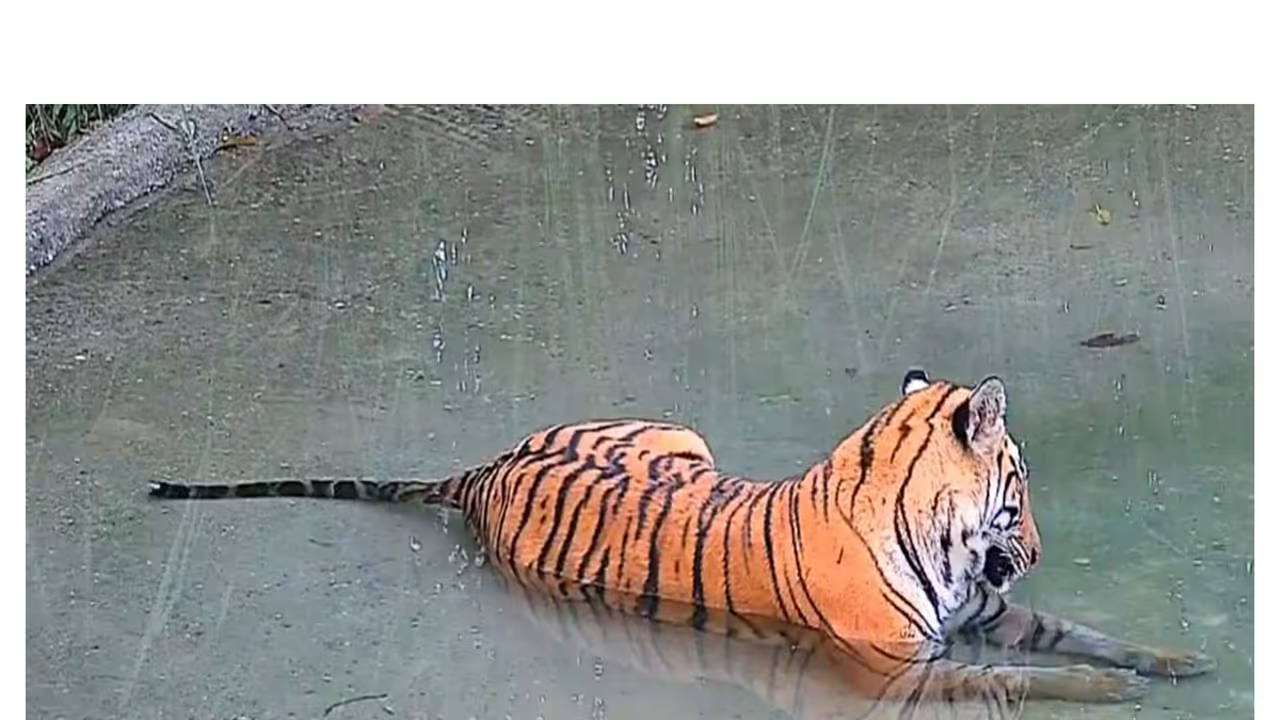
West Bengal launched its first tiger reintroduction programme by releasing a three-year-old tigress into the Buxa Tiger Reserve. The tigress was brought from Bihar's Valmiki Tiger Reserve and released by CM Suvendu Adhikari and Bhupender Yadav.
A three-year-old tigress was released into the core zone of the Buxa Tiger Reserve (BTR) in West Bengal, marking the commencement of the state's first tiger reintroduction programme. West Bengal Chief Minister Suvendu Adhikari and Union Minister for Environment, Forest and Climate Change Bhupender Yadav jointly released the tigress, identified as T138, who was brought from Bihar's Valmiki Tiger Reserve. The release also coincides with the nationwide launch of National Wildlife Week.
Yadav said the project was inspired by Prime Minister Narendra Modi's push for landscape conservation and species protection. "Inspired by PM Shri Narendra Modi ji's push for landscape conservation and species protection, today we have fulfilled the significant promise to reintroduce a tiger in Buxa. T138 has been brought from Valmiki Tiger Reserve in Bihar to Buxa," he said on X. He thanked Bihar Chief Minister Samrat Choudhary and Chief Minister Suvendu Adhikari for their support in the reintroduction.
Efforts Behind the Reintroduction
Addressing a press conference after the release, Yadav said efforts to bring tigers back began long back, when studies were commissioned into why the species had disappeared from the area. "We sent conservation experts, naturalists, and scientists from across the country here, and stated that this was tiger habitat and tigers could thrive here again," he said.
He alleged that the previous state government did not act on the Centre's requests. "The then-government paid no attention to our requests. We kept writing letters to them repeatedly," Yadav said.
Crediting the present state government, he added, "The work from 2018 up to 2026, which could not be accomplished in 8 years, our Suvendu delivered in just a few months."
Securing the Habitat
Yadav said the reserve now has adequate prey and that two villages had been voluntarily relocated to secure the habitat. "The prey area here is sufficient. But alongside this, we also carried out the voluntary relocation of two villages in the interim," he said.
As we start the #WorldWildlifeWeek2026, posing with the team that made it possible to get the #TigerBackInBuxa. P.S: Photos only tell a part of the story. This project has been made possible due to the steadfast dedication of @ntca_india, @wii_india, many field officers and staff who are not part of this photo. — Bhupender Yadav (@byadavbjp) October 2, 2026
Yadav also thanked officials of the National Tiger Conservation Authority (NTCA) for their role in the project. On the occasion of Gandhi Jayanti and Swachh Bharat Diwas, Bhupendra Yadav also participated in a cleanliness drive along with forest warriors in Buxa Tiger Reserve.
The Road to Recovery for Buxa
Buxa has historically been an important tiger landscape of North Bengal. Declared a Tiger Reserve in 1983, it forms part of a larger ecological landscape with connectivity to forests and protected areas of Bhutan and Assam.
Over the decades, however, habitat degradation and fragmentation, changes in land use and decline in prey availability affected the ecological conditions required to sustain a resident tiger population. The Reserve subsequently witnessed a prolonged absence of a stable resident tiger population.
According to a release from the Ministry of Environment, Forest and Climate Change, the recovery of Buxa has been a sustained, science-based effort. The Tiger Augmentation and Recovery Project, initiated by the Government of West Bengal with support from the National Tiger Conservation Authority (NTCA) and Wildlife Institute of India (WII), has been implemented collaboratively since 2018.
Habitat and Prey Base Augmentation
The focus has been on rebuilding the ecological foundations necessary for tiger recovery through habitat improvement, prey-base augmentation, strengthening protection and monitoring, scientific assessment and capacity building. More than 800 chital have been released to supplement the prey base, while approximately 380 hectares of grassland have been restored or converted over the past eight years. Scientific monitoring has indicated a positive trend in prey abundance. (ANI)
(Except for the headline, this story has not been edited by Asianet Newsable English staff and is published from a syndicated feed.)