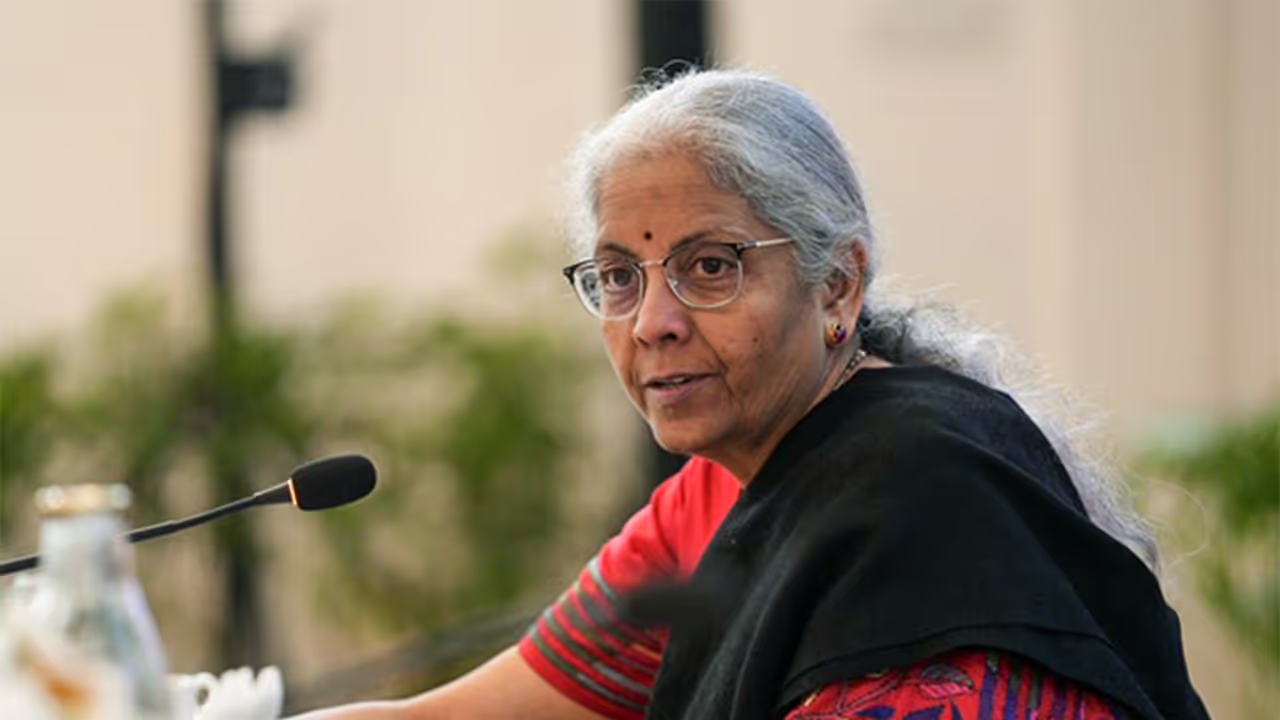
Union Finance Minister Nirmala Sitharaman will present the Union Budget for 2026-27. This follows the tabling of the Economic Survey for 2025-26, reinforcing its status as the fastest-growing major economy.
Union Finance Minister Nirmala Sitharaman will present the Union Budget for the financial year 2026-27 in the Lok Sabha as part of the ongoing Budget session of Parliament. According to the Lok Sabha List of Business, the House will meet at 11 am.
Sitharaman will present a statement of the estimated receipts and expenditure of the Government of India for the year 2026-27.
The Finance Minister will also lay on the table two statements under Section 3(1) of the Fiscal Responsibility and Budget Management (FRBM) Act, 2003.
Related Articles

These include the Medium-term Fiscal Policy-cum-Fiscal Policy Strategy Statement and the Macro-economic Framework Statement.
The List of Business further states that Sitharaman will move for leave to introduce the Finance Bill, 2026, in the Lok Sabha. She will also formally introduce the Bill.
The Finance Bill gives legal effect to the financial proposals of the government.
FM Sitharaman is set to present India's ninth consecutive Union Budget. On Thursday, Union Finance Minister Nirmala Sitharaman tabled the Economic Survey of India in Parliament for the financial year 2025-26.
The tabling of the Economic Survey ahead of the Budget follows the long-standing tradition of outlining the state of the economy before detailing future fiscal plans.
The Economic Survey of India is regarded as the nation's official annual "report card" on the economy. It provides a comprehensive, data-backed review of the economy's performance over the previous year and offers a broad roadmap for future policy direction. As the government's flagship annual report, it reviews key economic developments over the past 12 months.
The survey plays a crucial role in the lead-up to the Union Budget. While the Budget focuses on future government spending, taxation, and policy measures, the Economic Survey explains why those decisions are necessary by analysing past economic performance and trends.
The Economic Survey is prepared by the Economic Division of the Department of Economic Affairs under the leadership of the Chief Economic Adviser (CEA). It is presented in two parts, each focusing on different aspects of the economy.
Referring to the Economic Survey 2025-26, Union Minister Piyush Goyal noted that the First Advance Estimates project real GDP growth at 7.4 per cent for the Financial Year (FY) 2025-26, reinforcing India's position as the fastest-growing major economy for the fourth consecutive year.
"The Indian economy has sustained strong momentum, with the First Advance Estimates projecting real GDP growth at 7.4% for FY 2025-26. This underscores India's position as the fastest-growing major economy for the 4th consecutive year," Piyush Goyal wrote on X on Thursday.
Goyal noted that India recorded an inflation rate of 1.7 per cent during April-December 2025, largely due to a contraction in food prices for key commodities like vegetables and pulses, demonstrating effective inflation management by the government.
He also emphasised the government's focus on strengthening manufacturing, describing the progression from 'Swadeshi' to 'Strategic Resilience' and now 'Strategic Indispensability', aimed at promoting confidence in 'buying Indian without thinking'.
The Budget session will span 30 sittings over 65 days, concluding on April 2. The two Houses will adjourn for a recess on February 13 and reconvene on March 9 to enable the Standing Committees to examine the Demands for Grants of various ministries and departments. (ANI)
(Except for the headline, this story has not been edited by Asianet Newsable English staff and is published from a syndicated feed.)