
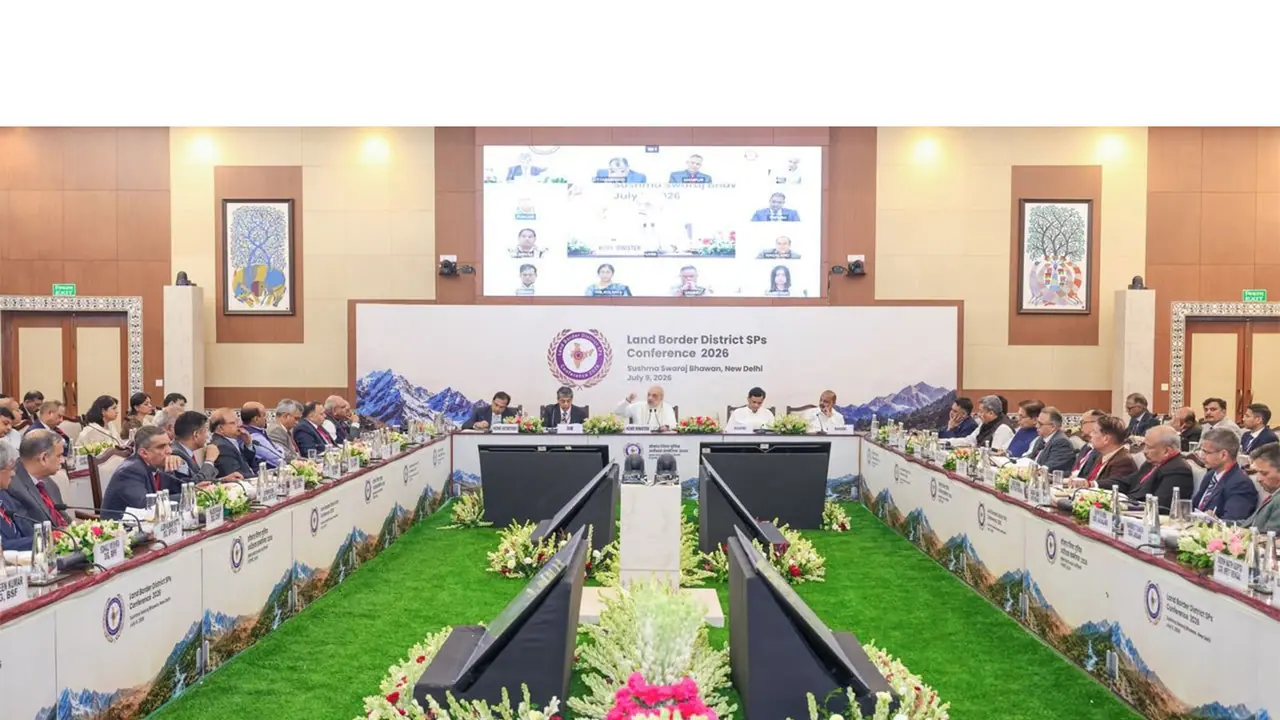
Uttarakhand Police attended the Land Border Districts' SP Conference in New Delhi, which helped bolster security, development, and citizen participation in border areas. The state presented its people-centric policing model and tech-driven solutions.
Uttarakhand Police on Friday said the exchange of best practices, innovations, and experiences during the Land Border Districts' Superintendents of Police Conference 2026 in New Delhi helped further strengthen security, development, and citizen participation in the state's border regions.
Uttarakhand's Participation and Key Takeaways
Representing Uttarakhand at the conference was Director General of Police Deepam Seth, who hailed the conference as an important step in making security in border districts more modern, better coordinated, and people-centric. Along with DGP Seth, Superintendents of Police from the state's five border districts, Udham Singh Nagar, Pithoragarh, Champawat, Uttarkashi, and Chamoli, which share international borders with Nepal and Tibet (China), attended the conference. Uttarakhand Home Secretary Shailesh Bagauli, Director General (Intelligence and Security) Abhinav Kumar, and other senior officials participated virtually.
Considering Uttarakhand's strategic importance as a state sharing two international borders, the state police presented suggestions on technology-driven border surveillance, prevention of cross-border crimes, strengthening local intelligence networks, development of infrastructure in border areas, and enhancing coordination among various security agencies, the state police informed.
Focus on Community-Centric Policing
According to a statement from the Uttarakhand Police Headquarters, during the session on "Community Engagement for Border Development," Champawat Superintendent of Police Rekha Yadav delivered a detailed presentation on Uttarakhand Police's people-centric and participatory policing model. She highlighted the concept of the "Five Pillars of Community Force Multiplication"--Trust, Information, Participation, Capacity Building, and Incentives and Protection--as a framework for strengthening security in border regions through active community involvement. She also shared the positive outcomes of the "Ratri Chaupal" initiative, under which regular community interactions are organised in border villages, and showcased the "Gunji Model" developed in Pithoragarh district as a successful example of reverse migration.
National Framework for Border Security
Union Home Minister Amit Shah presided over the Land Border District Superintendents of Police (SP) Conference in New Delhi, establishing a new collaborative framework to fortify the nation's frontiers. The conference served as a platform to align state police and central agencies, shifting the country's border management from a reactive to a proactive stance.
The Home Minister stressed the need for timely reporting of demographic changes in border areas to higher authorities, adding that tackling challenges such as proxy warfare, radicalisation, drone threats, cybercrime, and organised crime remains a top priority to ensure secure and prosperous borders. During various thematic sessions, the Union Home Minister held discussions on key issues including cross-border terrorism and organised crime, border security, financial crimes and illicit money flows, demographic changes in border areas, and community participation in border development.
Vision for 'Smart Borders' and Vibrant Villages
On Thursday, Union Home Minister Amit Shah chaired the country's first Land Border District SPs Conference-2026 in New Delhi. The conference brought together Directors General of Police from 18 border states and Union Territories, chiefs of Central Armed Police Forces, other central police organisations, senior border security officials, and Superintendents of Police from border districts across the country.
Addressing the conference, Amit Shah said the Central Government is committed to making India's border security architecture stronger and more technologically advanced. Under the concept of "Smart Borders," an integrated security framework is being developed through close coordination among border guarding forces, state governments, district administrations, other agencies, and local communities. He said that over the next three years, the government aims to establish a robust system to effectively curb narcotics smuggling and eliminate illegal infiltration. Under the Prime Minister's Vibrant Villages Programme, special emphasis is being placed on preventing migration from border villages, generating employment opportunities, and ensuring effective implementation of government welfare schemes. (ANI)
(Except for the headline, this story has not been edited by Asianet Newsable English staff and is published from a syndicated feed.)