
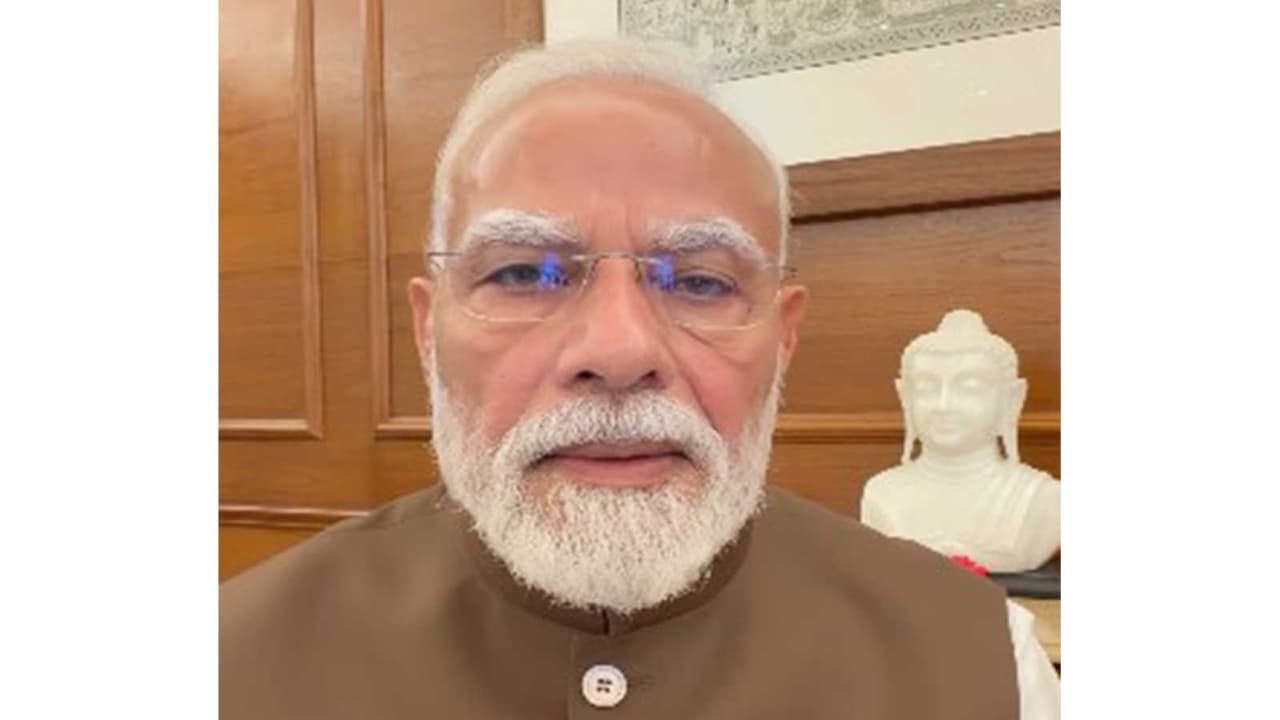
PM Narendra Modi hailed the passage of the Public Examinations (Prevention of Unfair Means) Amendment Bill, 2026, promising a reliable exam system and vowing that those involved in paper leaks 'will not be spared.' The Bill proposes stricter penalties.
Prime Minister Narendra Modi on Thursday welcomed Parliament's passage of the Public Examinations (Prevention of Unfair Means) Amendment Bill, 2026, saying the legislation marks a significant step towards creating a reliable examination system and reiterating that those involved in examination paper leaks "will not be spared."
In a video message shared on Instagram after the Rajya Sabha passed the Bill, the Prime Minister said the government has been taking continuous steps to ensure transparency and strengthen the examination system. "Friends, for a reliable examination system, we are continuously taking one step after the other. Whether it is the creation of transparency, creation towards fast track, or taking states' suggestions into consideration... every state and the central government has been facing this kind of paper leak trouble for several decades. This is also creating a crisis for the future of children," PM Modi said.
He said reforms in the education system had become mandatory across the country and stressed the need for greater use of technology to curb examination-related malpractices. "Keeping all these things in mind, reforms in the education system have become mandatory nationwide in all states as well as at the Centre. There is a need for the abundant and useful application of technology," he said.
The Prime Minister asserted that the government would take strict action against those involved in paper leak rackets. "If any paper mafia, the gang doing paper leaks, the gang playing with the future of the country's children--they will not be spared. Therefore, stringent laws are also needed," the Prime Minister said.
Bill passed with stringent legal provisions
Referring to the passage of the Bill in Parliament, PM Modi said the promise had been discussed extensively in both Houses before being passed with stringent legal provisions. "We had taken a Bill to Parliament, and as I had promised you, in just two days, both Houses of Parliament, with the maximum number of honourable MPs, have discussed it extensively, and today both Houses have passed this Bill with stringent legal provisions and clauses," he said.
Calling the passage of the legislation a major milestone, the Prime Minister said the government would continue working to strengthen the examination system. "Now, a significant task has been completed in moving towards a reliable examination system. The work will continue to move forward as well. We will not let such circumstances persist for a long time. With this confidence, friends, let us all together walk hand in hand to fulfil the dream of a developed India," he added.
After clearance in the Lok Sabha, the Public Examinations (Prevention of Unfair Means) Amendment Bill, 2026, was passed in the Rajya Sabha on Thursday. The Bill proposes stricter penalties, time-bound investigations, and Special Fast Track Courts to curb cheating and paper leaks in public examinations. The Bill will now be sent to the President for assent.
In the Upper House, the opposition MPs walked out before the Bill was passed.
Govt committed to protecting students' welfare: Union Minister
Replying to the discussion in the House, Union Minister of State Jitendra Singh highlighted various measures taken by the government in the education sector, including the National Education Policy (NEP) 2020 and the increase in the number of universities across the country. "This is an issue which concerns every parent of this country, every family of this country. These young children are a huge investment for the country," Singh said.
He said that around 7.65 crore students would be affected by measures aimed at strengthening the examination system. "We have made very earnest efforts to liberate it from the management quota malice and tried to make medical education more accessible," he said.
Singh also described the NEP 2020 as a "game changer" for the education system, saying it had provided students with greater freedom in choosing their educational paths. "The biggest game changer of the education system is NEP 2020 as it has liberated students from the slavery of choices made by their parents, guardians, and elders," he said.
He said it will reaffirm the government's commitment to protecting the welfare and interests of students and youth. He added that under the new legislation, investigations would have to be completed within two months, while trials would have to be concluded within three months of the filing of the charge sheet.
Singh termed paper leaks a serious issue and said several such incidents had been reported across different states under various state governments as well as previous central governments. He further said that the number of universities in the country had increased from 760 to 1,293 and that 400 Eklavya schools were operational across the country.
Opposition criticises 'cosmetic changes'
Earlier today, Leader of Opposition in the Rajya Sabha Mallikarjun Kharge criticised the Bill, saying the government had made only "cosmetic changes" that would not be enough to prevent malpractices in public examinations. Although the Congress supported the legislation, Kharge said it did not contain sufficiently strict provisions to guarantee transparent and paper-leak-free examinations. He claimed that the government was forced to act only after students voiced concerns over paper leaks, irregularities in examinations, and institutional shortcomings.
Congress leader lists demands
Kharge demanded a 'National Youth Employment Strategy' and a fixed annual examination calendar as reforms for youth. Calling for an employment strategy, he added, "Investment will only be meaningful for youth when it generates quality employment on a large scale. That is why we demand that the government present a 'National Youth Employment Strategy' before Parliament, clearly outlining how a policy and business environment oriented towards investment should be shaped in India, and incorporating all these aspects."
The Congress leader also sought the filling of vacancies in public sector jobs, especially seats reserved for Scheduled Caste and OBC candidates. His demands also included a High Court-monitored probe into police action against protesters. "My demands are straightforward: First, there should be a fixed annual examination calendar in the country so that students do not have to face uncertainty. Second, an investigation into this matter should be conducted by a Supreme Court-appointed high-powered committee so that the truth comes to light and accountability is fixed. Third, all vacant positions in the public sector and government institutions should be filled through recruitment. Fourth, incidents related to law and order--such as lathi charges, dragging women, and beating up people and children--all these incidents should be inquired into under the supervision of the High Court," he said.
Enhanced punishments and fast-track trials
The Bill proposes to enhance the punishment for persons resorting to unfair means by increasing the term of imprisonment to not less than five years, extendable up to ten years, as against the existing provision of imprisonment for a term of not less than three years, extendable up to five years. The maximum fine is also proposed to be enhanced from Rs 10 lakh to Rs 50 lakh.
For service providers found involved in offences, the Bill proposes to increase the maximum fine to Rs 5 crore and extend the period of debarment from conducting any public examination from four years to eight years.
For organised examination-related crimes, the Amendment Bill proposes to increase the minimum term of imprisonment from five years to seven years, extendable up to ten years, while enhancing the maximum fine from Rs 1 crore to Rs 10 crore.
The Bill also empowers the Centre to constitute a Special Task Force for probing paper leak and examination-related offences and proposes a new Section 12A providing for the completion of investigations within two months, the designation of Courts of Session as Special Fast Track Courts for day-to-day trials of offences under the Act, the completion of trials within three months from the date of filing of the charge sheet, and the appointment of Special Public Prosecutors for every Special Fast Track Court. (ANI)
(Except for the headline, this story has not been edited by Asianetnews Editorial staff and is published from a syndicated feed.)