
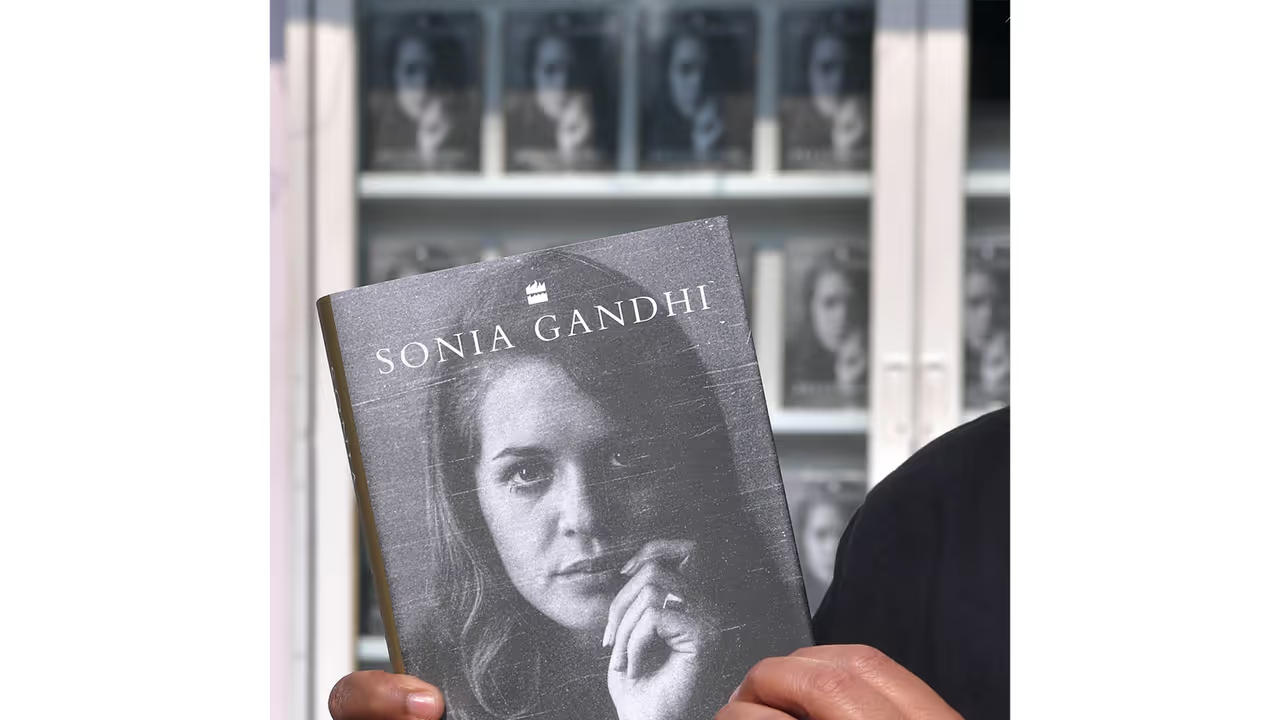
Sonia Gandhi's memoir, 'Belonging: A Journey of Love,' has ignited a sharp political row between the BJP and Congress, revisiting sensitive historical events including the Babri Masjid demolition, the 1984 riots, and the Emergency.
Sonia Gandhi's Memoir Sparks Political Controversy
A demolition that brought tears to her eyes, an Italian passport she found difficult to surrender, a Prime Minister whose India she says is shaped by the RSS, and a political movement she alleges was backed by the BJP to dislodge the UPA government. Congress Parliamentary Party Chairperson Sonia Gandhi's memoir, 'Belonging: A Journey of Love', has opened several chapters of India's political history, triggering a fresh war of words between the BJP and Congress, with Opposition leaders also weighing in on the contentious recollections.
From the demolition of the Babri Masjid in 1992 and the 2002 Gujarat riots to the 1984 Operation Blue Star, the Emergency, the 2004 Prime Ministerial episode and the Anna Hazare-led anti-corruption movement, Gandhi's memoir has brought several politically sensitive episodes back into the spotlight. While the BJP has accused the former Congress president of attempting to "whitewash" the Nehru-Gandhi family's historical record and selectively expressing grief, Congress leaders have defended her right to recount her personal experiences, accusing the ruling party of deliberately politicising the memoir.
The Babri Masjid Demolition and BJP Response
The sharpest exchange has centred on Gandhi's recollection of watching the Babri Masjid being demolished on December 6, 1992, and breaking down in tears. In her memoir, Gandhi revisits the demolition as a defining moment in India's political journey, describing it as an indication of the growing influence of the BJP-RSS and their affiliates. "There had been for several years clear indications that the BJP-RSS and their affiliates were single-mindedly advancing their divisive agenda. The tragic demolition of the Babri Masjid in 1992 and the ensuing spiral of communal violence were definite pointers: Those outfits were no longer going to work behind the scenes. The BJP was drawing closer to its dream of absolute power," she wrote.
Her account has drawn a sharp response from BJP leaders, who have questioned why she expressed grief over the demolition but, according to them, did not show similar sensitivity towards Hindu victims, security personnel and victims of terrorist attacks. BJP national spokesperson CR Kesavan launched one of the strongest attacks, suggesting that the memoir should have been titled 'Whitewashing' instead of 'Belonging'. "Sonia Gandhi could have titled her memoir 'Whitewashing', instead of 'Belonging', because the motive of this book appears to be sugarcoating the historical wrongs perpetrated by the Nehru-Gandhi family and camouflaging the cardinal sins committed by the Congress party," he said.
Criticism of the Emergency and Historical Legacy
Kesavan also accused Gandhi of attempting to normalise the Emergency imposed by former Prime Minister Indira Gandhi, saying, "The way in which Sonia Gandhi has tried to normalise and justify the notorious Emergency imposed by Indira Gandhi, which suspended fundamental rights and murdered our Constitution, is appalling and shocking." He credited Prime Minister Narendra Modi with "resolutely course-correcting the historical wrongs and the sins committed by the Congress Party".
Union Minister Giriraj Singh went further, alleging that Gandhi's account exposed her "true face" and accusing her of selectively expressing concern over incidents involving different communities. "Tears only well up in their eyes when incidents like the Babri (Masjid demolition) or the Batla House (encounter) occur--but when an incident like Godhra happens, her tears dry up," Singh said. Referring to the Pahalgam terror attack, he asked why she did not express similar grief when Hindu pilgrims were targeted and killed by Pakistani terrorists.
Political Rivalry and Vision for India
One of the most politically significant sections of the memoir is Gandhi's direct assessment of Prime Minister Narendra Modi and the ideological differences between Congress and the BJP. Gandhi described their political rivalry as a contest between two fundamentally different visions of India rather than a personal feud. "We come from different ideological worlds; his idea of this country is vastly different from mine. All I learnt about India was assimilated from the members of my family, their lives of service, and their faith in a nation that encompassed a host of races and cultures, languages and faiths, based on principles of liberty and equality for all," she wrote.
She alleged that the Prime Minister's understanding of India was shaped by the RSS. "Narendra Modi's idea of India was constructed by the ideologues of the RSS and the experience of his own growing up. It affirmed a fundamentalism in which his faith and culture superseded all others. In that India, hierarchy, order, and control are central," she wrote. "He was fighting for his vision of India, and I for mine: an India against hegemony, an India that stands for inclusiveness, secularism, and social justice," she added.
Renouncing Italian Citizenship and 2004 Prime Minister Episode
Gandhi's account of surrendering her Italian citizenship has emerged as another major point of political confrontation. In her memoir, she explained that retaining her Italian passport was initially important because it represented the part of her identity she had brought with her to India and allowed her to visit her parents without complicated paperwork. "I'd kept my Italian passport because it was the part of me that I brought to India, the Italy that my proud and patriotic father had fought for with his comrades," she wrote.
Gandhi's account of declining the Prime Minister's post after the Congress-led alliance won the 2004 general elections has also reignited debate over the political developments surrounding the formation of the UPA government. In an excerpt shared on X, Gandhi recalled the moment she decided against taking the top post. "'Sonia, be true to yourself,' I could hear myself say. 'You've always known it. Just leave it!'" she wrote. She also recalled informing her son Rahul Gandhi about her decision. "'I've made up my mind. I'm going to stick to my stand,' I told him. He stepped up to me and with his arms around me said, 'It's the right decision,'" she wrote.
Ahmed Patel and Congress Legacy
In a significant passage in her memoir, Sonia Gandhi has remembered late Congress veteran Ahmed Patel as one of her most trusted colleagues and a key political troubleshooter, describing him as a loyal party colleague who was “approachable day and night”. Recounting his role in Congress organisation, Gandhi writes that Patel, popularly known as “AP”, was always ready to listen patiently to disgruntled colleagues and played an important role in resolving internal differences.
However, the memoir contains a factual error in its reference to Patel’s death. Sonia Gandhi writes that he fell victim to the Covid pandemic in 2022. Ahmed Patel, however, died on November 25, 2020, at the age of 71, due to COVID-19-related complications at a hospital in Gurugram. He had tested positive for the virus on October 1, 2020.
(Except for the headline, this story has not been edited by Asianetnews Editorial staff and is published from a syndicated feed.)










