
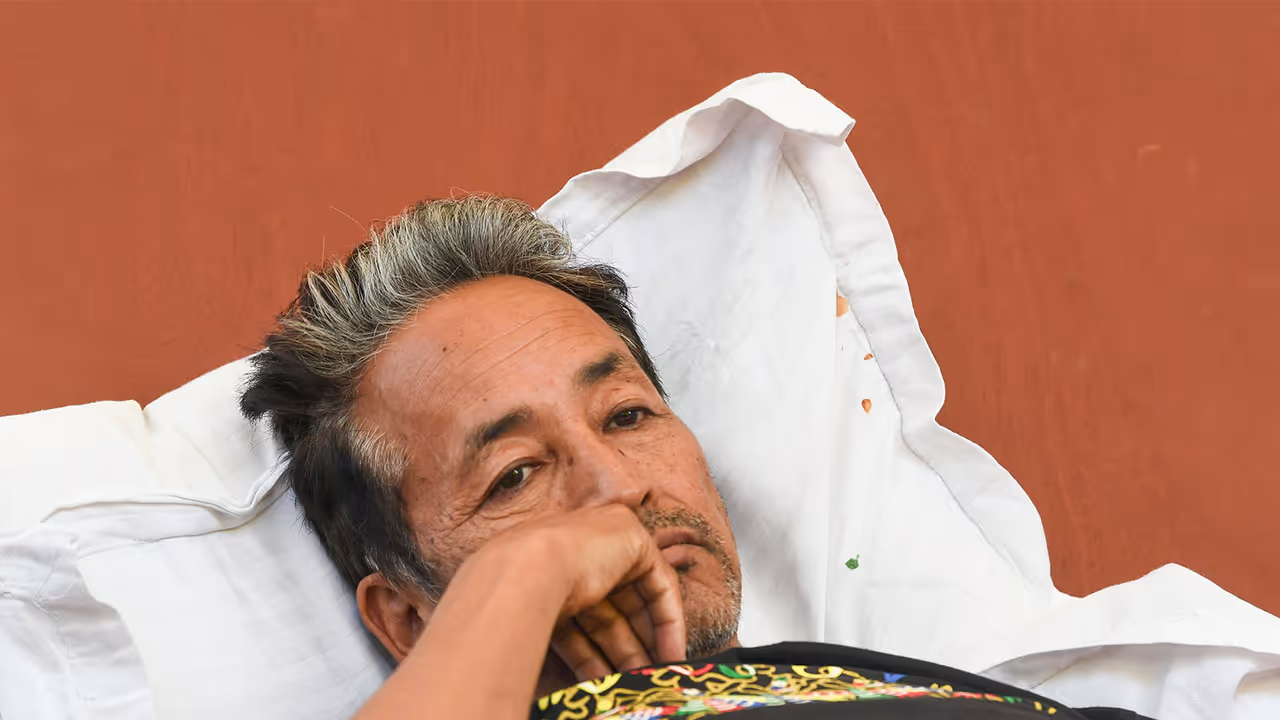
Activist Sonam Wangchuk, on a 20-day hunger strike over NEET irregularities, was moved to Safdarjung Hospital. Doctors report dehydration, low potassium, and rising ketones, risking his kidney function. He is currently refusing all treatment.
The doctors have found that activist Sonam Wangchuk, who was admitted to the Safdarjung Hospital here today after 20 days of prolonged fasting, is facing dehydration, low potassium and rising ketone levels, which may pose a risk to kidney function and other metabolic complications. He is under close medical observation, and the hospital authorities are continuously counselling the family to allow treatment to begin without further delay, sources said.
Health Bulletin Details
According to the Health Bulletin released Safdarjung Hospital, Wangchuk (59) was admitted to Safdarjung Hospital at 7:40 am on Saturday after being brought by Delhi Police. He was admitted with a history of fasting for 20 days from solid food and generalised weakness. There is no history of fainting attacks. "At the time of admission, he was conscious with a stable pulse, blood pressure and oxygen saturation. Signs of dehydration were seen. Blood gas analysis revealed compensated acidosis with decreased serum potassium and blood sugar of 78 mg/dl. Repeat Serum Potassium was similar. Urinary ketones were 1+ at the time of admission, which increased to 3+ by 1:00 pm," the Health Bulletin said.
"Although intravenous fluids were advised, the patient has refused all intravenous fluids, oral rehydration fluid or any other medication. He is being continuously monitored and counselled for treatment in the best interest of his health," it added.
Protest and Police Action
Wangchuk was on indefinite hunger strike for 20 consecutive days, demanding the resignation of Union Education Minister Dharmendra Pradhan over alleged nationwide examination irregularities, including the NEET paper leak controversy.
Earlier today, the Delhi Police said Wangchuk was shifted to the Safdarjung Hospital from the Jantar Mantar protest site in compliance with the Delhi High Court's directions and on medical advice due to his deteriorating health. Police officials said maximum restraint was exercised during the operation.
The police action has drawn criticism from several Opposition leaders, including those from the Aam Aadmi Party, Samajwadi Party, Congress and Trinamool Congress. Left student organisations also joined the protest organised by the Cockroach Janata Party (CJP) at Jantar Mantar.
Continued Protests and Security Measures
The Cockroach Janata Party (CJP) continued to stage its protest at Jantar Mantar in Delhi and has given a call for a march to Parliament on the first day of the Monsoon Session on Monday. However, sources have told ANI that the organisation is yet to approach the Delhi Police to seek official clearance for this march.
Moreover, even if the political outfit applies for permission now, it is highly unlikely to be granted, given the stringent security protocols in place for the upcoming Monsoon Session of Parliament.
Notably, Delhi Police has enforced prohibitory orders under Section 163 of the BNSS (earlier called Section 144), in New Delhi district, especially around Parliament House and India Gate, as Parliament is in session from Monday. The order bans gatherings of four or more people, unauthorised rallies, and carrying weapons.
Restrictions are being strictly applied to prevent protests and ensure the smooth movement of lawmakers. Student groups and political workers attempting to march to Parliament without permission will face immediate detention or dispersal. (ANI)
(Except for the headline, this story has not been edited by Asianet Newsable English staff and is published from a syndicated feed.)