
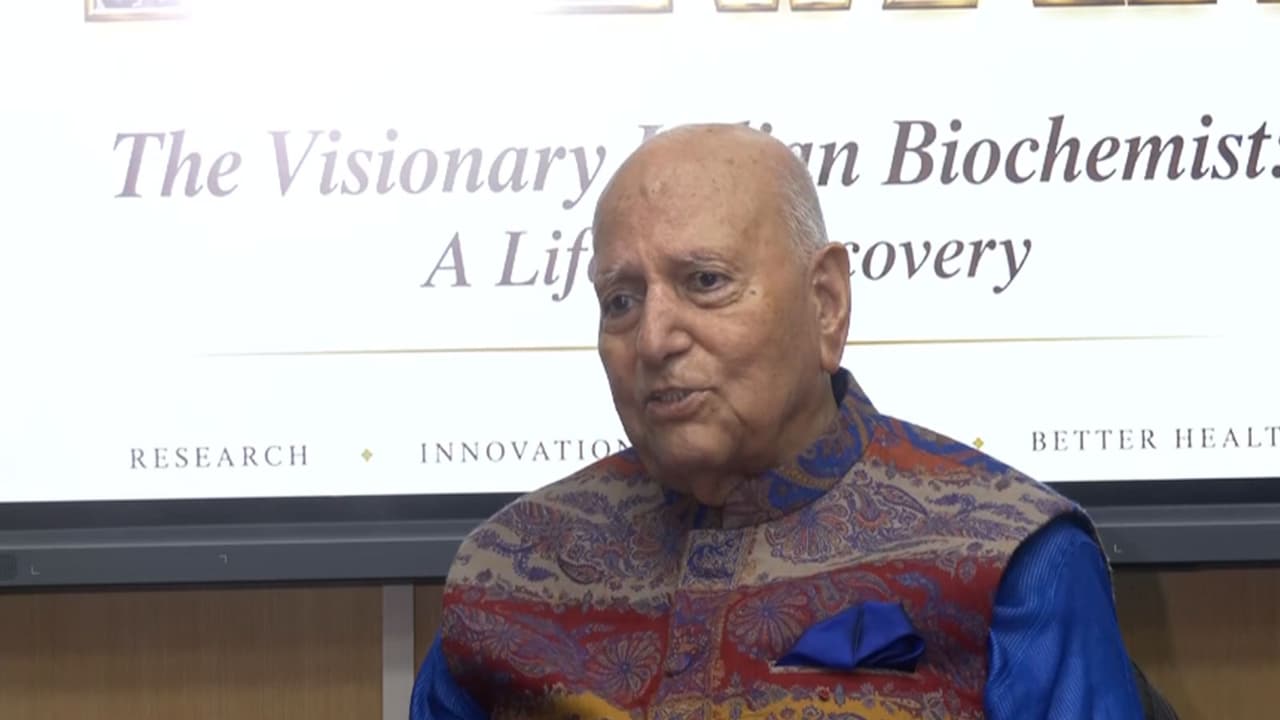
The international scientific community celebrated the 100th birthday of biomedical pioneer GP Talwar at AIIMS. His contributions include the anti-leprosy vaccine and the world's first birth control vaccine. A call was made for him to be awarded the Bharat Ratna.
The international scientific community gathered at the All-India Institute of Medical Sciences (AIIMS), New Delhi, to celebrate the 100th birthday of GP Talwar, a founder faculty member of AIIMS and a titan of global biomedical research. Despite entering his centenary year, Talwar remains actively involved in guiding cutting-edge research on the frontiers of biomedicine. To mark the occasion, a commemorative coffee table book detailing his monumental achievements and featuring tribute messages from scientists worldwide was officially released. The event was attended by global researchers, former students, and institutional leaders.
A Lifetime of High-Impact Scientific Contributions
Speaking at the event, M. Srinivas, Member (Health) of NITI Aayog, highlighted how Talwar’s work over the last six decades has fundamentally transformed the landscape of health research in India. Rather than remaining in the West, where he earned his PhD under Nobel Laureate Jacques Monod at the Institut Pasteur, France, and held a prestigious Humboldt Fellowship in Germany, Talwar chose to return home to build India's scientific sovereignty. His most significant contributions to global health and medicine include: Eradication of Leprosy: Talwar developed the world's first anti-leprosy vaccine (Mycobacterium indicus pranii - MIP), a breakthrough that proved instrumental in the near-eradication of the dreaded disease across India. Pioneering Birth Control Vaccine: He conceptualised and developed the world’s first vaccine for family planning, a revolutionary approach to reproductive health that garnered international acclaim. Architect of World-Class Institutions: He founded the world-renowned Department of Biochemistry at AIIMS and established the iconic National Institute of Immunology (NII) in Delhi, alongside the Talwar Research Foundation. Globalising Indian Science: In 1969, he established the ICMR-WHO Research & Training Centre at AIIMS, transforming India into a global hub for immunology training. His international stature brought multiple Nobel Laureates and world-class scientists to India to share their research. Mentorship and Bio-Industry Catalyst: He mentored hundreds of students who now head leading research labs and biotechnology industries globally, laying the groundwork for India’s modern biotech sector.
Calls for the Highest Honors
In recognition of his service to humanity, Talwar has already been awarded the Padma Bhushan by the Government of India and the Officier de la Légion d’Honneur, the highest civilian award conferred by the French Government. Given the global impact of his vaccines and institutional legacy, speakers at the conference revealed that Talwar has been nominated for the Nobel Prize multiple times by peers in the US and Europe. The committee collectively urged the Government of India to confer upon him the nation's highest civilian honour, the Bharat Ratna.
Narendra Malhotra, Convener of the Celebrations Committee and Editor of the coffee table book, shared that the grand event was entirely funded and organised through voluntary contributions from Talwar’s global alumni network. He extended deep gratitude to Talwar’s wife, Raksha Talwar, whose unwavering support allowed the scientist to dedicate his life to research.
Concluding the event, Rima Dada, Professor at AIIMS and Media Advisor, thanked the media for their extensive coverage of a milestone celebration that honors one of India’s greatest living scientific treasures.
(Except for the headline, this story has not been edited by Asianetnews Editorial staff and is published from a syndicated feed.)