
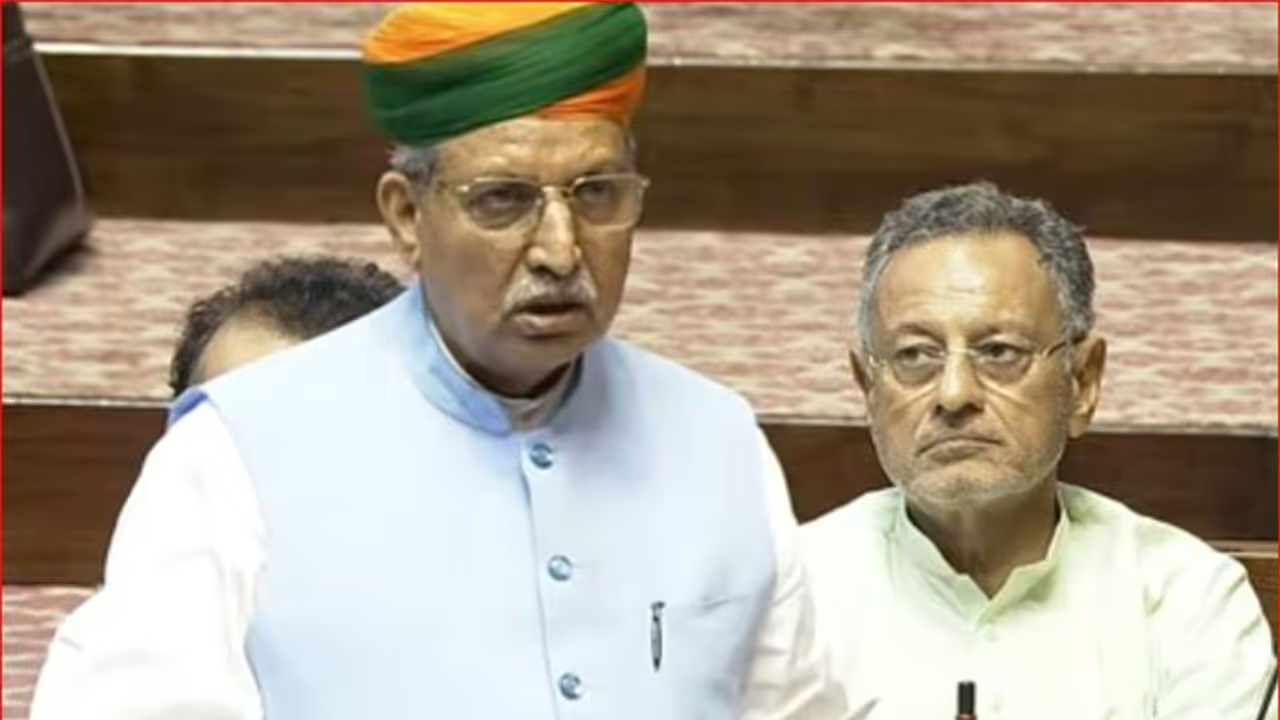
The Rajya Sabha passed a bill to increase the number of Supreme Court judges from 34 to 38. Law Minister Arjun Ram Meghwal cited rising pendency and evolving legal matters as the reason, calling it a 'demand of the time' for judicial reform.
The Rajya Sabha on Wednesday passed the Supreme Court (Number of Judges) Amendment Bill, 2026, with Union Law and Justice Minister Arjun Ram Meghwal saying the increase in the sanctioned strength of Supreme Court judges is a "demand of the time" to deal with rising pendency and the evolving nature of judicial matters.
Replying to the debate on the Bill, Meghwal said, "Keeping in view the increasing workload of the judiciary, the changing nature of judicial matters, and the new questions of emerging constitutional and legal interpretations, increasing the number of judges in the Supreme Court is a demand of the time and also a timely reform."
The Bill, which had already been passed by the Lok Sabha, was returned to the Lower House after consideration in the Rajya Sabha, completing Parliament's approval of the legislation. It raises the sanctioned strength of Supreme Court judges from 34 to 38, including the Chief Justice of India, replacing the May 2026 Ordinance that had already expanded the court's strength. It marks the first increase since 2019.
Rationale for Increasing Judge Strength
Explaining the rationale behind the legislation, Meghwal said Chief Justice of India Justice Surya Kant had written to the Prime Minister on May 11, highlighting a significant rise in fresh filings before the apex court and the need for additional judges to maintain disposal rates. "He said there is a significant increase in daily case filing in the Supreme Court... he estimated a gap of 10,000 cases in a year," Meghwal said, adding that the constitution of larger Constitution Benches also reduces the number of judges available for regular hearings, leading to delays in criminal appeals and other cases.
The Minister said reducing pendency is a priority for the government and that increasing the number of judges is part of broader judicial reforms. "To ensure that access to justice is universally accessible and universally available, the Central Government is committed to reducing pendency by speedy disposal of pending cases... Increasing the strength of Supreme Court judges is a step in the direction of increasing judicial efficiency," he said.
Meghwal said the Union Cabinet, under the chairmanship of Prime Minister Narendra Modi, approved the proposal on May 5, 2026, following which an Ordinance was promulgated. He said five new Supreme Court judges were appointed on June 1, 2026, and four special benches had since been constituted to exclusively hear the oldest pending civil and criminal matters.
Judicial Infrastructure and Pendency Data
Responding to concerns over judicial infrastructure raised by members during the debate, Meghwal said expansion work worth Rs 795.53 crore is underway at the Supreme Court in two phases. "At a cost of Rs 795.53 crore, the work of expansion of the Supreme Court building is being done in two phases... 28 courtrooms, nine Constitution courtrooms, 42 judges' chambers, facilities for lawyers and parking are being provided," he said.
On judicial appointments, the Minister said the process is a collaborative exercise between the judiciary and the executive under the Constitution, while appointments in district courts fall within the domain of the respective High Courts and state governments.
Citing the National Judicial Data Grid, Meghwal said that as of July 16, 2026, there were 96,024 pending cases in the Supreme Court, 64.72 lakh cases pending in the High Courts and 4.98 crore cases pending in district and subordinate courts. He said the government was promoting alternative dispute resolution mechanisms and the e-Courts project to improve judicial efficiency.
Concluding the debate, Meghwal urged the House to support the legislation, saying, "We have come among you to light the lamp of reform... I request you to pass it."
Meanwhile, both the Rajya Sabha and the Lok Sabha were adjourned for the day, with proceedings in both Houses scheduled to resume at 11 am on Thursday. (ANI)
(Except for the headline, this story has not been edited by Asianetnews Editorial staff and is published from a syndicated feed.)