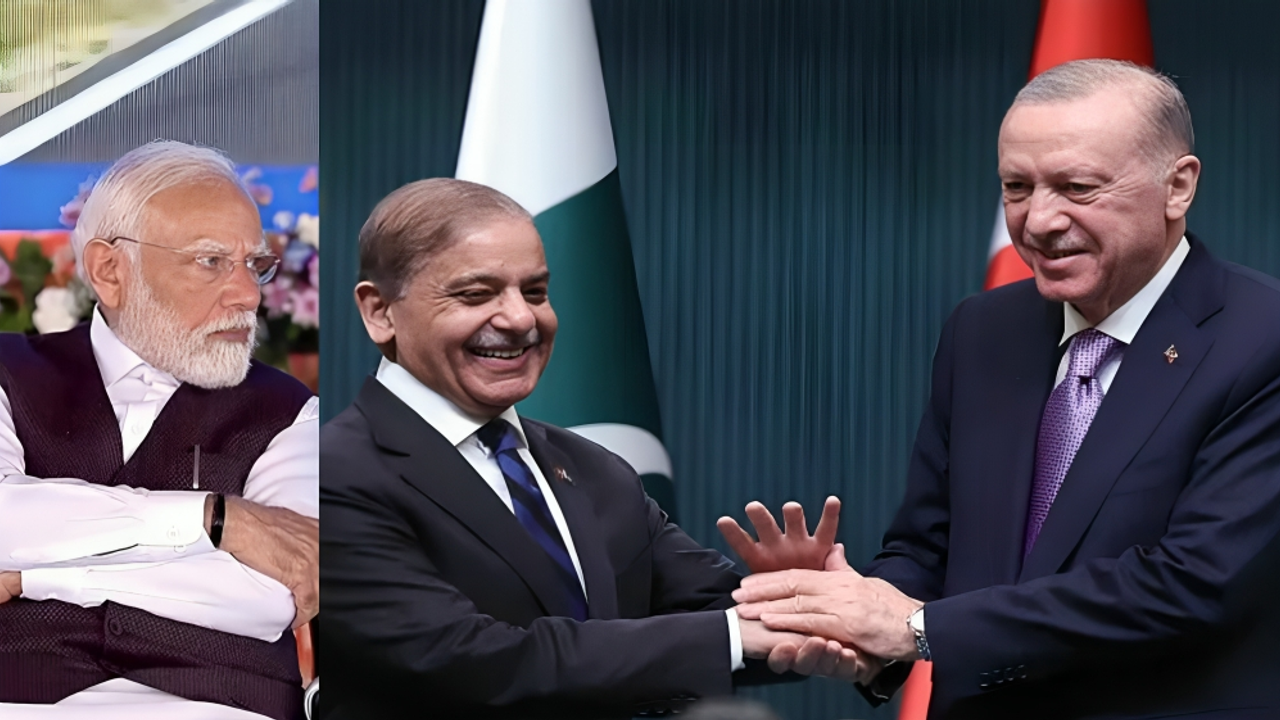
PM Modi's upcoming visit to Cyprus marks a major diplomatic signal amid rising Turkey-Pakistan ties post-Operation Sindoor. It underscores India's historic support for Nicosia and deepens cooperation under India-Middle East-Europe Economic Corridor.
Amid closer Pakistan-Turkey alignment in the wake of India's Operation Sindoor, Prime Minister Narendra Modi has also chosen to pay an official visit to Cyprus, a country which has been in conflict with Turkey since 1974.
PM Modi's Cyprus visit
On June 15, PM Modi will make a two-day visit to Cyprus which marks the first visit by an Indian Prime Minister in 23 years following an invitation from Cyprus President Christodoulides.
His visit to Nicosia, the capital city of Cyprus assumes significance for both the countries in terms of geopolitical reasons and bilateral relations. Since Independence of India, only two prime ministers --- Rajiv Gandhi and Atal Behari Vajpayee have been able to make it to the tiny island country. PM Modi would be the third prime minister to visit Cyprus.
Related Articles

Experts on PM Modi's foreign visits
Asianet News English spoke to Professor Swaran Singh, a geopolitical expert and professor at the School of International Studies, Jawaharlal Nehru University (JNU), New Delhi, to understand the significance of Prime Minister Modi’s visit to Nicosia and why it matters for India.
Professor Swaran Singh highlighted three points for this visit. The first one is PM Modi's style for embarking on foreign visits, signalling to Turkey and historic ties the two countries have.
“Prime Minister Narendra Modi’s style of foreign visits often includes hectic schedules to connect with as many countries as possible. So one would not expect that he will travel all the way to Canada just for the G-7 meeting and come back. So obviously he will be having two stopovers in Croatia and Cyprus. So it was expected that the visit would include more than just one country,” he said.
Speaking about the recent military conflict between New Delhi and Islamabad, Prof Swaran Singh said: “Turkey has openly become far more pro-Pakistan than traditional friend China has been. At various levels, India had showcased its discomfort and even annoyance with that kind of gesture that Turkey has made during the recent military confrontation between India and Pakistan.”
“This could also be seen as a gesture to Turkey because as you know, the Republic of northern Cyprus versus Republic of Cyprus story goes to the 1950s and 1960s. India has always stood with Nicosia, which is a Republic of Cyprus. And in that sense it could also be seen as a signal to Turkey that it's not just annoyance at the levels of various reactions from India, within India, but also connected with other major other partner countries could be symbolic to Turkey.”
“The most important is that the Republic of Cyprus is a very small island country, but has had very sustained close warm relations with India and India has likewise had very strong warm and historic relations with Cyprus. The story goes back to the anti-British imperial struggle which India was also doing at that time. And of course since then they have both supported each other,” the professor at JNU added.
Talking about the bilateral relations between Delhi and Nicosia, he said: “India had supported Nicosia against their struggles vis-à-vis Turkey and Cyprus has been a very strong support to India of almost all international issues starting from Kashmir to India's membership to UNSC to the recent US nuclear agreement. On all issues, they have stood with India and this has been possible because of a regular visit.”
“Despite the small island country in the Mediterranean, Gandhi (Rajiv Gandhi) had visited 1983, Atal Behari Vajpayee in 2002, and then in 2018, former President Ramnath Kovind visited. Likewise their presidents and military leaders also visited India frequently. The foreign minister was there in 2022.”
It must be noted that the geopolitical scenario in the Greece-Cyprus-India triangle has been evolving since 2023, through the India-Middle East-Europe Economic Corridor (IMEC).
Supported by the United States as an alternative to China’s Belt and Road Initiative (BRI) and also envisions an economic and energy corridor, the ambitious project – IMEC will be linking India to Europe via the Middle East, involving countries such as the UAE, Saudi Arabia, Israel, and EU member states.
As per the reports, Greece has formally backed the initiative, and Cyprus views it positively as well. Earlier this year, Athens and Nicosia jointly established a Greece-India Business Council (IGC).
Pakistan’s recent references to the “North of Cyprus” and its repeated recognition support for the Republic of North Cyprus have not gone down well in the tiny island country.
Even since the talk of launching the IMEC initiative, Turkey has been criticizing the effort and vouching for an alternative route via Iraq as a competing corridor between Asia and Europe.
Ever since the Republic of Cyprus came into existence in 1960, India was one of the first Asian countries to recognize Cyprus and aligned itself with Nicosia during the Cold War through the Non-Aligned Movement.