Prime Minister Narendra Modi concluded a productive Japan visit and headed to Tianjin, China, for the SCO Summit on Saturday. He will meet Xi Jinping and Vladimir Putin amid US tariffs, highlighting India’s balancing act in global diplomacy.
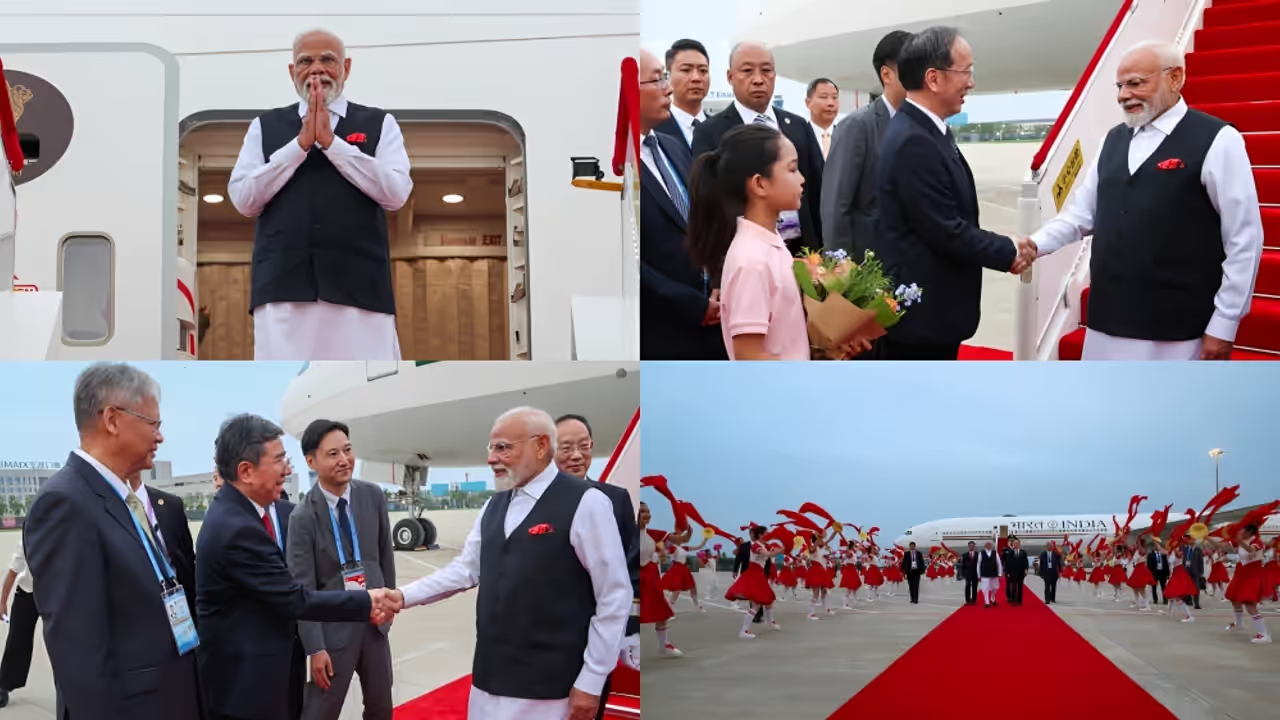
Prime Minister Narendra Modi on Saturday arrived in China's Tianjin to attend the Shanghai Cooperation Organisation (SCO) Summit in Tianjin after concluding his two-day official visit to Japan. The SCO Summit is being hosted by Chinese President Xi Jinping and will also see the participation of Russian President Vladimir Putin, along with leaders of other member nations. This SCO Summit is particularly important for India as it comes amid new trade challenges following the United States’ decision to impose 50 per cent tariffs, including a 25 per cent tariff on New Delhi’s imports of Russian crude oil.
PM Modi's Message Before Departure
Before boarding his flight to China, Prime Minister Modi described his Japan visit as highly productive. In a statement, he said, "I will travel to China to attend the Shanghai Cooperation Organisation Summit in Tianjin, at the invitation of President Xi Jinping. India is an active and constructive member of the SCO. During our Presidency, we have introduced new ideas and initiated collaboration in the fields of innovation, health and cultural exchanges."
The Ministry of External Affairs (MEA) spokesperson Randhir Jaiswal also shared details on X, noting that the Prime Minister had emplaned for China after concluding a 'highly productive visit' to Japan.
Related Articles

PM Modi's productive Japan visit
Before heading to China, PM Modi wrapped up a two-day visit to Japan, where he attended the 15th India-Japan Annual Summit with Japanese Prime Minister Shigeru Ishiba. This was Modi’s eighth visit to Japan since becoming Prime Minister in 2014, underlining the importance of the Special Strategic and Global Partnership between the two nations.
During his visit, Japan announced a $68 billion investment plan in India spread over the next decade. Discussions covered areas such as defence, security, clean energy, rare earths, and advanced technology. Cooperation in the semiconductor sector was given particular focus, with both leaders visiting a semiconductor plant in Sendai and exploring opportunities for India-Japan collaboration in manufacturing and supply chains.
PM Modi also highlighted Tokyo’s participation in India’s bullet train project, including the possible procurement of E10 bullet trains for the Mumbai-Ahmedabad High-Speed Rail corridor.
Warmth and symbolism in Japan
The visit was marked by a warm reception from both the Japanese leadership and the local people. In Sendai, PM Modi was greeted with chants of “Welcome to Japan, Modi San!” by members of the Indian community and locals alike. He interacted warmly with children and community members.
Japanese Prime Minister Shigeru Ishiba accompanied PM Modi on a bullet train ride to Sendai, a gesture that was widely seen as symbolic of the closeness between the two nations.
At a luncheon event, PM Modi met the Governor of Miyagi Prefecture, Murai; JR East Chairman Fukazawa; Tokyo Electron President Kawai; and Tohoku University President Tomunaga. Discussions centred around technology cooperation, investment, and cultural exchanges.
Strengthening India-Japan relations
During the summit, both leaders reviewed the full spectrum of the India-Japan Special Strategic and Global Partnership. Defence and security cooperation, technology collaboration, and trade expansion were among the highlights. PM Modi expressed gratitude for the hospitality extended by his Japanese counterpart. In a post on X, he said, "This visit to Japan will be remembered for the productive outcomes which will benefit the people of our nations. I thank PM Ishiba, the Japanese people and the Government for their warmth."
Prime Minister Ishiba also shared his appreciation on X, emphasising the strong bonds between the two nations and the promise of greater collaboration in the years ahead.
India's balancing act
PM Modi’s back-to-back engagements in Japan and China reflect India’s broader foreign policy approach of balancing relations with multiple global powers. In Tokyo, the focus was on advancing high-technology partnerships and strategic cooperation. In Tianjin, the focus shifts to regional stability and economic resilience amid trade challenges and geopolitical competition.
As India navigates its relationships with both China and Russia, while managing its ties with the United States, the SCO Summit provides New Delhi a critical platform to shape discussions on multilateralism, economic cooperation, and regional peace.
The coming days will be significant for India's diplomacy. The outcomes of PM Modi's bilateral meetings with Xi Jinping and Vladimir Putin will be closely watched, particularly against the backdrop of US tariffs and ongoing global realignments.
India’s active participation in the SCO Summit demonstrates its continued commitment to multilateralism, regional cooperation, and constructive engagement with both friends and rivals. As Prime Minister Modi charts India’s path forward, these visits to Japan and China underline New Delhi’s determination to play a central role in shaping the future of Asia and the wider world.
First visit to China since Galwan
This visit marks PM Modi’s first trip to China since the Galwan Valley clashes in 2020, which had strained relations between the two countries. In recent months, however, India and China have taken steps to stabilise their bilateral ties.
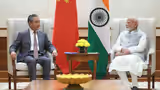
During the visit of Chinese Foreign Minister Wang Yi to India on August 18-19, both countries agreed to restore direct flight connectivity between India and mainland China at the earliest, finalise an updated Air Services Agreement, and ease visa processes for tourists, businesses, and media representatives. They also discussed cooperation in multilateral forums and stressed the importance of upholding a rules-based multilateral trading system. Wang Yi also met PM Modi during his India visit.
The resumption of trade through key border passes, Lipulekh in Uttarakhand, Shipki La in Himachal Pradesh, and Nathu La in Sikkim, has also added momentum to efforts at normalisation.
SCO Summit: A crucial platform
The Shanghai Cooperation Organisation is a regional grouping that today consists of 10 full members: India, China, Russia, Pakistan, Kazakhstan, Kyrgyzstan, Tajikistan, Uzbekistan, Iran and Belarus. Apart from members, it also has observer states and dialogue partners.
India became an observer in 2005 and a full member in 2017. Since then, PM Modi has consistently attended the SCO Summits: in Chengdao (2018), Bishkek (2019), Moscow (2020, virtual), Dushanbe (2021, virtual), Tashkent (2022) and New Delhi (2023, virtual). India also held the SCO chair of the Council of Heads of Government in 2020 and the Council of Heads of State from 2022 to 2023.
The 2025 Tianjin Summit will focus on economic cooperation, energy security, and regional stability. For India, it comes at a time when global supply chains are under stress and international trade tensions are increasing.
Key bilateral meetings
Alongside the SCO Summit, PM Modi will hold two key bilateral meetings: one with Chinese President Xi Jinping and another with Russian President Vladimir Putin. The meeting with Xi Jinping is expected to focus on stabilising the India-China relationship, exploring opportunities for trade and investment, and addressing border concerns. The meeting with President Putin will likely cover energy cooperation, defence supplies, and bilateral projects, especially in light of U.S. tariffs targeting India’s purchase of Russian crude oil.