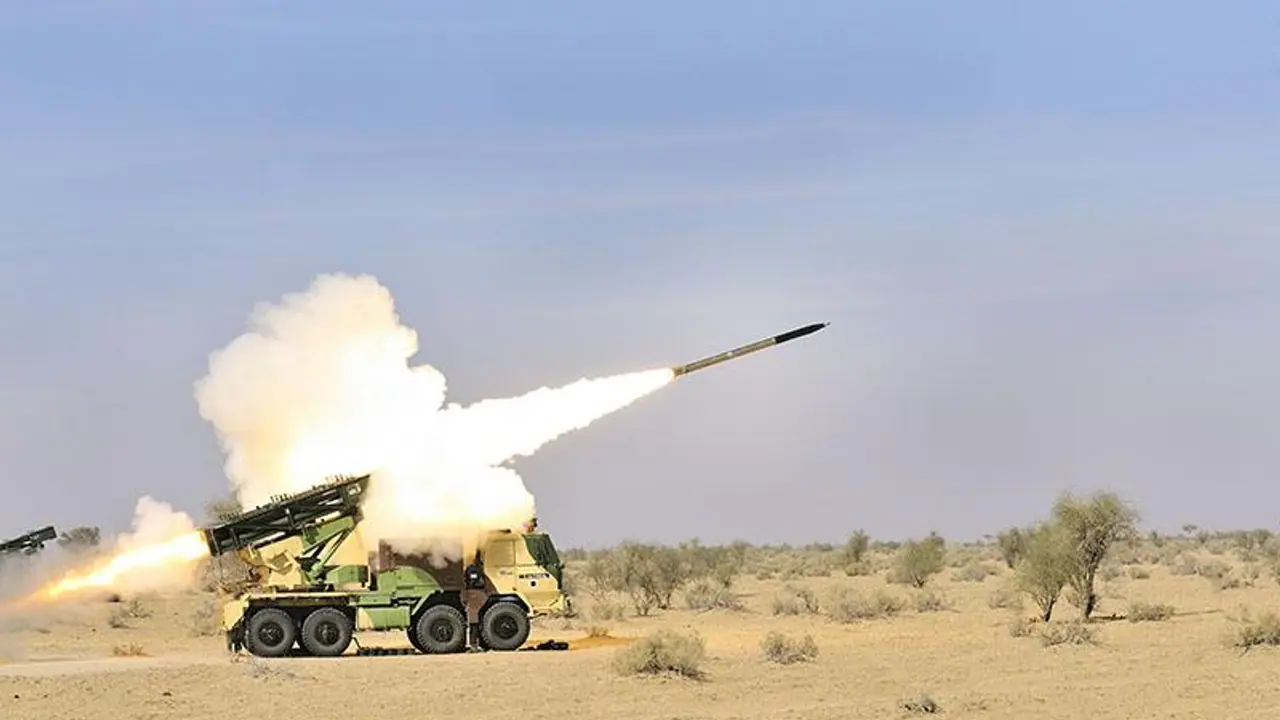
Former DRDO scientist Dr Ravi Gupta says India’s Pinaka rocket launcher is a game-changer — boosting indigenous defence production, cutting costs vs missiles, and now striking targets up to 120 km with high accuracy.
Former DRDO scientist Doctor Ravi Gupta on Tuesday highlighted the strategic and technological significance of India's Pinaka multi-barrel rocket launcher system, describing it as a transformative achievement for the country's defence ecosystem and a major boost for the indigenous industry.
Speaking to ANI, Dr Gupta said the Pinaka system marked a historic shift in India's defence manufacturing journey, as it became the first defence system to be produced with the participation of private industry. "The Pinaka multi-barrel rocket launcher system is significant in many ways. It was the first defence system to be manufactured by private industries in the country. In 2008, under the leadership of Prime Minister Atal Bihari Vajpayee, for the first time in the history of independent India, the participation of private industries in the defence sector was approved. This proved to be a game-changer, and leveraging this, DRDO collaborated with the private sector to have it produced by private industries," he said.
Related Articles

Early Success and Battlefield Potential
Dr Gupta recalled that even during the Kargil War, when the system was still under development, it had demonstrated its potential on the battlefield. "Even during the Kargil War, when the Pinaka was not yet fully developed, it demonstrated its capabilities. Since then, it has made a very significant contribution to the army," he added.
Strategic Advantage: Cost-Effectiveness
Highlighting the cost-effectiveness of the system, the former DRDO scientist said multi-barrel rocket launchers offer a strategic advantage over guided missiles in terms of affordability, while still delivering formidable firepower. "Moreover, the advantage of a multi-barrel rocket launcher is that it is less expensive. Compared to our guided missiles, their cost is significantly lower, although their accuracy is not as high as that of guided missiles," he said.
Technological Advancements and Enhanced Capabilities
Dr Gupta further noted that recent technological advancements have significantly enhanced the system's capabilities. "Now, the recently developed 120-kilometre range multi-barrelled long-range rocket system has an accuracy comparable to a guided missile, but at a much lower cost. A large area of enemy territory can be destroyed in just a few minutes," he said.
Decisive Tactical Advantage
Emphasising the system's battlefield relevance, he added that its extended range gives India a decisive tactical advantage. "A 120-kilometre range can prove very decisive for a tactical weapon on the battlefield, and this will give our armed forces great strength and power. Even though it is a tactical weapon, when it is used in large quantities by our armed forces in battle, it can prove very decisive in the war," he said.
Boosting Indigenous Defence Industry
Dr Gupta also highlighted the programme's broader industrial impact, noting its role in strengthening India's defence manufacturing ecosystem. "Another important aspect is that since it was developed in collaboration with the private sector, it will give a significant boost to our industries. It will help in expanding our defence industries," he added.
Successful Test of Long-Range Variant
On Monday, the maiden flight test of the Pinaka Long Range Guided Rocket (LRGR 120) was successfully conducted at the Integrated Test Range in Chandipur, Odisha. The rocket was tested for its maximum range of 120 kms, demonstrating all in-flight manoeuvres as planned. The LRGR impacted the target with textbook precision. (ANI)
(Except for the headline, this story has not been edited by Asianet Newsable English staff and is published from a syndicated feed.)