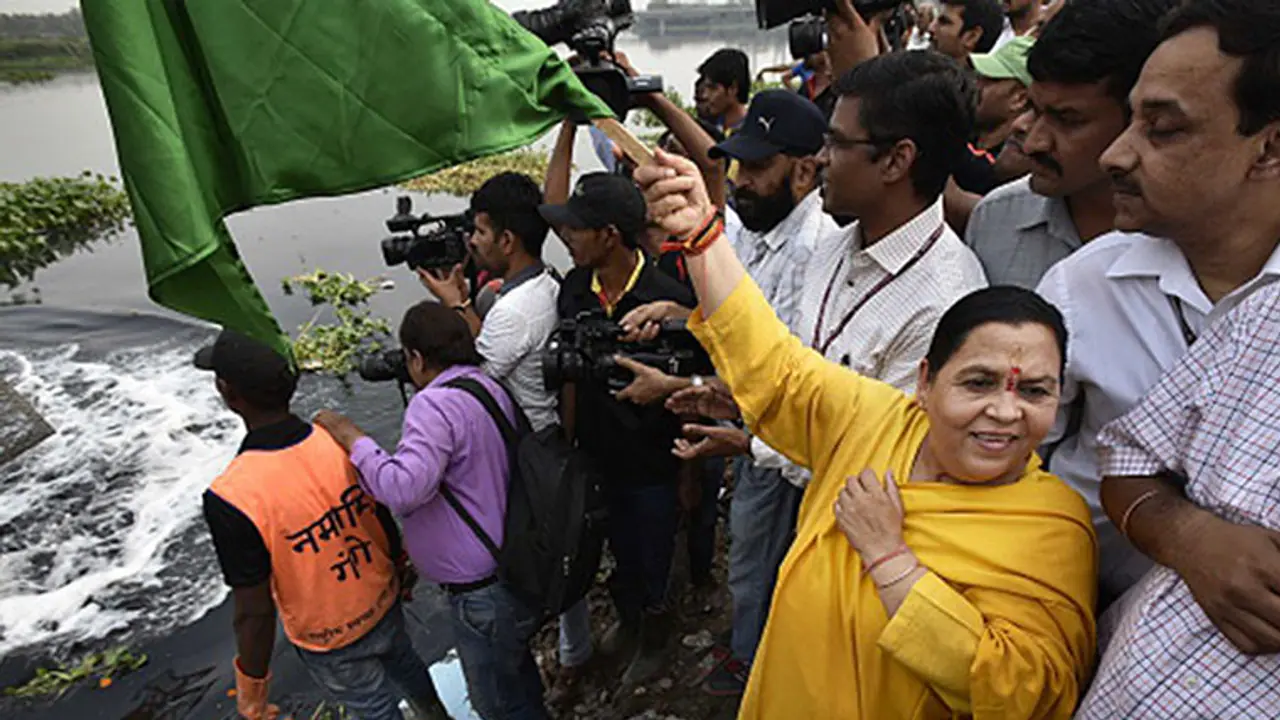
On August 3 in the Lok Sabha, Congress MP Sushmita Dev raised a question on the 'Jal Marg Vikas' scheme and the effect of pollution on fish in the river Ganga.
Uma Bharti replied, dissecting the complicated question into many parts.
The water resources minister was certainly on top of her game when it came to Hilsa, that great delicacy of Eastern India. Apparently, the government will now set up 'pool ladders' in the Ganga to encourage the breeding of Hilsa.
It was when Bharti shifted to the other rare species in the Ganga that things took a turn sideways. Speaking in the House, Bharti claimed that the return of river dolphins and goldfish in the Ganga aqua life system would be the biggest benchmark to prove that the river has been rejuvenated.
Bharti added that the Ganga dolphins had lost their eyesight due to prolonged exposure to pollution.
She claimed that the creature had developed other senses over the years to overcome blindness. Now, she went on, there were plans to release dolphins having eyes, she said, adding if they do not turn blind, then it would prove that the level of pollution in the river has declined.
This is a strange and must we say, fairly ill-informed statement by a minister technically responsible for all things Gangetic.
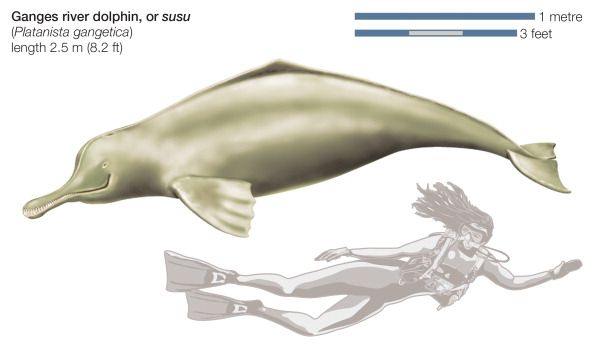
For those who aren't aware, the rare and endangered Gangetic Dolphin (Platanista Gangetica) is not 'blind' due to pollution. In fact, it is a river dolphin that does not have eyes at all. Scientists believe that at most, it can detect light and dark, but the species as a whole does not have eye lenses at all.
They have evolved this way over hundreds of years in response to the muddy bottom of the Ganga, long before any human form of pollution existed.
As Bharti mentioned, they have indeed 'developed' other senses, but that has not happened in the past 30 or 40 years. Rather, that other sense - a system of echolocation similar to the ones that bats use - also took thousands of years to evolve.
Bharti's idea of introducing new dolphins is fine as such. And perhaps if they are not blinded, then yes, technically, one supposes it means the pollution in the Ganga has come down.
But surely there are better ways to check for water pollution than possibly blinding a bunch of animals, because of an assumption about creatures who have no eyes in the first place.
Watch video: