
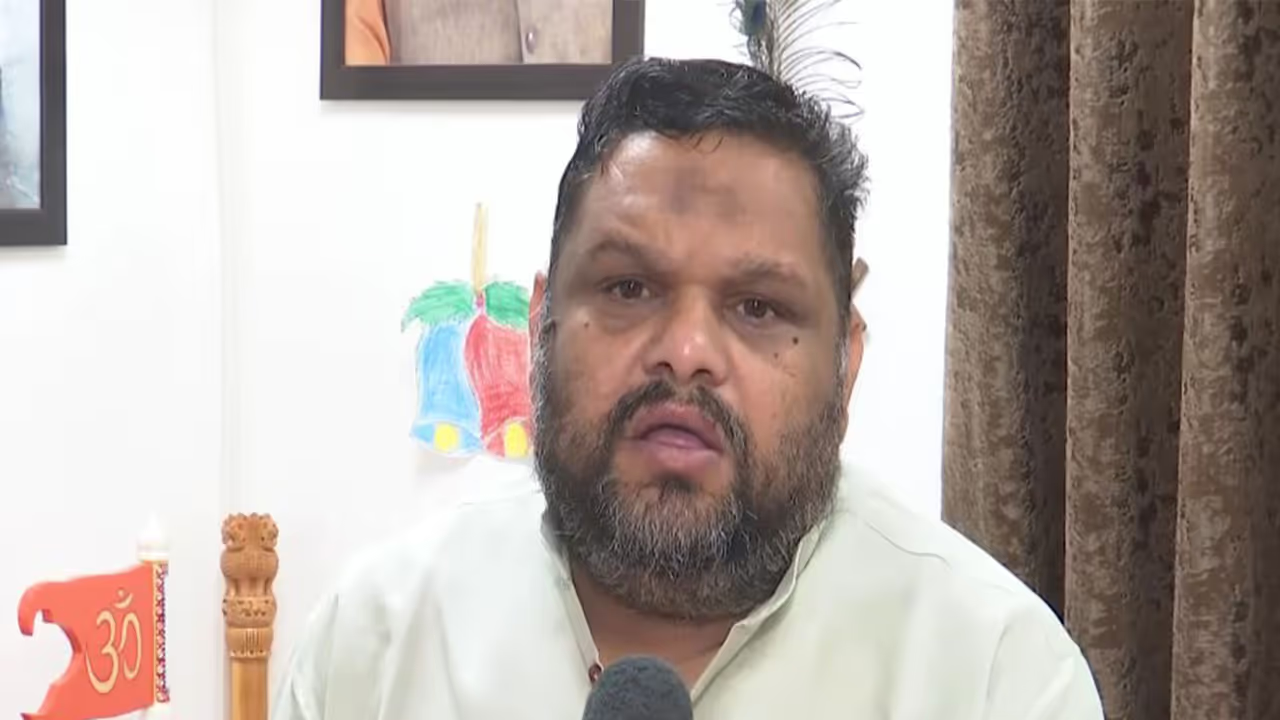
The NHRC has taken cognisance of paid Instagram ads allegedly promoting Child Sexual Abuse Material, seeking Action Taken Reports from MeitY, MIB, and Delhi Police within two weeks. The probe follows media reports on the issue.
NHRC Seeks Reports Over Alleged CSAM Ads on Instagram
A bench of the National Human Rights Commission (NHRC) headed by Priyank Kanoongo has taken cognisance of allegations concerning paid advertisements on Instagram that allegedly facilitated access to Child Sexual Abuse Material (CSAM/CSEAM), and has sought point-wise Action Taken Reports (ATRs) within two weeks from the Ministry of Electronics and Information Technology (MeitY), the Ministry of Information and Broadcasting (MIB), and the Delhi Police.
The matter arose from media reports by the BBC World Service alleging that paid advertisements using terms such as “rape video” and “child video” were displayed on Instagram and redirected users to Telegram channels where such material was allegedly offered for sale. The reports further alleged that the advertisements passed through Meta’s review mechanism and remained accessible despite being reported through the grievance mechanism until the matter was specifically brought to Meta’s notice by the BBC.
The Priyank Kanoongo bench of the NHRC observed that, if established, the allegations would not merely concern objectionable online content but could involve sexual exploitation of children, recording, circulation, promotion and monetisation of such material, and possible organised criminal activity.
Legal Framework and Mandatory Reporting Under Scrutiny
The Commission has emphasised examination under the POCSO Act, 2012, the Information Technology Act, 2000, and the applicable intermediary framework, including preservation and forensic scrutiny of electronic evidence, identification of persons involved, tracing of financial trails, and the rescue, protection, and rehabilitation of child victims.
The bench has specifically sought a response from MeitY regarding compliance with Section 19 of the POCSO Act, 2012, which provides for mandatory reporting of offences. The Commission has asked whether, after acquiring knowledge of the alleged offences, the matter was reported to the Special Juvenile Police Unit (SJPU) or the local police. In case the matter was not reported, MeitY has been asked to identify the responsible officer or authority and indicate the action taken in relation to any failure to report.
The Commission also took note of the Supreme Court judgment in Just Rights for Children Alliance & Anr. v. S. Harish & Ors., which emphasised prompt reporting, preservation of electronic evidence, coordinated investigation, and identification, rescue, and protection of child victims.
The Commission has further noted that Section 79 of the Information Technology Act does not, by itself, absolve an entity from its obligations under the POCSO Act.
Questioning Meta's 'Intermediary' Status
Material placed before the NHRC includes screenshots of Meta’s systems which, according to the complainant, provide suggestions relating to content ideas, formats, slide sequencing, captions, calls-to-action, posting schedules, audience engagement strategies and monetisation methods.
Against this backdrop, the Priyank Kanoongo bench has raised a question of whether, when a digital platform’s own systems actively generate, modify, curate, recommend, publish, amplify or monetise content, its legal position can continue to be treated merely as that of a passive intermediary.
The Commission has observed that this determination should not depend merely on the nomenclature used for the platform, but on the actual editorial and publishing functions performed by the platform and the degree of its involvement and control over the content. The Commission has attached particular significance to the risks arising from content curation, recommendation, targeted amplification and monetisation in matters involving children and CSAM/CSEAM.
MIB to Examine Meta's Role as Publisher
In this context, the NHRC has specifically referred to Rule 2(1)(q), Rule 2(1)(s) and Rule 2(1)(u) of the Information Technology (Intermediary Guidelines and Digital Media Ethics Code) Rules, 2021. These provisions relate to online curated content, publishers and publishers of online curated content, including the concept of a “significant role”.
The Commission has specifically asked the Ministry of Information and Broadcasting to examine whether, where Meta’s systems generate, modify, curate, recommend, publish or amplify content, Meta falls within the regulatory purview of the MIB as a publisher or publisher of online curated content under the IT Rules, 2021. The MIB has also been asked to indicate, if applicable, the regulatory status and obligations of Meta and the action required to be undertaken by the Ministry under the existing regulatory framework.
Delhi Police Investigation Update
The NHRC has taken the earlier report submitted by the Delhi Police on record and granted the Commissioner of Police, Delhi, a further period of two weeks to submit additional information. The Police have been specifically asked to provide details of the action taken in the matter, information sought from or received from Telegram, and the consequential action taken on the basis of such information.
Expanded Scope of Inquiry
The NHRC has directed MeitY, MIB and the Delhi Police, along with the concerned authorities, to submit specific and point-wise reports within two weeks. The Commission has made it clear that the responses should not be general or omnibus in nature and must be supported by contemporaneous records.
The inquiry is no longer confined to who uploaded objectionable content on a platform; it also examines the extent to which the platform’s own editorial and publishing systems participate in the generation, selection, circulation, amplification or monetisation of that content.
In the context of Rules 2(1)(q), 2(1)(s) and 2(1)(u) of the IT Rules, 2021, the determination of Meta’s actual functional role whether it remains limited to that of an intermediary or extends into the regulatory domain applicable to a publisher or publisher of online curated content, has therefore assumed particular significance.
Last month, the Centre also conveyed to Meta that safe harbour protections will not be available to individuals or persons involved in violations related to child sexual abuse material (CSAM), while stressing that the government has exercised only those powers available under the existing legal and statutory framework, government sources said. (ANI)
(Except for the headline, this story has not been edited by Asianet Newsable English staff and is published from a syndicated feed.)