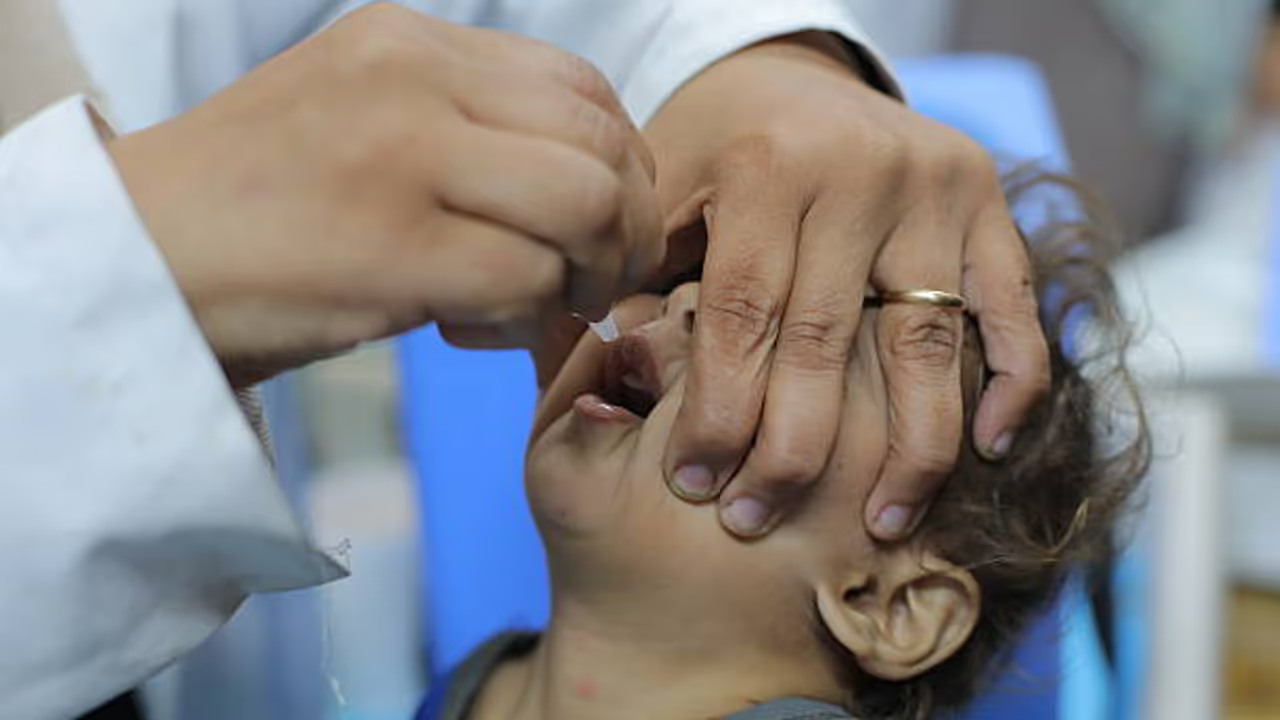
On March 27, 2014, India was officially certified polio-free by the World Health Organization (WHO). Thanks to an aggressive and adaptable vaccination campaign that lasted years.
On March 27, 2014, World Health Organization (WHO) officially declared India polio-free after an aggressive vaccination drive that penetrated even the most remote corners of the nation. The achievement ensured that millions of children escaped a devastating virus that once crippled over 350,000 people globally every year at its peak.
It wasn't just a national victory but a major turning point in global health. Since 1988, worldwide polio cases have plunged by more than 99%, with the disease now endemic in only two countries - Pakistan and Afghanistan.
For decades, India was widely regarded as one of the toughest battlegrounds in the war against poliovirus. With a population now exceeding 1.4 billion, weak surveillance systems in earlier years, dense populations, and large pockets of remote and underserved communities, eliminating the virus appeared to be an almost impossible mission.
Related Articles

Children could easily miss vaccinations, allowing the virus to silently circulate through communities. For many public health professionals who witnessed the crisis firsthand, polio seemed so widespread that imagining an India without it felt unrealistic.
Yet the country defied expectations.
A powerful alliance of volunteer vaccinators, medical experts, international agencies, private organizations, and the Indian government worked with extraordinary coordination and persistence. Their collective effort eventually paid off when India reported its last case of polio in 2011, paving the way for its formal certification three years later.
How India fought against Polio - The long battle from 1990s to 2014
Polio, also known as poliomyelitis, is a highly contagious disease that primarily affects children under five. The virus attacks the nervous system and can lead to sudden and irreversible paralysis within hours.
The global fight against the disease intensified after the 1988 resolution by the World Health Assembly to eradicate polio worldwide. Soon after, the Global Polio Eradication Initiative (GPEI) was launched — an ambitious partnership involving national governments and global institutions such as the World Health Organization, Rotary International, the Centers for Disease Control and Prevention (CDC), the UNICEF, and the Bill & Melinda Gates Foundation.
The initiative aimed to deliver vaccines worldwide and tackle the logistical and social barriers that allowed the virus to survive.
In India, progress was not always smooth. In 2001, volunteers working with Rotary’s immunization campaign saw significant declines in polio cases. But the following year brought a shocking setback — reported infections surged to 1,600 cases, nearly 500% higher than the previous year.
The spike exposed major weaknesses. While vaccines were widely available, gaps remained in disease tracking, outbreak prevention, and ensuring that children completed their full immunization schedules.
To overcome these challenges, India’s strategy evolved rapidly.
Grassroots vaccination drives — largely spearheaded by women health workers and volunteers — intensified across villages and cities alike. At the same time, officials began transforming immunization campaigns into public awareness movements.
Colorful banners, giveaways, and the involvement of Bollywood celebrities helped capture public attention and promote confidence in vaccines.
Another crucial weapon in the fight was enhanced surveillance. Since poliovirus spreads mainly through the fecal-oral route, health officials began monitoring sewage systems to detect the virus early. Environmental sampling allowed authorities to identify outbreak clusters and ensure that every eligible child in affected communities was vaccinated immediately.
However, logistics were not the only hurdle. Vaccine hesitancy in certain communities posed a significant barrier.
To tackle misinformation, members of the Global Polio Eradication Initiative collaborated closely with local leaders. Community influencers and religious figures — particularly within the Muslim community — were educated about the vaccine’s safety and importance. As these trusted voices began advocating immunization, resistance gradually melted away.
India’s extraordinary success story proved that even the most daunting public health challenges can be overcome through determination, coordination, and community trust.
Today, experts emphasize that the tools to eradicate polio globally already exist. The challenge now lies in ensuring those tools reach every child, everywhere, so that no family ever again faces the fear of paralysis caused by this preventable disease.