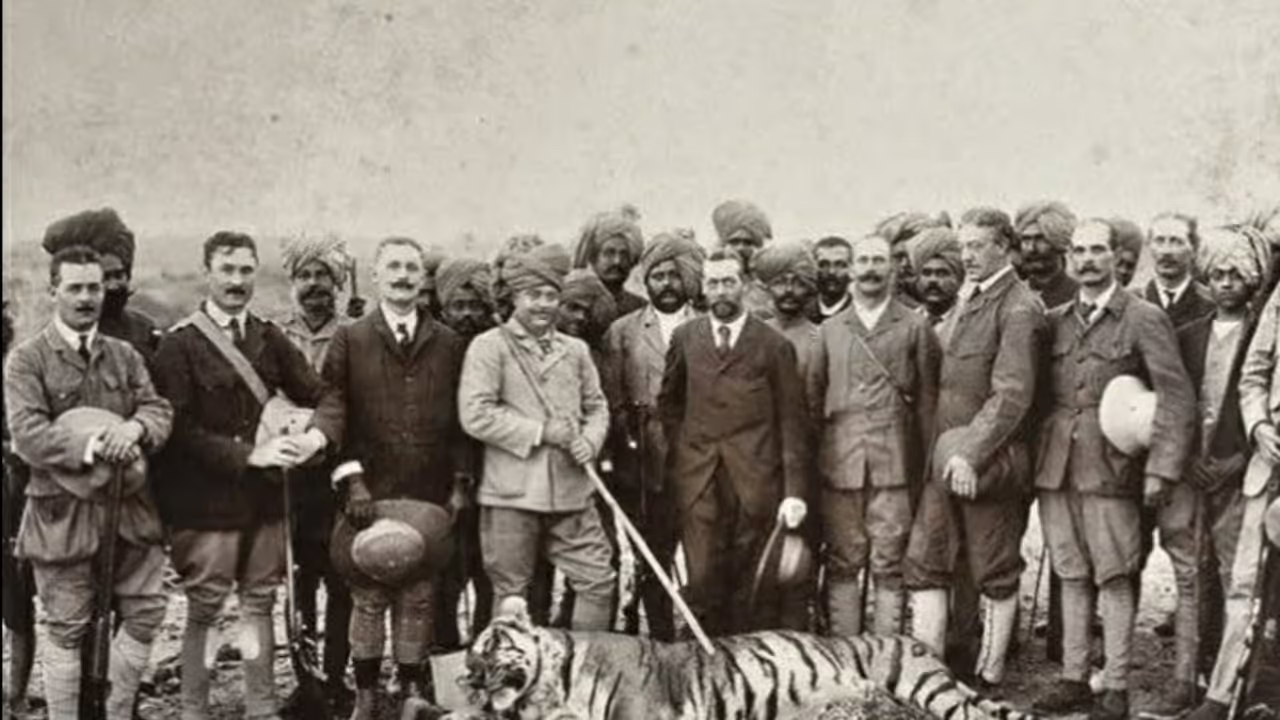
India's last documented cheetahs, three adult males, met a tragic end in 1947. They were shot at night by Maharaja Ramanuj Pratap Singh Deo of Koriya (in present-day Chhattisgarh).
For centuries, the cheetah sprinted across India’s vast grasslands and the word “cheetah” itself traces its roots to Sanskrit. It graced royal courts, figured in hunting chronicles, and symbolised power and prestige.
And then, in a matter of decades, it vanished.
The disappearance of the cheetah was not a sudden event but a slow, silent collapse driven by relentless hunting, shrinking habitats, and administrative indifference. Its extinction was more than the loss of a species; it was the erasure of a living chapter of India’s ecological heritage.
Related Articles

Now, as cheetahs sprint once again in Kuno, the country stands at a historic crossroads, attempting not just restoration, but redemption.
How India Lost Its Cheetahs
The cheetah once roamed widely across India’s open forests and dry grasslands, thriving alongside prey like blackbuck. Historical records reveal how extensively royalty exploited the species, particularly during the Mughal era. Emperor Akbar reportedly kept over a thousand cheetahs in his menagerie for coursing hunts, a symbol of imperial fascination.
But admiration came at a price.
The same bond that elevated the cheetah to royal icon status also sealed its fate. By the 18th and 19th centuries, excessive hunting, habitat fragmentation, and prey depletion triggered a dramatic population crash. A BBC-cited study referenced in Firstpost states that between 1799 and 1968, only around 230 cheetahs remained in India’s wild landscapes.
As grasslands were aggressively converted into farmland, the ecosystem that sustained the world’s fastest land animal crumbled beneath the pressures of development.
The King Who Shot India’s Last Cheetahs
India’s final documented cheetahs — three adult males — met their end in 1947. They were shot at night by Maharaja Ramanuj Pratap Singh Deo of Koriya, in present-day Chhattisgarh.
A widely circulated photograph shows the king posing with the dead animals, an image that would later haunt conservationists and symbolise irreversible loss. His private secretary submitted the photograph to the Journal of the Bombay Natural History Society in January 1948, marking the last confirmed record of the Asiatic cheetah in India.
Just five years later, in 1952, the Government of India officially declared the cheetah extinct.
An ancient predator had been erased from its homeland.
Efforts to Reverse Extinction
India’s desire to bring back the cheetah began almost immediately. Discussions around reintroduction started in the 1950s. In the 1970s, negotiations were held with Iran to exchange Asiatic lions for Asiatic cheetahs but political turmoil and emergencies derailed the plan.
A renewed effort in 2009 collapsed when Iran refused to part with its critically endangered population.
By then, the Iranian cheetah numbers had plummeted so drastically that translocation became nearly impossible. Conservationists pivoted toward introducing the Southeast African cheetah, genetically similar and available in more stable numbers. Legal battles stalled progress until the Supreme Court permitted an experimental reintroduction in 2020.
The Return: Kuno and Project Cheetah
On 17 September 2022, history was rewritten.
Eight African cheetahs, five females and three males, arrived from Namibia in what became the world’s first intercontinental carnivore translocation. They were placed in quarantine enclosures in Kuno National Park, Madhya Pradesh, a landscape chosen for its grassland-forest mosaic and prey base.
Thus began Project Cheetah — India’s bold ecological experiment to restore the species to its former niche.
In the months that followed, more cheetahs arrived from South Africa as part of a long-term vision to establish a founder population of around 50 individuals. For the first time in 70 years, the cheetah’s silhouette once again cut across Indian soil.
Hope, Setbacks, and Hard Lessons
The journey has delivered both triumph and turbulence. There have been encouraging signs — natural mating, cub births, and moments that signal adaptation.
But the path has not been without loss. Several cheetahs have died due to territorial conflicts, stress, and other complications. These setbacks have sparked critical debates about Kuno’s carrying capacity and whether India’s landscapes are fully prepared for such an ambitious revival.
Yet, even amid uncertainty, the sight of a cheetah sprinting through Kuno carries profound meaning.
It is a reminder that extinction need not always be the final word. That a nation can confront its past even its most uncomfortable chapters and attempt to rebuild what was lost.