
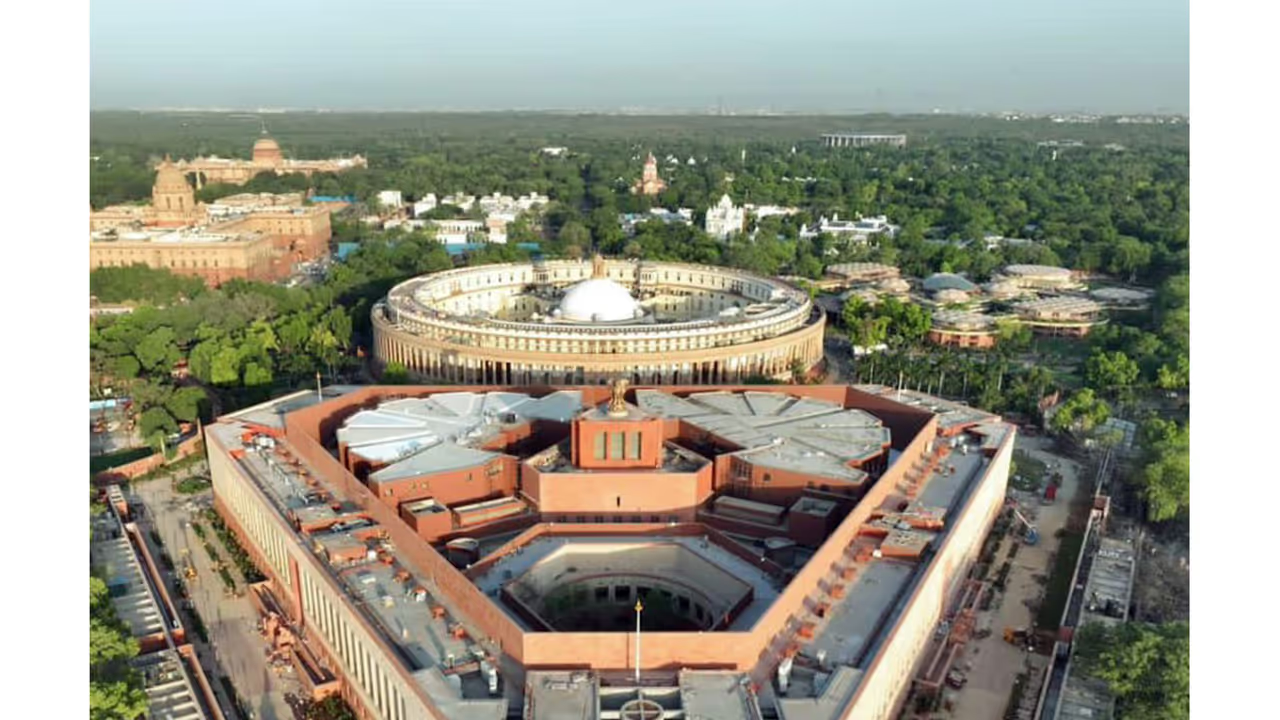
As the Monsoon Session nears its end, Parliament is set for a busy day with key bills like the Tribunals Reforms and FCRA Amendment on the agenda, even as the opposition continues to demand Amit Shah's statement on the NEET protest issue.
With four days left in the ongoing Monsoon Session in Parliament, both houses are set for a packed day of legislative business on Monday, even as the opposition has signalled no signs of stopping their demand for Union Home Minister Amit Shah to address the police action on student protestors over the NEET paper leak.
Lok Sabha Agenda
The Lok Sabha is scheduled to take up the introduction of several key bills, including the Tribunals Reforms Bill, 2026, the Mines and Minerals (Development and Regulation) Amendment Bill, 2026, the Kerala (Alteration of Name) Bill, 2026, and the National Co-operative Development Corporation (Amendment) Bill, 2026. Union Home Minister Amit Shah is scheduled to move for leave to introduce the Kerala (Alteration of Name) Bill, 2026, seeking to alter the name of the state of Kerala. Shah will also move for leave to introduce the National Co-operative Development Corporation (Amendment) Bill, 2026, which seeks to further amend the National Co-operative Development Corporation Act, 1962. Alongside these, Union Law and Justice Minister Arjun Ram Meghwal will move to introduce the Tribunals Reforms Bill, 2026, which seeks to improve efficiency, independence, transparency and uniformity in the qualifications, appointments and service conditions of chairpersons and members across various tribunals. The Bill also proposes setting up a National Tribunals Commission and making consequential amendments to related laws.
The Lok Sabha's list of business also includes the laying of papers on the table by several Union ministers, including Gajendra Singh Shekhawat, Jayant Chaudhary, Pankaj Chaudhary, Kirti Vardhan Singh, Sukanta Majumdar and Tokhan Sahu.
Rajya Sabha Business
Meanwhile, the Rajya Sabha is slated to take up the Taxation and Other Laws (Amendment) Bill and the Bankers' Books Evidence Bill on Monday. These two bills have already been passed by the Lok Sabha. Union Finance Minister Nirmala Sitharaman is slated to move the two bills for consideration and passing in the House.
The 'Taxation and Other Laws (Amendment) Bill, 2026 ' seeks to amend the Payment and Settlement Systems Act, 2007, Income-tax Act, 2025, and Finance Act, 2026. The bill proposes a series of tax changes aimed at boosting investment, supporting manufacturing, providing tax certainty and will replace the Income-tax (Amendment) Ordinance, 2026. The bill was brought against the backdrop of evolving geopolitical developments and disruptions in global trade and supply chains. The government has said the amendments are intended to mitigate external economic shocks, ensure domestic economic stability and support sectors affected by prevailing global conditions while also providing greater ease of doing business and tax certainty.
The Bankers' Books Evidence Bill seeks to modernise the legal framework governing the admissibility of bank records as evidence and align it with contemporary digital banking practices. The Bill seeks to replace the existing legal framework with provisions that recognise the growing use of electronic and digital records in the banking sector. It provides that an electronic or digital record of a banker's book will be admissible, valid and legally enforceable as evidence, subject to the conditions prescribed under the legislation. The proposed law expands the definition of "bankers' books" to cover records maintained by banks in physical, electronic, digital, virtual and cloud-based forms, as well as records stored through other electronic systems. The two Bills were passed in Lok Sabha by voice vote without discussion amid protests by opposition members over their demands related to police action against protestors in the national capital on July 20.
FCRA Amendment Bill Sparks Opposition
As the Monsoon Session draws near to closure, the government is likely to bring up the Foreign Contribution (Regulation) Amendment Bill, 2026, for discussion and passing before it concludes on August 13. The legislation was reintroduced in the Lok Sabha during the Monsoon Session.
The Bill seeks to amend the Foreign Contribution (Regulation) Act, 2010, with the stated objective of enhancing transparency and accountability in the regulation of foreign contributions. The proposed legislation provides that an organisation's FCRA registration will cease upon expiry, non-renewal or refusal of renewal by the government. It also provides for the creation of a designated authority to oversee the vesting, supervision, management and disposal of foreign contributions and related assets.
Reports indicate the Bill is likely to be taken up in the Lok Sabha on August 12. The Bill has drawn strong pushback from Christian groups and minority organisations, who have met Amit Shah to address their concerns. The delegation formally pressed for three primary remedial actions: Complete withdrawal of the FCRA Amendment Bill, 2026, or its referral alongside a comprehensive review of the Principal FCRA Act of 2010 to a Joint Parliamentary Committee (JPC), complete repeal of Section 15 of the Principal FCRA Act, 2010, to eliminate the principle of asset vesting from the statutory framework and ensuring that administrative or technical delays in certificate renewals do not trigger automatic cessation, provisional vesting, and the permanent absorption of community and religious assets into the Consolidated Fund of India.
The Congress has issued a whip to its Lok Sabha MPs ahead of the anticipated discussion. Opposition MPs have expressed their apprehensions about the proposed legislation, with Shiv Sena (UBT) MP Arvind Sawant accusing the Union government of selective concern over foreign funding. "The content of the FCRA bill is not understandable...There is a calculated agenda behind all these moves... They stir up conflict, harp on religion and caste, and spout bogus rhetoric about development - but in reality, nothing is actually being achieved," said Sawant.
Speaking on the issue, BJD MP Sulata Deo said her party's position would depend on a better reading of the bill's provisions once it is formally tabled. AAP MP Sanjay Singh also weighed in on the bill's passage process, stating, "Let the Bill first be introduced in the BAC (Business Advisory Committee).
DMK MP Tiruchi Siva also expressed the party's stance. "We are against FCRA, because most of the provisions are against the minority Christian community. They have raised their concern to the Union Home Minister. We will be opposing the bill and will be insisting on referring it to a joint parliamentary committee," he said.
Delimitation and Women's Reservation
Another point of political tension is the delimitation exercise, as Congress President Mallikarjun Kharge has said that any move by the government to again bring the Delimitation Bill linked to women's reservation will be discussed by opposition parties and they will take a collective stand. He said the Congress position on the issue is clear.
Amid efforts by the government to reach out to the Congress on the proposed bill, the party has said that there should be an all-party meeting. The Constitution (131st Amendment) Bill, 2026 was introduced in the Lok Sabha on April 16 to expand the Lok Sabha strength to 850 seats, and expedite the implementation of the Women's Reservation Bill passed in 2023. However, the bill was not passed as it failed to secure the constitutionally required special two-thirds majority of members present and voting in Parliament.
While the Congress and the opposition parties have expressed support for the women's reservation bill, they opposed the delimitation exercise, seeking to increase the number of seats in the Lower House of Parliament. The Opposition has demanded delinking of women's reservation from the delimitation exercise. (ANI)
(Except for the headline, this story has not been edited by Asianetnews Editorial staff and is published from a syndicated feed.)