
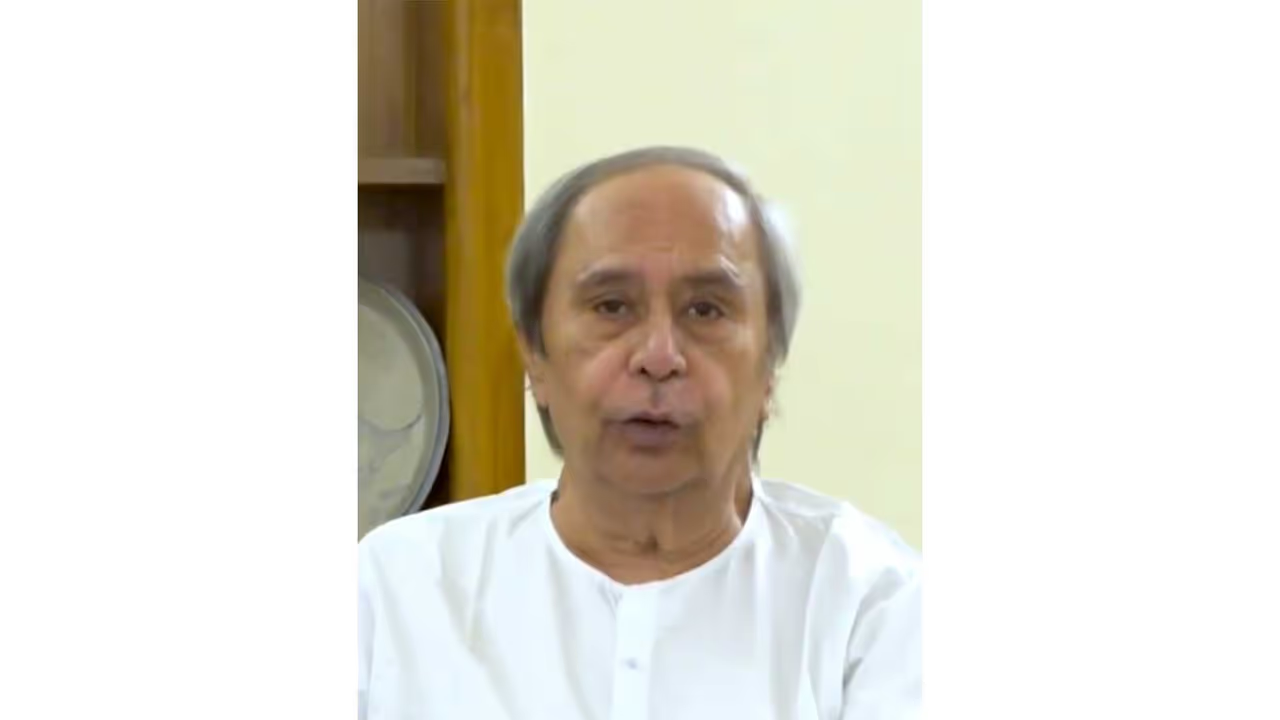
BJD president Naveen Patnaik has written to Odisha CM Mohan Majhi, expressing deep alarm over the Mines and Minerals Amendment Bill, 2026, warning it poses a serious threat to the state's fiscal autonomy and will lead to massive revenue losses.
Patnaik Raises Alarm Over Mines Bill
BJD president and former Odisha Chief Minister Naveen Patnaik on Friday wrote a letter to Odisha Chief Minister Mohan Majhi regarding the concerns related to the Mines and Minerals (Development and Regulation) Amendment Bill, 2026, warning that the law heavily damages the state's fiscal autonomy and mineral rights.
Leader of the Opposition in the Odisha Assembly expressed deep alarm and formal objection regarding the legislative changes passed in Parliament. "This legislative measure poses a serious threat to Odisha's fiscal autonomy and constitutional rights over its natural resources," Naveen Patnaik wrote.
Highlighting how party representatives strongly resisted the measure in Parliament over severe financial infringements, Patnaik added, "The provisions introduced in this Bill will disproportionately impact mineral-rich states like Odisha, leading to massive revenue losses and stifling our state's developmental agenda."
Specific Concerns Highlighted
He further detailed specific statutory clauses that strip regional governments of their financial powers and expand central jurisdiction. "Specifically, the amendment raises critical concerns through the following provisions, which include encroachment of State Land and Fiscal Jurisdiction. The amendment expands Union control under Section 2 to include "mineral-bearing lands" alongside regulation of mines. Restriction on State Revenue Powers: Section 9D explicitly prohibits State Governments from levying any tax, cess, or similar levy on mineral rights or mineral-bearing lands (whether based on quantity, value, or royalty) except under conditions imposed by the Central Government. Delegation of Power to the Centre: The amendment to Section 13 grants the Central Government sole authority to frame rules restricting states' power to levy taxes on minerals," the letter noted
Call for United Opposition and Defence of Federalism
Emphasising the vital importance of mining revenues for public welfare and condemning the blow to federalism, Patnaik stated, "Odisha's natural wealth belongs to her people, and the revenue generated from mining operations is crucial for financing healthcare, education, social welfare schemes, and infrastructure development across the state. By stripping the state of its power to impose taxes and cesses on its own mineral-bearing lands, the Union Government has dealt a heavy blow to federalism and state revenue autonomy."
Calling for immediate political steps to counter the legislation and build a united front, the opposition leader urged, "Given the gravity of this situation and its long-term adverse implications for Odisha's economy, I strongly urge you to take immediate action that includes to convene an All-Party Meeting immediately to build a unified consensus on safeguarding Odisha's federal rights and mineral revenues and summon a Special Session of the Odisha Legislative Assembly to formally pass a unanimous Resolution opposing this Amendment Act and protesting the Union Government's usurpation of state powers."
Describing the retrogressive effect of the law on cooperative federalism, Patnaik observed, "Fiscal autonomy is a constitutional principle built into our federal system. This Bill directly undermines a critical pillar of the Centre-State relationship, taking India's federal structure in a distinctly retrogressive direction and striking at the foundation of cooperative federalism."
Warning against the long-term cost of losing fiscal authority while bearing environmental burdens, the letter stated, "This issue transcends political affiliations, as it directly impacts the financial stability and future growth of Odisha. If the Central Government takes away the State's authority over mineral-bearing lands and its right to levy cesses, only pollution, displacement, and burden of mining will remain with Odisha, while the benefits are taken away from its people."
"I hope you will act swiftly in the paramount interest of the people of Odisha," the letter wrote.
Chidambaram Echoes Concerns
Meanwhile, Congress leader P Chidambaram also criticised the passing of legislation, saying that it takes away whatever left "little taxation power the States had in respect of 'mineral bearing land'. "After the Bill, such taxation by the States would be subject to conditions and restrictions imposed by the GoI It is a matter that concerns the taxation powers of the States. Were the States consulted by the GoI before introducing the Bill? The answer is NO The Bill carefully avoids even a reference to the landmark judgement of the 9-judge Bench of the SC which interpreted the Constitution and ruled that the States have the power to tax mineral bearing land All that has been set at nought by one Bill The States will be poorer. Worse, the outstanding tax bills issued when the States had the unrestricted power to tax mineral bearing land are, under the Bill, been CANCELED Apart from the validity of the new law, there is the fundamental question of whether, in a democracy and a Union of States, the GoI can take away the taxation power of States without even 'consultation' The mine owners are laughing their way to the bank!" he wrote on X.
Ministry of Mines Defends Amendment
Meanwhile, the Ministry of Mines said that the amendment Bill will not take away any of the rights of the States on land and minerals or any tax on minerals collected by the States. "At present, out of the total taxes and statutory payments in mining, around 90% accrues to the States, and this arrangement will continue even after the amendment. Further, this amendment will not impact the power of the States to regulate and impose tax on minor minerals The States are currently levying around 14 types of taxes, charges, fees, and other levies on mining operations, such as royalty, auction premium, dead rent, contribution to the District Mineral Foundation (DMF), Goods and Services Tax (GST), transit fee, etc. Around 90% of total mining revenue accrues to the States. From FY 2015-16 till FY 2025-26, a total of over Rs. 5 lakh crores has accrued to major mining states, whereas during the same period, the revenue to the Centre was only Rs. 82,000 crores. This scenario will continue to be the same even after the Mines and Minerals (Development and Regulation) Amendment Bill, 2026 (MMDR Amendment Bill, 2026), the Ministry of Mines said.
Ministry said that after the introduction of the auction regime in 2015, States have got another major source of revenue as auction premium - the amount quoted by the successful bidder in the auction. During 2020-21 to 2025-26, major mining states have collected auction premiums of more than Rs. 96 thousand crores, which is in addition to other revenue sources like royalty, DMF, GST, etc. Thus, States which have taken the lead in the auction and operationalisation of auctioned blocks have seen an exponential rise in their revenues. (ANI)
(Except for the headline, this story has not been edited by Asianet Newsable English staff and is published from a syndicated feed.)