
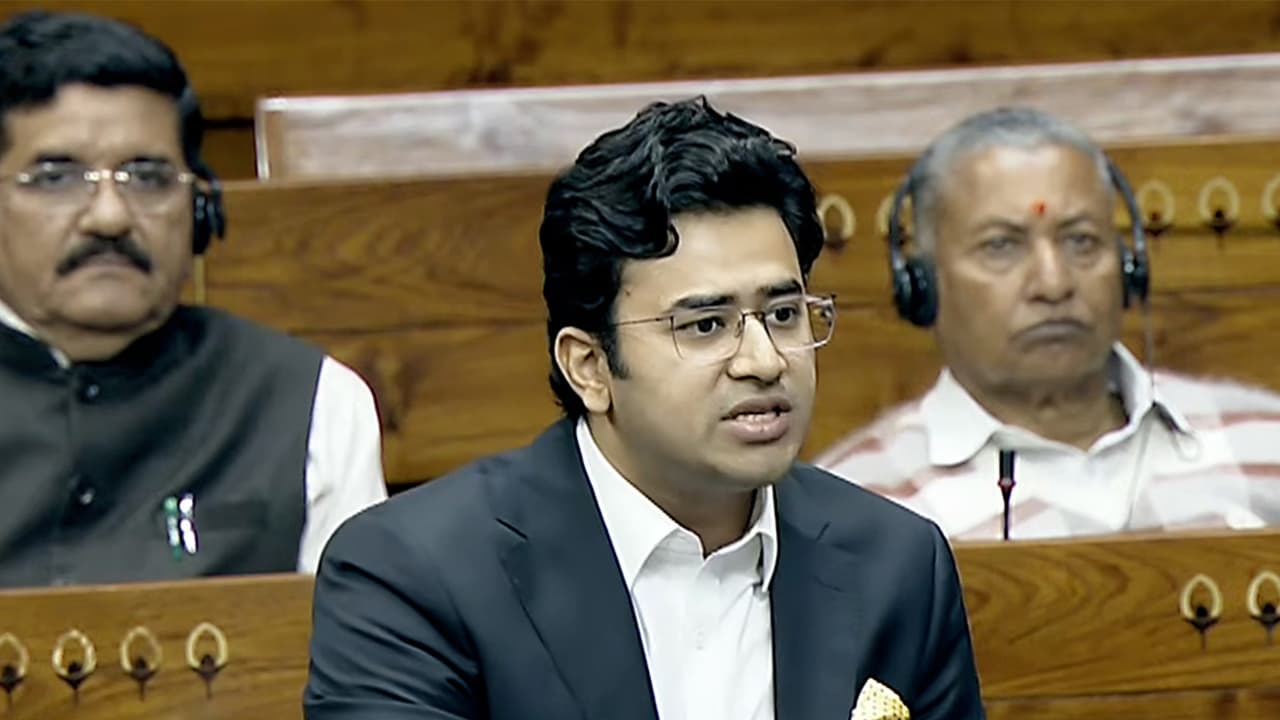
The Tejasvi Surya-chaired Select Committee on the Jan Vishwas (Amendment of Provisions) Bill, 2025, presented its report to the Lok Sabha. The Bill seeks to decriminalise minor offences to improve Ease of Living and Ease of Doing Business.
The Select Committee on the Jan Vishwas (Amendment of Provisions) Bill, 2025, chaired by Bengaluru South MP Tejasvi Surya, on Friday presented its report to the Lok Sabha.
The Bill seeks to further the Government's effort to improve Ease of Living and Ease of Doing Business by decriminalising minor offences across multiple sectors, including municipal governance, motor vehicles regulation, MSMEs, electricity, textiles, agriculture processing and legal metrology.
Bill's Scope and Committee's Diligence
Introduced in the Lok Sabha on August 18, 2025, by Union Minister for Commerce and Industry Piyush Goyal, the Bill was referred to a Select Committee the same day, and Surya was appointed Chairperson of the Committee on October 1, 2025.
Building on the Reform Express during the Jan Vishwas (Amendment of Provisions) Act, 2023, the 2025 Bill proposed amendments across 17 Central Acts administered by multiple Ministries. The Committee examined the provisions in detail and made several recommendations aimed at balancing regulatory compliance with citizen convenience while ensuring deterrence against serious offences.
Since October 2025, the Committee has held 49 sittings, including one for adopting the report, reflecting the extensive efforts made in the finalisation of the report.
A Major Step for Ease of Living
Speaking on the submission of the report, Surya said, "The Committee has recommended the decriminalisation of 689 provisions across 78 different legislations, resulting in the removal of more than 1000 criminal offences. This makes it the largest exercise of its kind and a major step towards promoting Ease of Living."
"Under the leadership of Prime Minister Narendra Modi, the Government has been consistently working towards rationalising regulatory frameworks and reducing compliance burdens. The Jan Vishwas 2.0 Bill represents one of the most comprehensive efforts in this direction and will further strengthen India's journey towards becoming a Viksit Bharat by 2047," he added.
Committee's Key Recommendations
As per the release, the Committee recommended decriminalisation of several provisions by replacing imprisonment or criminal fines with civil penalties in areas where offences are procedural or technical in nature. At the same time, it retained criminal provisions in cases where public health, safety, or systemic integrity could be compromised.
Sector-Specific Amendments
Among its key recommendations, the Committee suggested retaining enforcement powers of the Reserve Bank of India under the RBI Act while accepting the removal of certain provisions relating to auditors.
With respect to the Motor Vehicles Act, the Committee endorsed the proposed amendments aimed at simplifying compliance and reducing legal ambiguity while strengthening road safety provisions. It also suggested clarifications in certain sections to improve legal clarity and ensure stronger deterrence against repeat offences.
In the Drugs and Cosmetics Act, the Committee recommended a calibrated approach to penalties to protect public health and maintain public trust in traditional medicine systems such as Ayurveda, Siddha, Sowa-Rigpa and Unani.
The Committee also supported conversion of fines into penalties in laws governing sectors such as the Central Silk Board Act, Tea Act, Coir Industry Act and the Agricultural and Processed Food Products Export Development Authority Act.
In municipal laws such as the Delhi Municipal Corporation Act and the New Delhi Municipal Council Act, the Committee recommended replacing imprisonment provisions with structured penalties and further decriminalising several additional sections to promote ease of living.
Framework and Governance Reforms
The Committee further recommended the adoption of graded compliance mechanisms in several Acts, where first-time violations could attract advisories or warnings, followed by monetary penalties for repeated violations. It also emphasised the need for clearly defined adjudication and appellate processes within each Act.
The Committee also made several broader recommendations, including ensuring proportional penalties based on the gravity of offences, establishing clear minimum and maximum penalty structures, introducing tiered compliance frameworks for repeat offenders, and strengthening digital compliance systems. It further suggested exploring the creation of a Centralised Regulatory Management System to streamline regulatory compliance across Ministries and regulators, the press release stated.
Tejasvi Surya added, "The Committee has undertaken a detailed examination of provisions across multiple laws to ensure that minor procedural violations do not attract criminal penalties while preserving strict action for serious offences affecting public safety and trust. This approach will significantly reduce unnecessary litigation and improve the ease of living for citizens."
Committee Members
Other members of the Committee include Damodar Agarwal, Dhairyasheel Sambhajirao Mane, Khagen Murmu, Kalyan Banerjee, Konda Vishweshwar Reddy, Malvika Devi, NK Premachandran, Praveen Khandelwal, Suresh Kumar Kashyap, T Sumathy, Sunil Dattatray Tatkare and Ujjwal Raman Singh. (ANI)
(Except for the headline, this story has not been edited by Asianet Newsable English staff and is published from a syndicated feed.)