
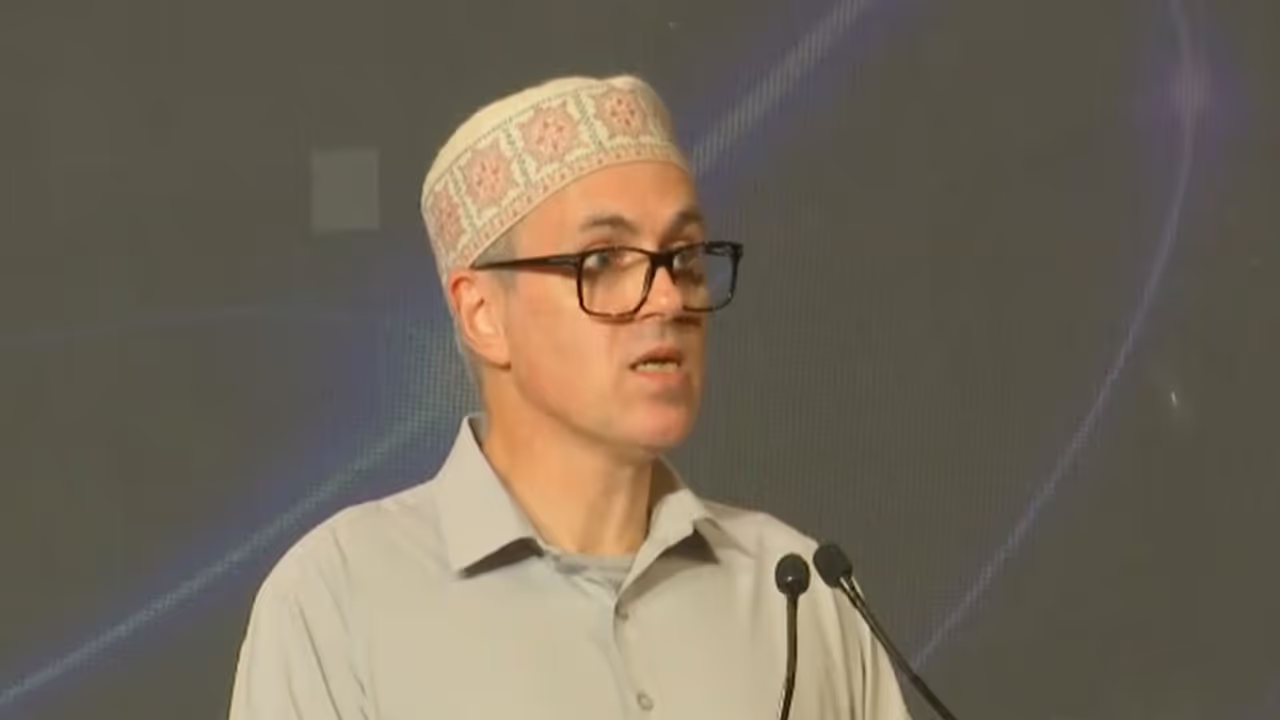
J&K CM Omar Abdullah, at IIMBue 2026, detailed historic agrarian reforms as a model for future economic growth. He outlined a 'slingshot' plan to leverage India's tech hubs and also addressed the Kulgam terror attack and the fight for statehood.
Jammu and Kashmir Chief Minister Omar Abdullah on Saturday delivered a keynote address at IIMBue 2026, where he reflected on the historic agrarian reforms of the Union Territory and outlined a vision for its future economic growth through a "slingshot" effect.
Historic Agrarian Reforms
Addressing a gathering of industry leaders and alumni of IIM Bangalore, the Chief Minister underscored the importance of the land reforms initiated decades ago. "Over nearly three decades after independence, Jammu and Kashmir undertook one of the most far-reaching programs of agrarian reform anywhere in the country. The tiller became the owner of the land, not in one region of it, but across the entire Jammu and Kashmir and in the districts in between. The reforms were defined in stages and reached their mature form in the 1970s," Abdullah said.
He emphasised that the purpose of these reforms was to broaden ownership and improve productivity. "The purpose was straightforward: to broaden ownership, strengthen incentives, improve productivity, and build a stable rural economy by putting reward where the work was. Their significance extended well beyond agriculture. Institutions set the incentives," he added.
Speaking on the psychological and professional impact of such institutional changes, the CM noted, "People read them before they invest, before they educate a child, before they take a risk, and before they decide not to. That is a calculation you make professionally. Every household in a poor economy makes it quietly all the time. That is why a change in landholding reached so far beyond the land. The agrarian reforms altered those incentives fundamentally."
Digital Age and Policy Choices
On the digital age and technological revolutions, Abdullah said that while technology lessens the need for physical proximity, the development of J&K remains a matter of policy choice. "Every technological revolution has altered the sources of comparative advantage. This one weakens the importance of physical proximity for a great deal of high-value work. Weaken it, but does not abolish it. Whether that weakening ever reaches a place like Jammu and Kashmir is not a property of the technology. It is a choice about infrastructure, institutions, and capability, and it has to be made before concentration hardens," he stated.
The 'Slingshot' Economic Strategy
In a candid assessment of J&K's economic strategy, Abdullah admitted that the region aims to leverage the momentum of India's existing tech hubs rather than competing directly. "Let me be honest about the manoeuvre available to us, because it is a narrow one. We cannot outwit Bangalore, and no place has ever generated that kind of momentum from a standing start. What a region in our position can do is pass close enough to something already moving to take a share of that motion. A small body passing a large one gains speed for nothing, and that energy is real. Not only, but only because something larger is already moving. A slingshot, not a toe. India is moving," he said.
Remarks on Current Issues
On Kulgam Terror Attack
Meanwhile, speaking to reporters on the sidelines of the event, the Chief Minister addressed the recent terror attack in the Kellam area of Kulgam, where two non-local workers were killed. He announced an ex-gratia of Rs 10 lakh for the families of the deceased. "This is really unfortunate. People had come from outside to Kashmir for work. They had come to earn a livelihood. Such innocent people were targeted. The more the attack is condemned, the less it is. Money cannot ease the pain of the bereaved families, but this is a small effort by us to help them in this difficult hour," Abdullah said.
On Statehood Restoration
The Chief Minister also talked about their recent protest at Jantar Mantar in Delhi demanding the restoration of statehood for Jammu and Kashmir. Abdullah asserted that the struggle for statehood would be a long-drawn process. "I had said earlier too that this was just the beginning. We too know that just a day's protest at Jantar Mantar won't restore statehood. Students had come in lakhs of numbers, and it took them too 25 days. We too will have to keep this going. We are not saying anything which wasn't promised to us," the CM added. (ANI)
(Except for the headline, this story has not been edited by Asianet Newsable English staff and is published from a syndicated feed.)