
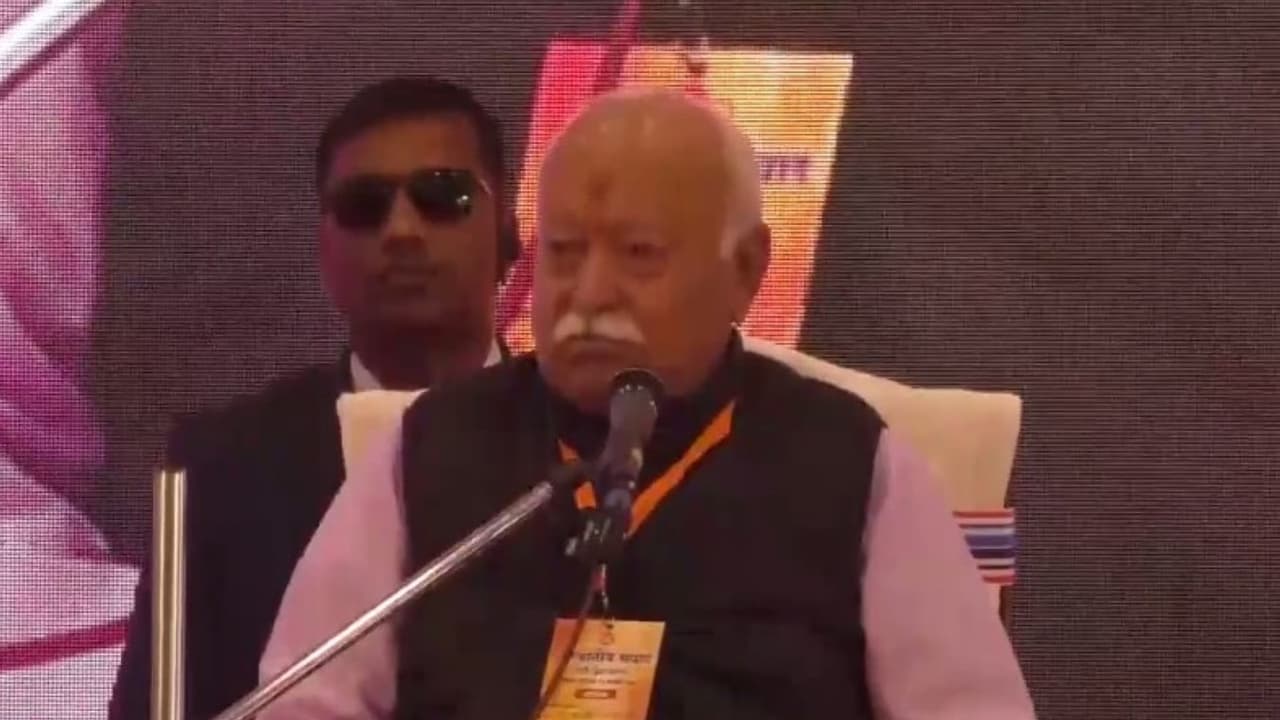
RSS chief Mohan Bhagwat stated that Indian civilisation is 2 lakh years old, with its core unity intact. Speaking in Ranchi, he highlighted the roots of Sanatan Dharma in tribal communities, describing them as the foundation of Indian culture.
Rashtriya Swayamsevak Sangh (RSS) chief Mohan Bhagwat on Saturday said that human civilisation in India is approximately two lakh years old, has undergone many changes in its culture and practices; however, its core unity and continuity have remained intact.
The RSS Chief was addressing the Janjati Samvad Karyakram in Ranchi, where he spoke at length on the origins of Indian civilisation, Sanatan Dharma and the role of tribal communities in shaping the country's cultural and religious traditions. "What is the history of civilisation in our country, the history of humanity? New findings are now emerging which suggest that it is about 200,000 years old. In this long span, the forms and practices have changed over time and it is natural that as time changes, outward expressions also change. But the unity with which we began has remained intact till today; that is our history," Mohan Bhagwat said.
Origins of Sanatan Dharma
He noted that the terms "Hindu" and "Hindu religion" came into use much later and that their roots lie in Sanatan Dharma, which he described as eternal in nature. Bhagwat said that when one traces the origins of Sanatan Dharma, its foundations are found in forest life and agriculture, highlighting the central role of tribal communities in India's civilisational journey. "So, how did what we today call 'Hindu' or 'Hindu religion' begin? The name 'Hindu' came much later; the religion is Sanatan (eternal). But when we search for how Sanatan Dharma itself emerged, we find its roots in forests and agriculture. In other words, the people whom we call Adivasis (tribals) are the foundational roots of our religion and culture. To search for the roots of the Vedas, we have to go there," he said.
Tribal Religious Traditions
The RSS chief also rejected the notion that tribal communities lack religious traditions. He said worship and the ideas behind it have existed since ancient times and continue to thrive among tribal societies even today. "Even today, among India's tribal societies, the many forms of religion and the many systems of thought that exist to say that they have no religion is completely wrong. 'Religion' means worship, and worship has been practised since ancient times. The ideas and beliefs behind worship have also continued from that very period," he said. (ANI)
(Except for the headline, this story has not been edited by Asianet Newsable English staff and is published from a syndicated feed.)