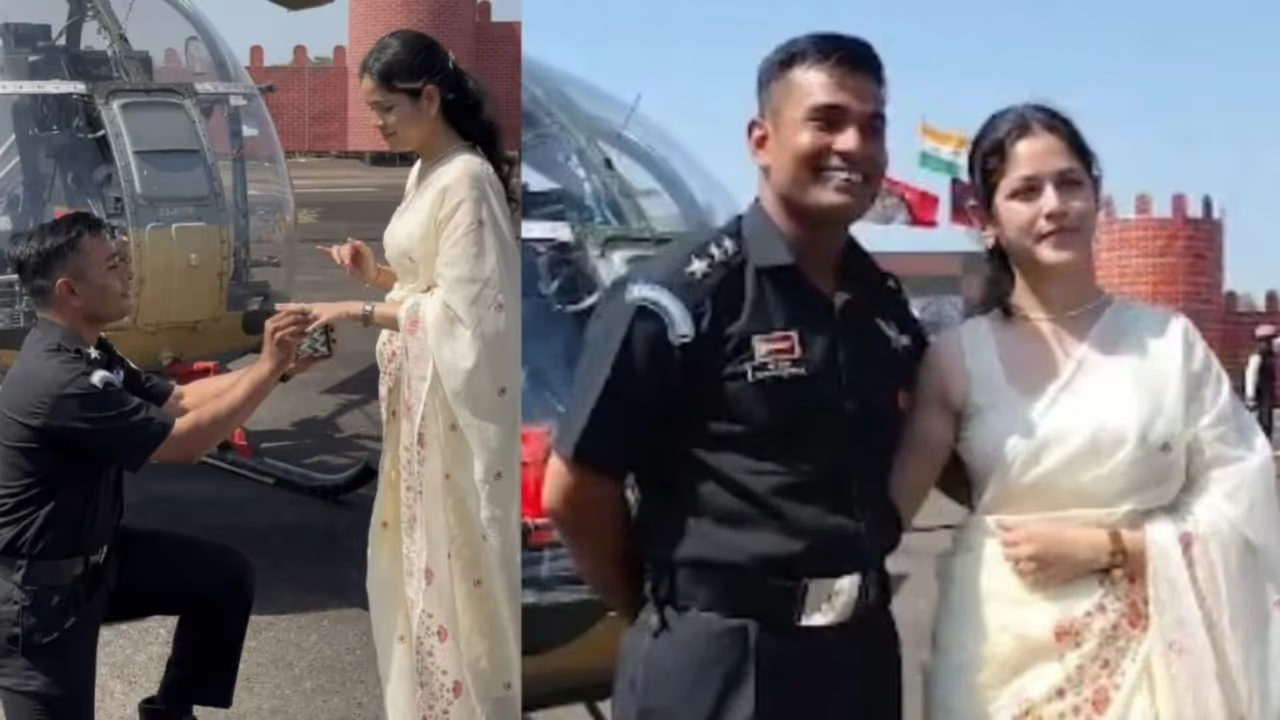
An Indian Army captain's proposal to his girlfriend at his graduation ceremony went viral, prompting an official inquiry from the army. The incident has sparked a significant debate, with many veterans questioning the army's response and arguing for adapting to changing social norms and the age of social media.
The officer dropped to one knee in front of a military helicopter moments after his wings ceremony at the Combat Army Aviation Training School. Veterans are divided over whether the Army's response is proportionate.
New Delhi: The Indian Army has asked an army captain to explain his conduct after a video of him proposing to his girlfriend at a military aviation graduation ceremony circulated widely on social media, triggering a debate about the armed forces’ relationship with the age of social media and changing societal norms.
The incident took place at the Combat Army Aviation Training School (CAATS) in Nashik, Maharashtra, where the officer had just completed his course and received his wings. He dropped to one knee in front of a military helicopter, proposing marriage to his girlfriend in the presence of fellow officers, their families, and military hardware that was on display at the ceremony.
Related Articles

The video was shared rapidly across platforms and drew reactions ranging from warm celebration to institutional concern.
Sources within the army confirmed that the officer is being asked to respond to allegations that he violated service rules. An army official said that the location and occasion were “not appropriate” for such a gesture, without elaborating on which specific regulations may have been breached.
It is pertinent to mention here that the Indian Army enforces strict social media guidelines to protect operational security, prevent intelligence leaks and combat disinformation. These rules mandate “passive participation” – viewing-only on public platforms, regulate messaging, and strictly prohibit posting personal opinions, photos in uniform, or sensitive location details.
In the video, the captain is heard saying: “We have all become pilots and instructors today. It was a big day for all of us. Our hard work yielded fruit today … We have known each other for the past five years. I don’t think there is a better day than this to propose marriage to her. This is a big day for my family too. I wanted to make this day memorable for my fiancée too.”
Veterans push back against the inquiry
Several retired senior officers have publicly questioned whether the army’s response is proportionate, arguing that the institution must adapt to a world where social media is ubiquitous and public sentiment shapes the military’s image as much as internal discipline does.
The former Indian Navy officer Commodore Anil Golaya (Retd), wrote on the social media platform X: “I don’t think it is a cause for worry or requires knee-jerk responses. So long as no sensitive information goes out … we need to move with the times.” He added that the helicopters were on public display during the function and that family members had been clicking photographs. “Just because the video went viral does not mean the youngster needs to be keel-hauled,” he said.
Golaya also noted that proposing in uniform does not denigrate it, pointing to a long tradition of military personnel marrying in uniform, including the “Arch of Sabres” ceremony in which fellow service members form an aisle using swords or rifles as the newly wedded couple walks through.
The retired Indian Army officer, lieutenant general, KJS Dhillon, former commander of the XV Corps, was more pointed in his criticism. Writing on X, he said: “You want the young officer to sacrifice his life for the love of the nation, but you don’t want him to express his love for his fiancée.” He invoked the army adage – “Youngster nahi karega, toh kaun karega” (If not the youngster, who will?) and argued that no security angle could legitimately be applied to the episode, given that military equipment is routinely put on display at public exhibitions organized by the army itself.
“If you cannot find a fault in his professional capabilities, don’t do this nukta-chini (nitpicking) for such a pure gesture of love and belonging,” Dhillon said.
A tradition well-established in Western militaries
In the United States and several Western countries, public proposals at military commissioning ceremonies have become an accepted, even celebrated, practice. Newly commissioned officers at the United States Military Academy at West Point, at Reserve Officers’ Training Corps (ROTC) ceremonies, and at Officer Candidate School have regularly proposed to their partners on graduation day, with such moments frequently going viral on social media without any institutional censure.
The US Army does not prohibit such proposals provided they occur after the official ceremony or during authorized celebration periods and do not disrupt proceedings or compromise military decorum. The tradition has deep roots: American commissioning ceremonies date to the nineteenth century, marking the formal transition from cadet to commissioned officer and are designed to be shared with family and mentors. The rise of social media in the 2000s and 2010s amplified these moments, turning them into a genre of their own online.
India does not have a directly comparable tradition, and the Indian military services maintain stricter protocols around conduct at official functions. However, critics of the army’s response argue that there is a difference between a lapse in discipline that compromises operational security or the dignity of a ceremony, and a spontaneous personal act that took place after the formal proceedings had concluded. Social media and the military: a widening tension
The episode is not the first time the Indian armed forces have been confronted with the challenge of managing the intersection of personal expression, social media, and institutional propriety. In recent years, the military has periodically issued advisories cautioning personnel against posting on social media in ways that could inadvertently reveal sensitive information or be perceived as inconsistent with the image of professional discipline. At the same time, recruitment campaigns, including the army’s own official social media handles, increasingly use emotional, humanizing content to attract a younger generation of officers.
The CAATS incident sits at exactly that fault line. No sensitive information appears to have been disclosed; the equipment visible in the video was already on display for civilian guests. The question being debated among veterans and observers is whether the army’s formal inquiry serves its interests or whether it projects an institutional rigidity that sits awkwardly against the warmth with which the video was received by the public.
The army has not indicated what action, if any, it intends to take once the captain’s explanation has been received.