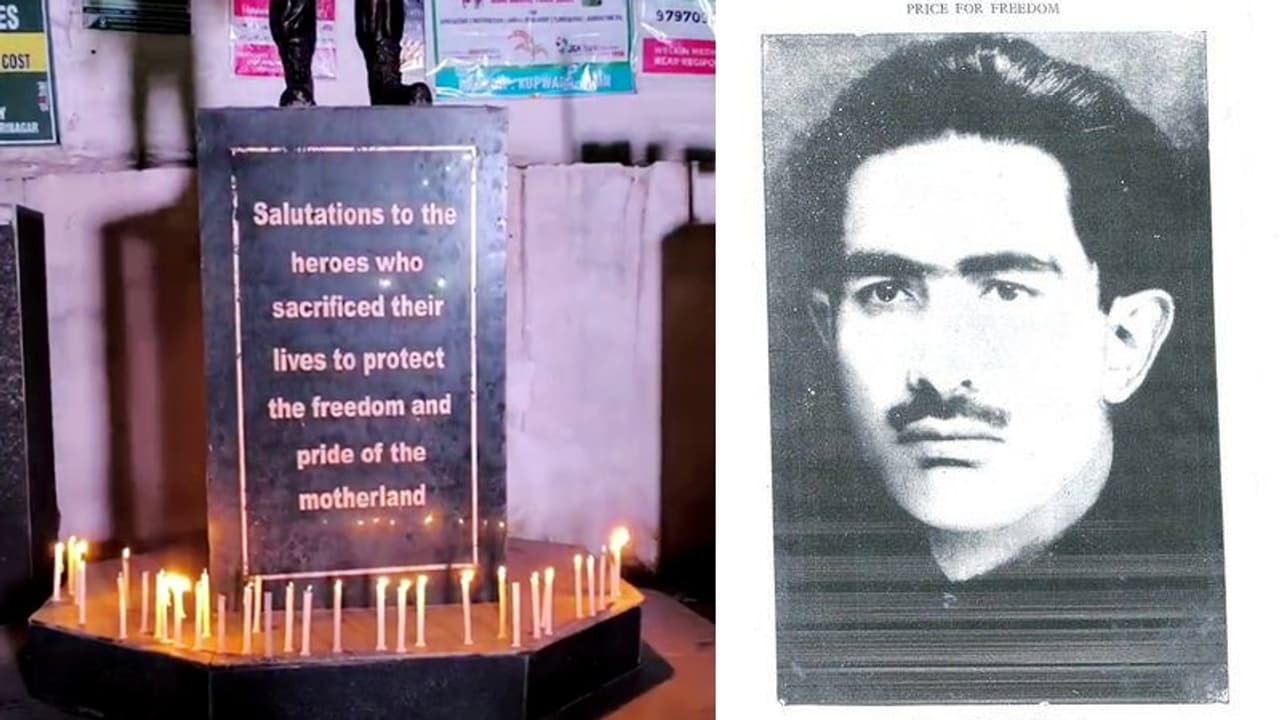
Amid the shock of the Pahalgam terror attack, the forgotten bravery of 19-year-old Maqbool Sherwani in 1947 resurfaces as a reminder of civilian sacrifice that helped save Kashmir for India.
As the nation reels from the brutal terror attack in Pahalgam’s Baisaran Valley that claimed the lives of 26 innocent tourists on April 23, it is impossible not to reflect on Kashmir’s long and tragic history of violence—and the enduring spirit of its people who have fought to keep it together.
More than 75 years ago, when the princely state of Jammu and Kashmir stood at the crossroads of chaos and survival in the wake of Independence, it wasn’t a politician, soldier, or general who stepped up to protect Srinagar from falling—it was a 19-year-old civilian political worker from Baramulla named Maqbool Sherwani.
Kashmir, October 1947: On the Brink of Collapse
On October 26, 1947, Maharaja Hari Singh signed the Instrument of Accession, merging the princely state of Jammu and Kashmir with the Indian Union. But this official declaration came at a time when the situation on the ground was spiralling out of control.
Related Articles

Pakistan-sponsored tribal raiders from the North-West Frontier Province had stormed into Kashmir. With the Indian Army yet to land, the raiders were only 54 km away from Srinagar, looting, pillaging, and murdering their way through Baramulla. Had Srinagar fallen, many believe Kashmir’s fate would have taken a drastically different turn.
And then came Maqbool Sherwani.
One Boy. One Lie. One Country Saved
A young worker of the National Conference, Sherwani idolised Sheikh Abdullah and was an active voice in Baramulla. When the tribal raiders arrived, Maqbool didn’t pick up a weapon—he chose to wield a lie. One version says he offered to guide the raiders to Srinagar but deliberately led them astray. Another version notes that he falsely told the raiders that Indian troops had already landed in Srinagar, causing hesitation in their advance.
This crucial delay gave the Indian Army just enough time to land at Srinagar airport on October 27 and defend the capital. The raiders were eventually intercepted at Shalteng on November 7 and driven out.
But the price Maqbool paid for that delay was horrific.
A Martyr Remembered—But Not Enough
Discovered by the raiders in Sumbal, Maqbool was tortured, bound to wooden planks, and shot with 14 bullets. A note in Urdu nailed to his forehead read: "He is a traitor, his punishment is death." When the Indian Army recaptured Baramulla, he was buried with full military honours.
According to a Times of India report dated November 9, 1947, “the most popular local leader of the National Conference, Meer Maqbool Sherwani, went through torture for his politics and was finally bound to wooden bars and shot dead—14 bullet holes were found in his body.”
Author Mulk Raj Anand penned a novella Death of a Hero in Sherwani’s honour. Mahatma Gandhi later referred to his sacrifice as “a martyrdom of which anyone, Hindu, Sikh, Muslim or any other, would be proud.”
The Spirit of Sherwani Lives On
Even those critical of his political methods, such as rival Muhammad Yusuf Saraf, acknowledged his bravery. Historian Andrew Whitehead writes how Saraf recalled Maqbool being nailed to an electric pole and still shouting “Sher-e-Kashmir Zindabad”—Long live the Lion of Kashmir.
Professor Amitabh Mattoo, whose grandfather served as Deputy Commissioner of Baramulla post-1947, wrote: “To his grandchildren, my grandfather described Sherwani as the one man who saved Kashmir for India.”
From 1947 to 2025: A Painful Echo
In the aftermath of the Pahalgam terror attack, where tourists from across India and Nepal were gunned down in cold blood, Kashmir mourns again. And yet, the memory of Maqbool Sherwani stands as a stark reminder of another time when civilians bore the brunt of terror—but chose courage over fear.
Kashmir’s story is not just of conflict, but of countless untold sacrifices like Sherwani’s—stories that deserve to be remembered not just in the pages of forgotten books, but in the national consciousness.
At a time when the valley faces fresh wounds, perhaps it's time to mainstream the memory of Maqbool Sherwani—the teenager who took 14 bullets so Kashmir could stay with India.