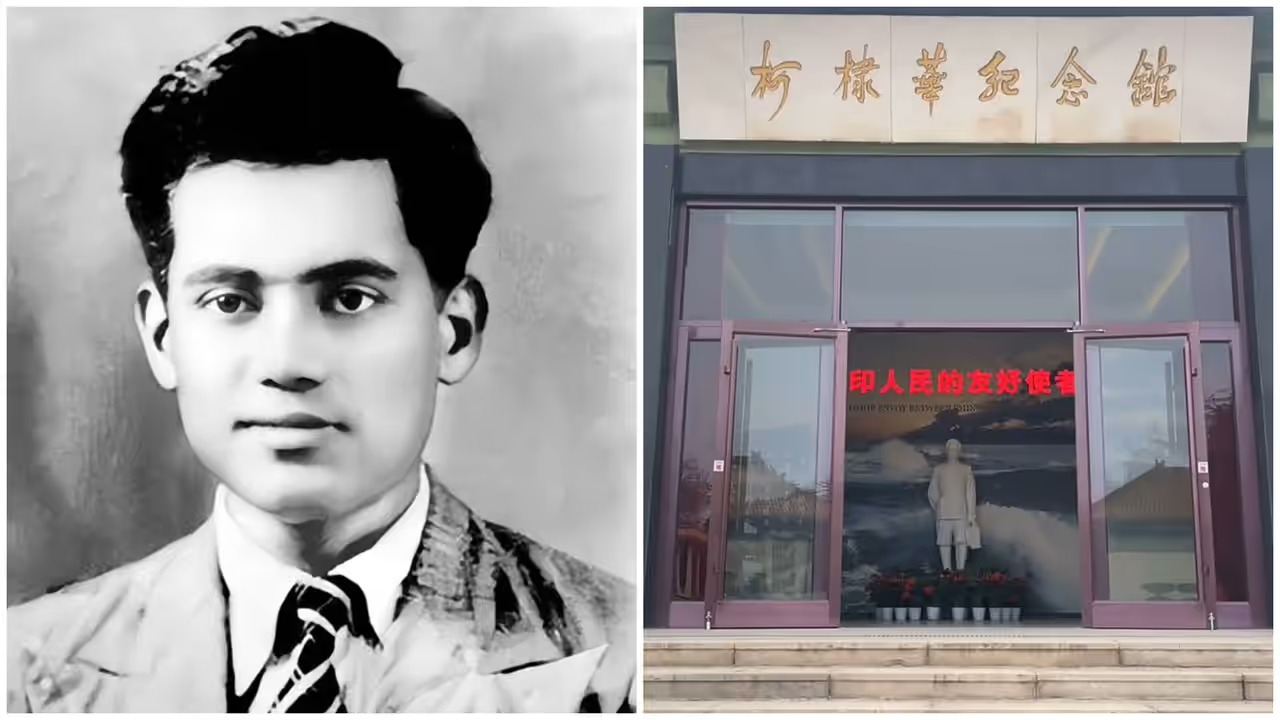
Dr Dwarkanath Shantaram Kotnis was an Indian doctor who crossed borders, braved war, and etched his name permanently into the history of Sino-Indian friendship.
“His memory belongs not only to your people and ours but to the noble roll-call of fighters for the freedom and progress of all mankind. The future will honour him even more than the present because it was for the future that he struggled." "The army has lost a helping hand; the nation has lost a friend. Let us always bear in mind his internationalist spirit."
These words by Mao Zedong, the founding father of the People’s Republic of China, were not reserved for a Chinese revolutionary, but for an Indian doctor who crossed borders, braved war, and etched his name permanently into the history of Sino-Indian friendship - Dr Dwarkanath Shantaram Kotnis.
Dr Kotnis, who spent the final five years of his short life serving Chinese soldiers during one of the darkest chapters of China’s history, died on Chinese soil but won immortality in the hearts of millions. To this day, he stands as a rare and powerful symbol of compassion without nationality and sacrifice without expectation.
Related Articles

Dr. Kotnis: An Indian Heart That Beat for China
Born on October 10, 1910, in a modest middle-class family in Solapur, Maharashtra, Dwarkanath was one of seven siblings. From an early age, he harboured ambitions far larger than his surroundings. He enrolled at Seth GS Medical College under the University of Bombay (now Mumbai), driven by a desire to “practice medicine in different parts of the world.”
The 1930s and 40s were turbulent years across Asia. While India’s freedom movement was gaining momentum, China was locked in a brutal war against Japanese invasion. Amid this chaos, Chinese revolutionary General Zhu De reached out to Jawaharlal Nehru, appealing for Indian doctors to help save the lives of Chinese soldiers.
Mao Zedong himself added a powerful note to this plea, writing, “...Our emancipation, the emancipation of the Indian people and the Chinese, will be the signal of the emancipation of all down-trodden and oppressed.”
In 1938, fresh out of medical college and preparing for postgraduate studies, Kotnis made a decision that would redefine his life. He informed his family of his wish to volunteer overseas before continuing his education. For his family, China was largely unknown - a distant land spoken of only as a war zone.
“Neither he nor any other member of the family knew much about China at the time. All we knew was that its natives used to come to India to sell Chinese silk,” recalls his younger sister, Manorama.
Despite the uncertainty and danger, Kotnis joined a medical team of four other Indian doctors - M Cholkar from Nagpur, BK Basu and Debesh Mukherjee from Calcutta, and M Atal from Allahabad.
The young doctors were personally welcomed by Mao Zedong and General Zhu De at the revolutionary base of Yan’an. It marked a historic moment - the first medical team from another Asian nation to volunteer for China’s war effort.
Assigned to mobile clinics near the frontlines, the Indian doctors treated an endless stream of wounded soldiers. The scale was overwhelming. Nearly 800 soldiers sought medical care daily during the prolonged Sino-Japanese conflict. Dr Kotnis often worked relentlessly, sometimes for 72 hours at a stretch without sleep.
When the war finally eased, the Indian doctors prepared to return home. All but one. Dr Kotnis had fallen deeply in love with China — its people, its culture, and its spirit of resistance. His letters home glowed with warmth and pride.
“He sounded very happy in the letters,” Manorama told Outlook India, adding, “People used to come to thank him for his help. He was telling the good part.”
Kotnis did more than serve China — he became part of it. He joked, sang, and conversed in Chinese, learned to write the language, and embraced the local way of life. Known fondly as Kedihua dai fu — Doctor Kotnis — he became a beloved figure among soldiers and civilians alike.
In 1939, after serving in northern China, Kotnis joined Mao’s Eighth Route Army. His dedication and tireless service soon earned recognition, and in 1940, he was appointed director of the Bethune International Peace Hospital.
It was here that destiny introduced him to Guo Qinglan.
Raised in an unconventional Christian family, Qinglan had trained as a nurse and volunteered with the Eighth Route Army at just 23. She first noticed the tall, broad-shouldered, curly-haired Indian doctor at the inauguration of Dr Norman Bethune’s tomb and fell for him instantly.
“He was vivacious and liked singing,” Qinglan later recalled, adding, “. . . and sometimes I couldn’t help laughing when he told me a joke.”
Kotnis, too, was smitten — especially by the nurse who noticed his frayed army jacket and gifted him a sweater. Their bond grew amid war and hardship, and in December 1941, they were married. In August 1942, they welcomed a son, Yinhua — a name suggested by communist leader Nie Rongzhen, symbolically uniting Yin (India) and Hua (China).
But happiness was painfully short-lived.
Years of relentless work had ravaged Kotnis’ health. On December 9, 1942, just months after his son’s birth, the 32-year-old doctor died following an epileptic attack. China mourned deeply. He was laid to rest in the Heroes Courtyard in Nanquan village.
Madame Sun Yat-sen, another towering Chinese leader, honoured him with the words: “His memory belongs not only to your people and ours but to the noble roll-call of fighters for the freedom and progress of all mankind. The future will honour him even more than the present because it was for the future that he struggled."
Tragedy continued to shadow his family. Yinhua, who followed his father’s path into medicine, died in 1967 — heartbreakingly, due to medical negligence, just before graduating.
Qinglan lived on, carrying memories of the men she loved and lost. She remained a respected presence at Indo-Chinese diplomatic events, including functions attended by former Indian President K R Narayanan and Prime Minister Atal Bihari Vajpayee. She also maintained close ties with Kotnis’ family in Mumbai, visiting them frequently until her death at 96 in 2012.
Until Manorama’s passing in 2015, Chinese leaders and delegations continued to visit her, remembering her brother with reverence and gratitude.