India and the UK have signed a landmark Free Trade Agreement under Prime Minister Modi’s leadership, offering zero-duty access to 99% of Indian exports. The deal boosts farmers, MSMEs, professionals, and affirms India’s global economic rise.
By Prem Shukla
(National Spokesperson, BJP)
The latest Free Trade Agreement signed between India and the United Kingdom stands as a powerful testament to India’s rising stature on the global stage. It is not just a trade pact but a historic declaration that the New India is politically and economically sovereign, decisive, and globally assertive. Before we explore the revolutionary features of this landmark agreement and its far-reaching benefits, it is important to look back at the colonial legacy that once crippled our nation and the decades of missed opportunities under the Congress-led governments that followed independence.
Related Articles

Trading chains broken, India rises
The British first landed on Indian shores in the early 1600s. The East India Company to conduct business with the East was established in 1599 by a group of traders known as the Merchant Adventurers. Queen Elizabeth-I gave it permission and exclusive trading privileges with the East in 1600. The Company’s first ships docked in 1608, and over time it began establishing trading posts along the Indian coastline. What started as a commercial mission soon turned into political manipulation. By 1757, following the Company's military victory in the Battle of Plassey, British control began solidifying, marking the formal start of colonial rule.
The East India Company quickly realized that India was a fragmented land of provincial kingdoms, and it took advantage of this disunity to expand its political control. Slowly and steadily, it transitioned from a trading entity to a ruling force. Its power continued to grow until the Revolt of 1857, after which the British Crown took direct control, beginning nearly a century of brutal colonial rule.
India achieved independence in 1947, but only politically. Economically, we remained tethered to the colonial mindset. Even after 1947, India continued to follow the economic framework that the British had designed. Instead of charting a bold new path for economic liberation, successive Congress governments from Nehru to Sonia Gandhi allowed India to remain trapped in a structure that benefitted Britain more than it served the Indian people.
During Nehru's tenure, the influence of British thinking was so pervasive that even our armed forces bore the imprint of colonial doctrines. India’s foreign policy, economic planning, and strategic institutions continued to reflect outdated British-era thinking. This pattern of dependency and economic stagnation remained unbroken until Prime Minister Narendra Modi took office. Today, the Free Trade Agreement signed between India and the UK is proof that India has finally claimed full independence both political and economic. And most importantly, this agreement has been signed on India’s terms and conditions.
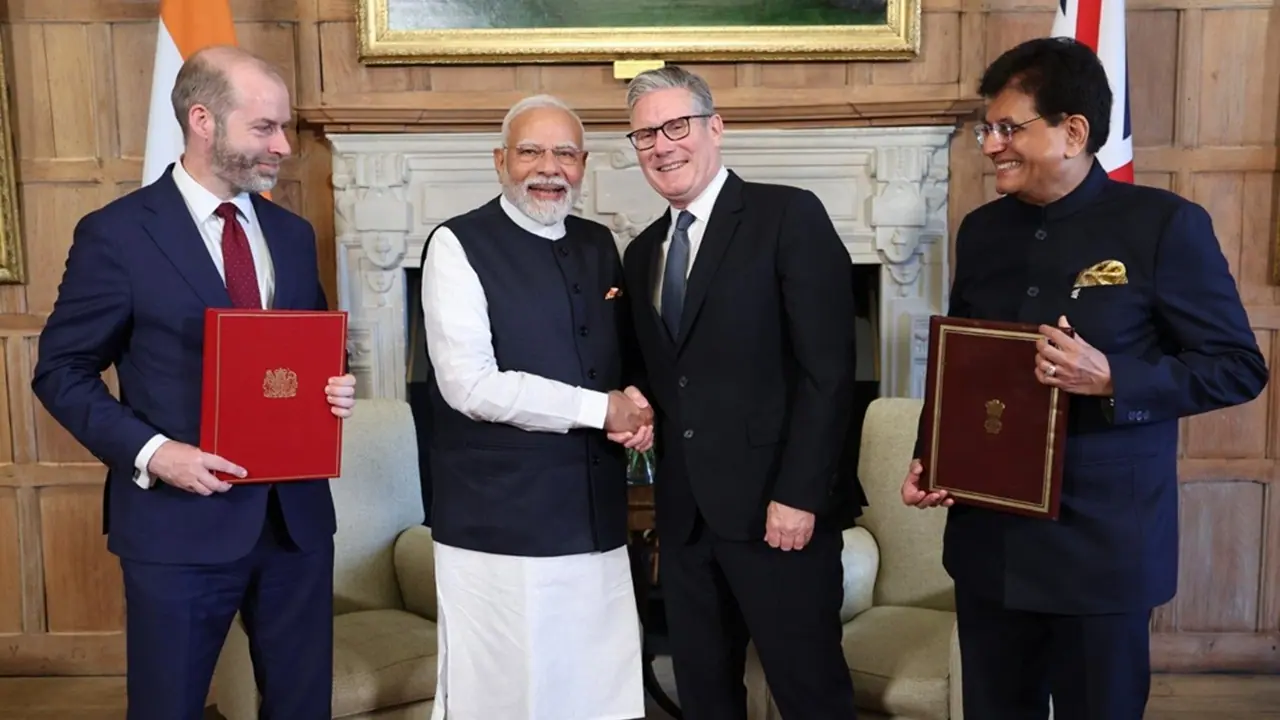
On Thursday, Prime Minister Narendra Modi and British Prime Minister Keir Starmer signed the long-awaited India UK Free Trade Agreement. This agreement is a game-changing moment in India UK bilateral relations. First and foremost, I extend heartfelt congratulations to PM Shri Narendra Modi for delivering this historic achievement. This treaty is a shining example of Modi Ji's people-first approach to diplomacy and trade. It brings direct benefits to our farmers, fishermen, MSMEs, artisans, professionals, women and youth.
This would be India's biggest deal signed in ten years and the UK’s fourth since its exit from the European Union. India has signed, with alacrity, a deal with the UK which will raise the total volume of trade to around thirty-four billion dollars per annum from the present levels of around twenty to twenty-five billion dollars. More importantly, it represents the first of many steps undertaken to sign deals with other nations to leverage mutual benefits.
This Free Trade Agreement marks a significant milestone in India’s engagement with major developed economies and reflects a shared commitment to strengthening economic integration. As the world’s fourth and sixth largest economies respectively, India and the UK’s bilateral engagement holds global economic significance. The signing of the India UK Comprehensive Economic and Trade Agreement follows the successful conclusion of negotiations announced on sixth May twenty twenty five. The bilateral trade between the two countries stands at nearly fifty-six billion dollars, with a joint goal to double this figure by twenty thirty.
The landmark India UK Comprehensive Economic and Trade Agreement secures unprecedented duty-free access for ninety nine percent of India’s exports to the UK, covering nearly the entire trade basket. This agreement waives duties on ninety five percent of India’s agricultural exports. This is expected to open new opportunities for labour-intensive industries such as textiles, marine products, leather, footwear, sports goods, toys, and gems and jewellery, alongside fast-growing sectors like engineering goods, auto components, and organic chemicals. The deal also promotes the Make in India initiative by opening global markets to our traditional industries, including artisans, weavers, textile workers, leather manufacturers, footwear units, toy makers, and gem and jewellery exporters. Their potential will now be elevated to a new height.
Transformative features of this historic agreement:-
1. Farmers to get preferential access to UK markets: Indian farmers will now get privileged access to the UK’s thirty-five-billion-dollar agricultural market. Over ninety five percent of agricultural and processed food products including fruits, vegetables, cereals, pickles, spice mixes, fruit pulps, ready to eat meals, and processed foods will now attract zero duties. This will significantly increase India’s agricultural exports and uplift the income of our farmers.
2. India protects sensitive sectors: While enabling duty-free access to a wide range of products, India has intelligently safeguarded its sensitive sectors. Items such as dairy products, apples, certain vegetables, oats, and cooking oils have been excluded to prevent market flooding and to protect Indian farmers and traders from unfair competition.
3. Big catch for Indian fishermen: India’s marine export sector gets a major breakthrough as UK import duties on marine products drop from up to twenty percent to zero. The UK’s five point four billion dollar market is now open to our fishermen, empowering coastal communities across the country.
4. Boost for job creation: This Free Trade Agreement strengthens India’s labour-intensive industries by giving them greater competitiveness in UK markets. This will result in large-scale job creation across sectors like textiles, leather, marine products, sports goods, toys, footwear, and gems and jewellery. Emerging industries such as engineering goods, auto components, and organic chemicals will also benefit.
5. Zero duty on major sectors: Key sectors will now enjoy zero import duties in the UK, down from previously high tariffs. Textiles at twelve percent, base metals at ten percent, and chemicals at eight percent will now face zero import duties. This will enhance export volumes and revenue across these industries.
6. Gains for rural India: Most processed food products that earlier faced duties as high as seventy percent are now duty-free. This change will directly benefit rural producers and exporters and uplift the agricultural processing sector in semi-urban and rural India.
7. Double Contribution Convention: The agreement includes a Double Contribution Convention that exempts Indian workers and employers from paying social security contributions for up to three years. This provision will benefit seventy-five thousand Indian workers in the UK, increasing their income and reducing the financial burden on Indian companies operating in the UK.
8. Better mobility access for Indian professionals: Indian professionals will enjoy simplified visa processes and better mobility to work in the UK across sectors such as information technology, financial services, legal, architecture, engineering, and education. The entry of professionals on contracts will become smoother and faster.
9. UK to import more from India: In the case of engineering, where our exports were just three point seven billion dollars to the UK, which imports as much as one hundred ninety-five to two hundred billion dollars from the world, with the free trade agreement in place, it should be possible to double our exports to the UK. Similar benefits can be seen in pharmaceuticals, electronics, software, jewellery, and more. In fact, the NHS would start to use generics manufactured by India, a big boost to the industry.
10. Cultural and wellness services to thrive: Up to one thousand eight hundred Indian chefs, yoga instructors, and classical musicians will now be allowed to temporarily work in the UK. This promotes India’s soft power and helps spread Indian culture, tradition, and wellness practices globally.
11. More opportunities for India’s services sector: India’s booming services sector will gain greater access to UK markets. Sectors like information technology, finance, legal services, education, and digital trade will benefit immensely. The agreement ensures simplified visa procedures, liberalised entry norms, and greater market access, giving Indian professionals a competitive edge.
12. Near-complete elimination of tariffs: India’s exports to the UK, which stood at twelve point nine billion dollars in financial year twenty twenty four and were earlier subject to import duties ranging from four percent to eighteen percent, will now face zero duties on ninety nine percent of tariff lines. This will sharply improve competitiveness and access for Indian exporters.
13. First-ever chapter on gender in a trade deal: For the first time in any Indian trade agreement, a dedicated chapter on gender has been included. This reflects Modi Ji’s progressive approach towards inclusive growth. It will encourage women entrepreneurs, ensure their better participation in international trade, and promote gender equality in global supply chains.
This Free Trade Agreement with the United Kingdom is not just about commerce. It is about confidence. It is about reclaiming our rightful place in the world. It is about correcting the economic injustices of the past and creating a prosperous future for every Indian.
For too long, we followed policies that served colonial interests. Under Congress, India remained economically subordinate even after independence. Today, under the dynamic leadership of Prime Minister Narendra Modi, we have finally broken those chains.
This agreement is a bold, strategic, and people-centric move. It reaffirms India's new role in the world, that of a strong, sovereign nation that does not beg for opportunities but commands respect, makes demands, and delivers results. This is New India. A confident India. A self-reliant India. And the architect of this transformation is none other than our beloved Prime Minister Narendra Modi.
Disclaimer: The opinions expressed are solely those of the author and do not reflect the views or stance of the organization. The organization assumes no responsibility for the content shared.