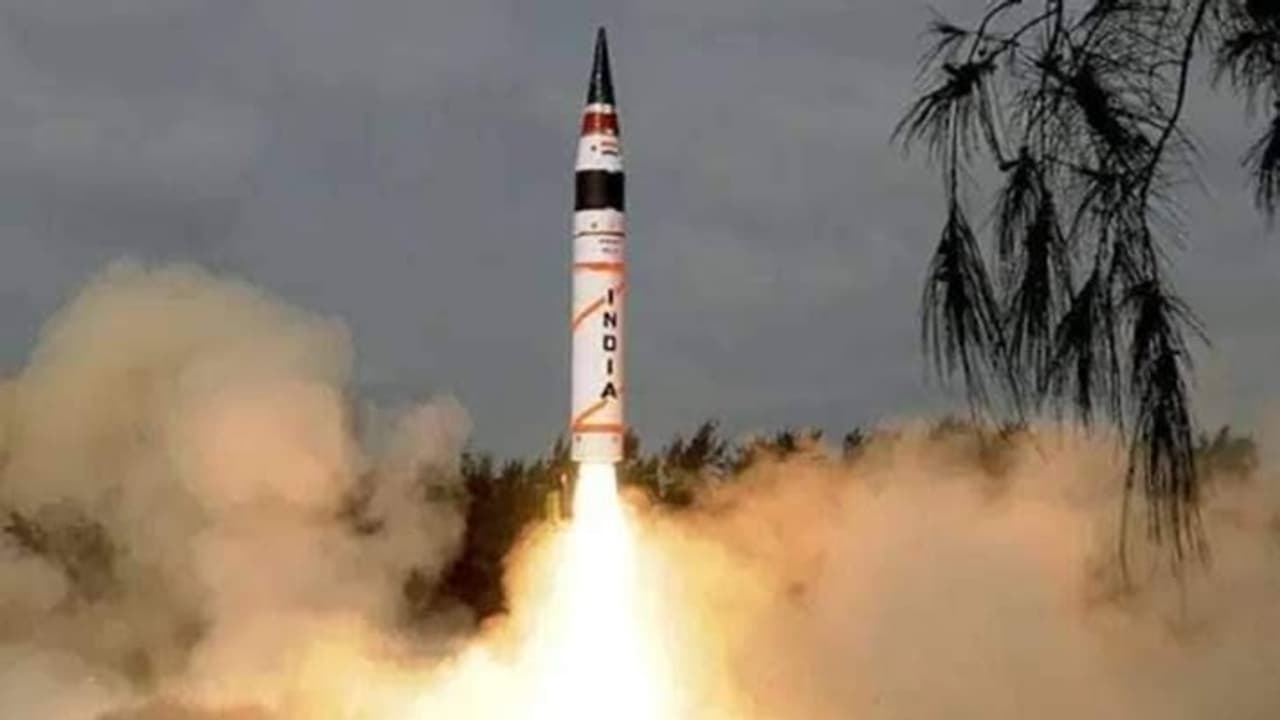
India successfully test-fired the intermediate-range ballistic missile Agni-5 from the Integrated Test Range at Chandipur, Odisha, on August 20, 2025.
Defence Ministry has said that India successfully test-fired the intermediate-range ballistic missile Agni-5 from the Integrated Test Range at Chandipur, Odisha, on August 20, 2025. Conducted under the Strategic Forces Command, the launch validated all key operational and technical parameters, the Ministry of Defence added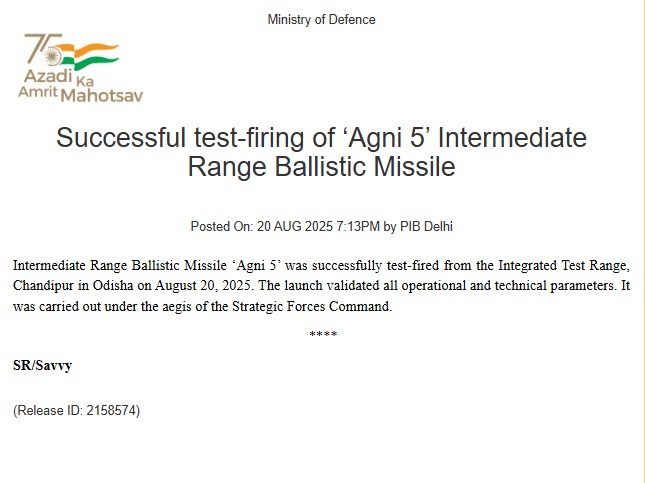 .
.
Last year, India successfully tested MIRV-capable Agni-5, which is capable of striking targets at ranges exceeding 5,000 kilometres. Following the successful test, PM Narendra Modi lauded the efforts of the Defence Research and Development Organisation (DRDO) scientists involved in the mission. In a post on X, he wrote: "Proud of our DRDO scientists for Mission Divyastra, the first flight test of the indigenously developed Agni-5 missile with Multiple Independently Targetable Re-entry Vehicle (MIRV) technology."
About ballistic missile Agni-5
Agni-5 is an intercontinental ballistic missile (ICBM) developed by India's Defence Research and Development Organisation (DRDO). It is a three-stage, solid-fuelled missile that can be launched from road-mobile platforms and stored in canisters, giving it higher mobility and quicker deployment. Officially, the missile has a range of over 5,000 kilometres, though several foreign defence analysts and Chinese sources suggest it could exceed 7,000-8,000 kilometres, placing it firmly in the ICBM category.
Agni-5 is capable of carrying nuclear warheads and significantly expands India’s strategic deterrence capabilities. With its reach, India can cover almost the entire Asian continent, including all of China, and parts of Europe if launched from central or southern India. This extended range allows India to base the missile deeper within its territory, providing both safety from potential strikes and credible second-strike capability, strengthening India’s overall nuclear posture.