
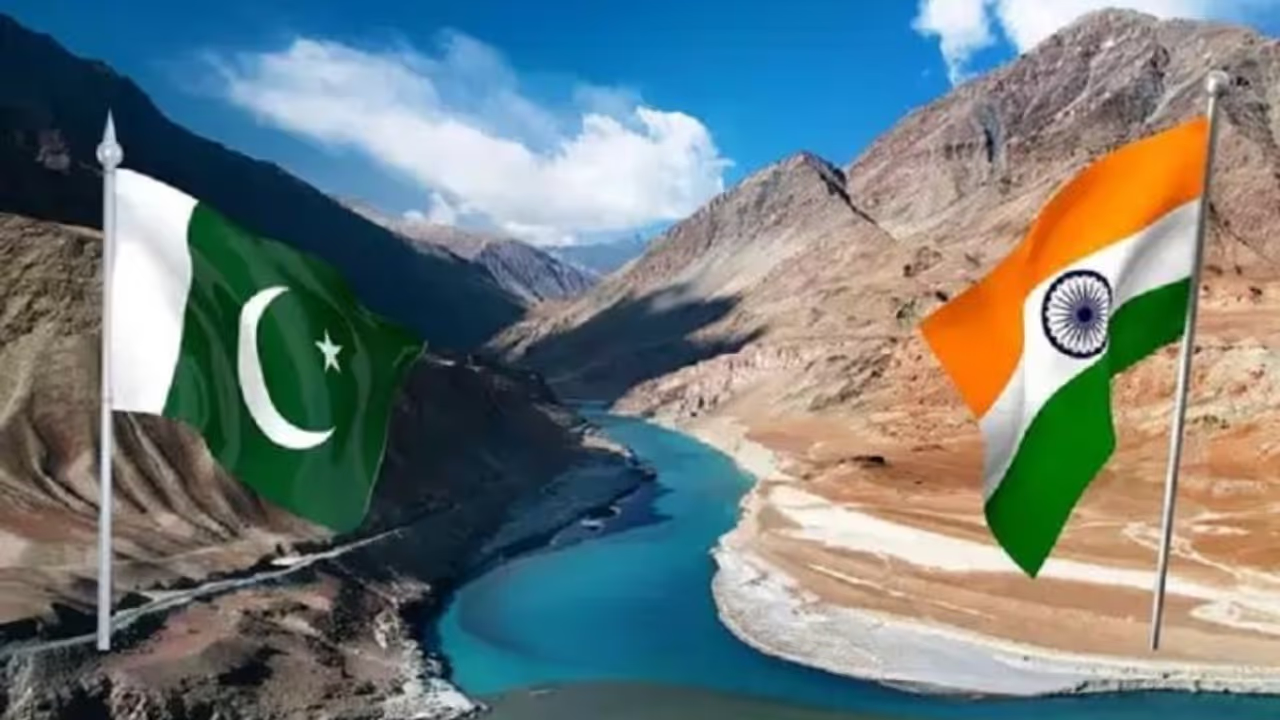
Following a deadly terrorist attack in Pahalgam, India has placed the 1960 Indus Waters Treaty (IWT) with Pakistan in abeyance. New Delhi frames this not as aggression but as a response to Pakistan's alleged sponsorship of terrorism. India argues that cooperation is untenable while Pakistan violates bilateral commitments like the Shimla Agreement.
This week marks fifty-four years since India and Pakistan signed the Shimla Agreement on 2 July 1972, the document meant to reset relations after the 1971 war and to settle, once and for all, that the two neighbours would resolve their differences by peaceful means through bilateral negotiations.
It is a fitting moment to ask a plain question: what is a treaty worth when one party honours neither its letter nor its spirit? India’s decision to hold the Indus Waters Treaty (IWT) in abeyance is best understood as New Delhi’s answer to precisely that question, not an act of aggression, but a sovereign and proportionate response to a state that has made the sponsorship of terrorism an instrument of policy.
The immediate cause requires no embellishment. On 22 April 2025, Pakistan-backed terrorists entered the Baisaran meadow above Pahalgam, separated tourists by religion, and murdered twenty-six civilians, the deadliest terror attack on Indian civilians since the 2008 Mumbai massacre. Responsibility was claimed, then hastily retracted, by The Resistance Front, a proxy of the United Nations-designated Lashkar-e-Taiba. The following day, the Cabinet Committee on Security met, and among the first decisions announced was to place the IWT in abeyance. That sequence matters. India did not reach for water as a weapon of first choice; it responded to mass murder by suspending the one cooperative arrangement whose continued, unconditional functioning had come to look indefensible.
Pahalgam was not an aberration but the latest entry in a long ledger. The 2008 terrorist attack on Mumbai, the 2016 attack at Uri, the 2019 Pulwama bombing that killed forty security personnel, each traced to groups that operate, recruit, and raise funds from Pakistani soil.
Days before Pahalgam, Pakistan’s army chief publicly described Kashmir as the country’s “jugular vein,” reviving the very rhetoric that has long accompanied cross-border terrorism.
A treaty signed in 1960 in a spirit of goodwill, friendship and cooperation cannot be quarantined from this record indefinitely. Cooperation presupposes a partner willing to cooperate.
Here the Shimla framework is decisive, and the irony is Pakistan's to own. Shimla committed both states to bilateralism and to keeping disputes, including Jammu and Kashmir, out of third-party forums. India has upheld that principle for half a century. Pakistan, by contrast, has repeatedly sought to internationalise Kashmir whenever it found bilateralism inconvenient.
In the days after Pahalgam, its National Security Committee said it would reserve the right to hold the Shimla Agreement itself in abeyance, and by June 2025 its defence minister had gone further still, calling Shimla a “dead document” and declaring that Kashmir would henceforth be handled internationally, a claim Pakistan's own foreign ministry partly walked back within a day.
The contradiction is glaring regardless: Islamabad cannot move to discard the foundational charter of bilateral relations and, in the same breath, insist that India remain perpetually bound by the technical obligations of a water-sharing pact. A country that walks away from the framework of peaceful coexistence forfeits the standing to demand the fruits of cooperation.
This is why abeyance, and not termination, is the apt instrument. India has not torn up the IWT; it has suspended its operation, a calibrated and reversible step that keeps the door open while making clear that the door is not free.
External Affairs Minister S. Jaishankar has stated that the treaty will remain in abeyance until Pakistan completely stops cross-border terrorism. That is a condition entirely within Pakistan's power to meet. The political message is unmistakable: the comity on which treaties rest must be earned, and it cannot be extracted from a state while that state sponsors the killing of the other's citizens.
Critics will note that the IWT contains no express provision for unilateral abeyance, and a court of arbitration that India regards as illegally constituted has said as much. But this objection mistakes legal form for moral substance. No instrument of international law obliges a state to extend good faith to a partner acting in manifest bad faith.
The treaty’s own preamble rests on goodwill and friendship; an agreement premised on amity cannot be wielded as a shield by a government whose proxies attack the very people that the treaty's spirit was meant to serve. India’s position, articulated at the United Nations on World Water Day in March 2026, is that it signed in good faith six decades ago, and that Pakistan, through repeated wars and sustained support for terrorism, broke that faith first.
The wider principle is the point of all this, and it is one India has now made explicit rather than left to inference: talks, treaties, and cooperation cannot be delinked from Pakistan’s obligation to end terrorism and to honour its bilateral commitments.
For decades, India compartmentalised, combating terrorism with one hand while sharing rivers, trade, and dialogue with the other. That separation rewarded bad behaviour by insulating it from consequence. Linking the two restores a basic logic of statecraft: a neighbour cannot expect normal relations while pursuing an abnormal and violent policy. The breadth of international attention after Pahalgam suggests the principle is widely understood, even where governments simultaneously urge restraint.
None of this closes the door to peace; it specifies the price of admission. India has not demanded the impossible. It has asked only that Pakistan do what every responsible state is already obliged to do: dismantle the networks that plan and finance terror, and return to the bilateral commitments it once signed. Until that happens, the rivers will keep flowing while the treaty governing them stays in abeyance, a standing reminder that there can be no treaty without trust, and no trust without a verifiable end to terrorism.
The key to restoring the Indus Waters Treaty lies not in New Delhi, but in Islamabad’s willingness to abandon the policy that placed it in abeyance.
