
The Himachal Pradesh government will challenge the 16th Finance Commission's move to scrap the Revenue Deficit Grant (RDG). CM Sukhvinder Singh Sukhu warns of a financial emergency and will seek PM Modi's political intervention to resolve the crisis.
Mounting a strong all-party appeal against the scrapping of the Revenue Deficit Grant (RDG), the Himachal Pradesh government on Sunday said it would challenge the decision both politically and legally, warning that the move threatens the state's financial backbone and can be resolved only through political intervention by Prime Minister Narendra Modi.
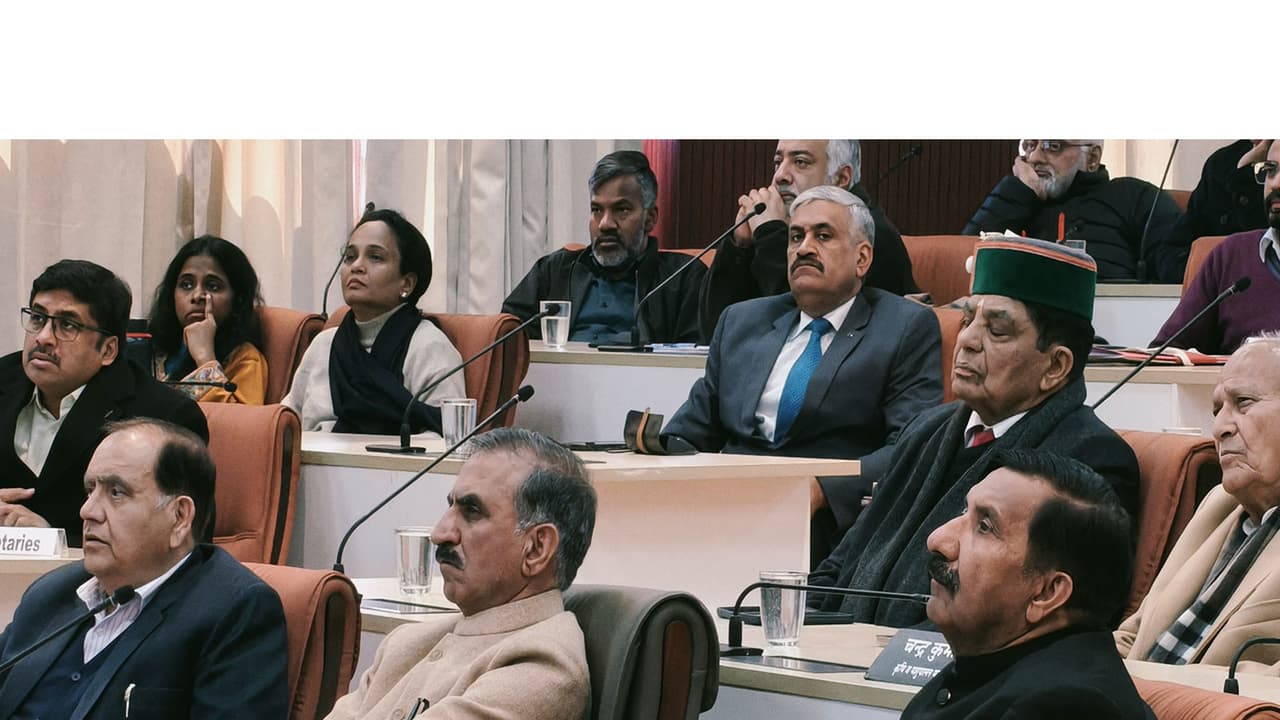
Following a Cabinet meeting chaired by Chief Minister Sukhvinder Singh Sukhu, who also holds the Finance portfolio, the state government made a detailed presentation on Himachal Pradesh's financial position before MLAs, senior officers and the media. The opposition BJP, however, skipped the presentation, a move the government described as "unfortunate" amid a deepening fiscal crisis.
Financial Emergency in Hill State
Addressing the gathering, Sukhu said the 16th Finance Commission's decision not to recommend RDG has pushed the hill state into a serious financial emergency."Himachal Pradesh is a geographically difficult hill state. A large administrative and service structure is unavoidable to deliver basic facilities to people living in remote and sparsely populated areas," he said.
Despite having a population of only about 70 lakh, the Chief Minister said the state faces heavy expenditure on salaries, pensions and interest payments, leading to a structural revenue deficit. "This cannot be addressed through routine fiscal measures," he said.
Sukhu pointed out that the 15th Finance Commission had recognised this reality through a state-wise assessment of revenues and expenditures and had recommended RDG accordingly. "In contrast, the 16th Finance Commission has adopted a one-size-fits-all approach without assessing the specific financial needs of individual states," he said.
The Chief Minister said that while Himachal Pradesh's share in central taxes has increased from 0.83 per cent to 0.914 per cent, the net increase of 0.084 per cent is marginal and insufficient to offset the loss of RDG. "RDG alone constituted nearly 13 per cent of the state's total budget. Without it, meeting committed expenditures such as salaries, pensions, social security schemes, power subsidies, water supply, transport and other essential public services will become extremely difficult," he warned.
He said that even after reducing capital expenditure to zero, the state would still face an annual resource gap of nearly ₹6,000 crore. "This decision is not limited to the present government. It will severely affect future governments as well," he said.
Sukhu termed the scrapping of RDG a blow to cooperative federalism, saying it weakens Himachal Pradesh's fiscal autonomy, regional equity and capacity to deliver essential services.
Impact of GST on State Finances
During the presentation, Sukhu gave a detailed account of the impact of GST on the state's finances. He said that prior to GST, Himachal Pradesh generated significant revenue through VAT, cess and other taxes. "After GST, our taxation powers were taken away. Earlier, we benefited by ₹4,000-5,000 crore annually," he said.
He added that while the state received around ₹3,200 crore annually as GST compensation till 2022, the tax growth rate fell sharply thereafter. "Our tax growth used to be 13-14 per cent. After GST, it dropped to around 7 per cent, a decline of nearly 50 per cent," Sukhu said.
He pointed out that GST benefits consumption-based, high-population states such as Uttar Pradesh, Maharashtra, Madhya Pradesh and West Bengal. "Despite producing nearly 35 per cent of the country's pharmaceuticals, Himachal Pradesh receives very little tax revenue," he said, adding that GST disadvantages manufacturing hill states.
Government's Resource Mobilisation Efforts
The Chief Minister also listed steps taken by the government to mobilise resources, including reforms in the power sector that yielded an additional ₹1,200 crore, improved utilisation of state assets like the Wildflower Hall hotel, which generated ₹400 crore, and legal victories such as the Supreme Court ruling in the JSW power case, which saved the state from a potential loss of ₹150 crore.
An Appeal for Political Unity
Sukhu said RDG was constitutionally envisaged to support revenue-deficit hill states. "This grant has existed since 1952. If it is discontinued now, it may never be restored in the future," he cautioned.
Appealing for unity, Sukhu urged BJP MLAs and MPs from Himachal Pradesh to rise above party politics. "This is not the fight of one government. Governments come and go, but this is about the rights of the state," he said. "We have spoken to the Union Finance Minister. Ultimately, only Prime Minister Narendra Modi can take a political decision on this."
He said the entire Cabinet was ready to go to Delhi under any leadership to press the state's case. "We will move the courts, but this is primarily a political battle that must be fought politically," he said, adding that special grants would not be a substitute for RDG.
Potential Consequences and Clarifications
Drastic Measures Loom
Meanwhile, Finance Secretary Devesh Kumar, while presenting the fiscal scenario, warned that the withdrawal of RDG could bring development works to a standstill. He said the state government may be forced to abolish all sanctioned posts lying vacant for more than two years and withdraw all subsidies and financial support being extended to various sections of society, including social welfare schemes.
'No Decision on Subsidy Cuts Yet'
Later, Technical Education and Town and Country Planning Minister Rajesh Dharmani clarified that no decision had yet been taken to withdraw subsidies. "This was a Finance Department presentation outlining the possible consequences and forward options after the withdrawal of RDG," he said.
Dharmani accused the BJP of politicising the issue. "When the BJP was in power, it received RDG as well as GST compensation. The accumulated loan burden and pending liabilities were inherited by the present government," he said.
He added that while fiscal discipline measures were necessary, abruptly discontinuing RDG was unjustified. "This is a democratic, elected government. Decisions like withdrawing subsidies are extremely difficult, and no such decision has been taken," Dharmani said.
Calling the situation a "grave challenge" for the state, he said, "As the Chief Minister has said, we have faced challenges before. We will fight this battle politically and legally, and we appeal to the Opposition to think in the larger interest of Himachal Pradesh." He added. (ANI)
(Except for the headline, this story has not been edited by Asianet Newsable English staff and is published from a syndicated feed.)