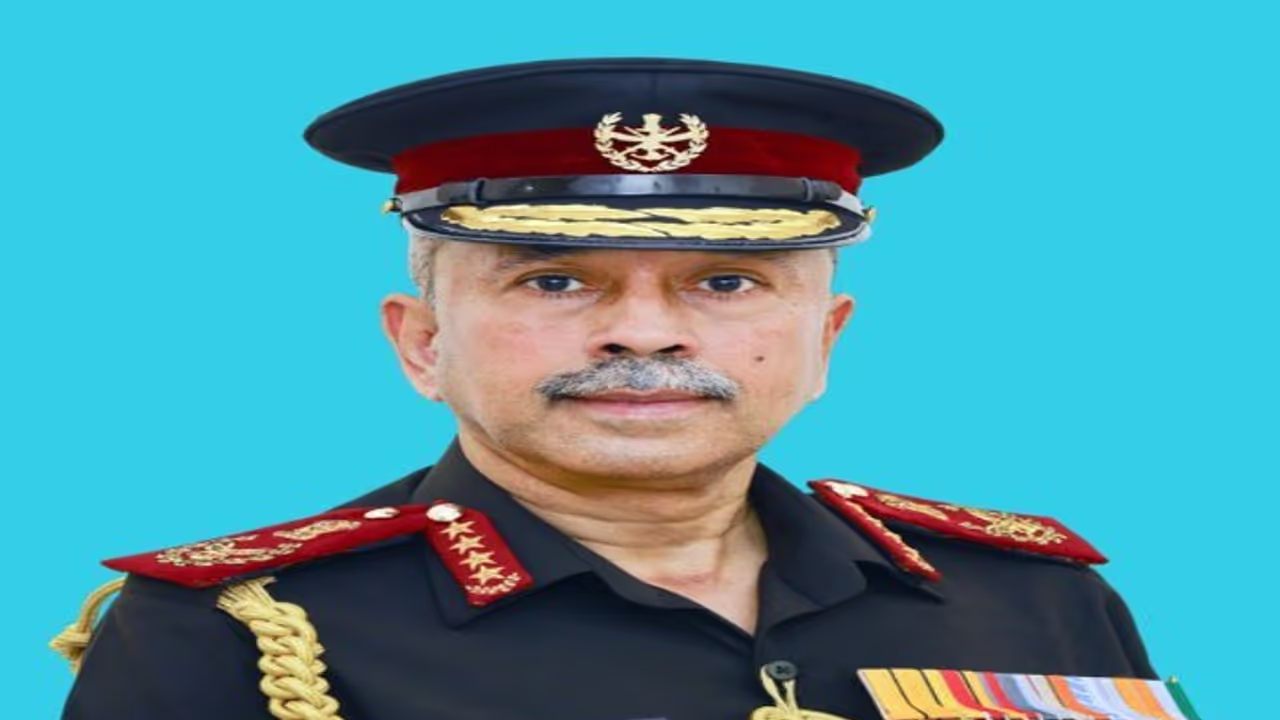
General NS Raja Subramani assumed charge on Sunday as India’s third chief of defence staff (CDS), stepping into the country’s highest military office at a juncture when the armed forces are grappling with an ambitious but still-unfinished transformation of their command structure.
New Delhi: General NS Raja Subramani assumed charge on Sunday as India’s third chief of defence staff (CDS), stepping into the country’s highest military office at a juncture when the armed forces are grappling with an ambitious but still-unfinished transformation of their command structure.
Raja Subramani, who was appointed by the government on May 9, 2026, succeeds General Anil Chauhan, whose three-year-and-eight-month tenure included the planning and execution of Operation Sindoor and a sustained, if incomplete, drive to restructure the army, navy and air force under integrated theatre commands.
The new CDS brings to the role nearly four decades of military experience across a wide range of command, staff and instructional appointments.
Related Articles

Commissioned into the 8th Battalion of the Garhwal Rifles on December 14, 1985, after training at the National Defence Academy and the Indian Military Academy, he has commanded formations on both India’s western and northern borders. His senior commands included 16 Garhwal Rifles in counter-insurgency operations in Assam under Operation Rhino, 168 Infantry Brigade in Jammu and Kashmir, 17th Mountain Division in the central sector, and II Corps – the Indian Army’s premier strike formation on the western front.
He later served as general officer commanding-in-chief of the central command at Lucknow before becoming vice chief of the army staff in July 2024, a post he held until his retirement on July 31, 2025.
After retirement, Raja Subramani was appointed military adviser to the National Security Council Secretariat with effect from September 1, 2025 – a role that placed him at the interface of military operations and national security policy at a particularly sensitive time following the Pahalgam terror attack of April 2025.
He also attended the Joint Services Command Staff College at Bracknell in the United Kingdom and the National Defence College in New Delhi.
An unfinished agenda
The most pressing agenda on the new CDS’s desk is the theatre commands proposal, which Gen Chauhan formally submitted to the ministry of defence before leaving office but was unable to see through to cabinet approval. The plan envisages reorganizing India’s existing 17 service-specific commands – seven each for the army and air force, and three for the navy – into a smaller number of geographically defined integrated commands, each with operational control over all war-fighting assets. A decision by the cabinet committee on security, which has yet to approve the plan, is considered the essential next step.
Raja Subramani’s central challenge will be translating the blueprint into an operational reality. The strategic logic behind theatrisation is straightforward: India faces potential simultaneous threats on two fronts, with Pakistan to the west and China to the north, and the current structure, in which the three services plan and operate largely independently, is seen as inadequate for managing a two-front conflict.
The new model is intended to shorten the decision-making cycle and allow a single commander to deploy assets from all three services in a coordinated response.
Role and responsibilities
As CDS, Gen Raja Subramani functions as the principal military adviser to the defence minister and also serves as secretary to the government in the department of military affairs within the ministry of defence. The post, created by the cabinet committee on security on December 24, 2019, and the department of military affairs, established on December 30, 2019, were both outcomes of recommendations that trace back to the Kargil Review Committee of 1999 and, more recently, the Shekatkar Committee of 2016.
The CDS is colloquially known as the “primus inter pares” – first among equals – in relation to the three service chiefs.
The first holder of the office, General Bipin Rawat, died in a military helicopter crash in Tamil Nadu in December 2021. Gen Chauhan was appointed as the second CDS in September 2022, the first time a retired officer was appointed to the role.
His tenure was originally to end in September 2025 but was extended by the government. Raja Subramani is the third consecutive CDS to come from the Indian Army.
The broader context
Raja Subramani takes charge at a time when the armed forces are also pursuing force modernization, including expanding indigenous defence production under the government’s Atmanirbhar Bharat policy, and integrating emerging technologies – drones, artificial intelligence-enabled surveillance and precision-strike systems into their operational toolkit.
The lessons of Operation Sindoor, which demonstrated both the capabilities and the limitations of India’s joint operational framework, are widely expected to shape the reform priorities of the new CDS.