
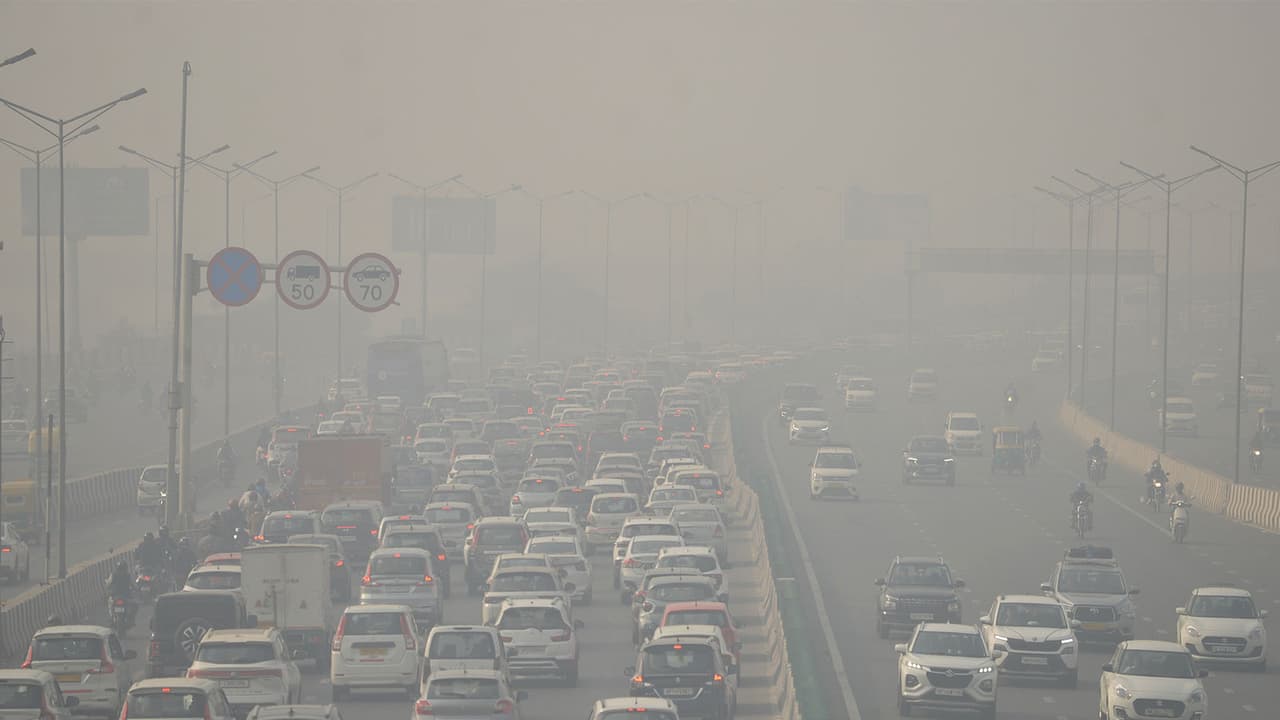
CAQM's new expert committee met to discuss curbing vehicular emissions as Delhi's AQI reached 'severe plus.' GRAP IV was imposed, and schools for young children were shifted online. Inspections revealed dust and waste issues on roads.
Expert Committee on Vehicular Emissions Holds First Meeting
The first meeting of the Expert Committee constituted by the Commission for Air Quality Management (CAQM) for in NCR and adjoining Areas to address air pollution from vehicular emissions was held on Monday under the Chairmanship of Ashok Jhunjhunwala and Co-Chaired by Prof Randeep Guleria. The meeting focused on broad discussions on key issues related to vehicular emission sources in Delhi-NCR, CAQM said in a post on X. "Deliberations covered assessment of segment-wise vehicular emission contributions, exposure risks, EV readiness and infrastructure needs," CAQM said.
The first meeting of the Expert Committee constituted by #CAQM to address air pollution from vehicular emissions was held today under the Chairmanship of Prof. Ashok Jhunjhunwala and Co-Chaired by Dr. (Prof.) Randeep Guleria. Contd. (1/3) — Commission for Air Quality Management (@CAQM_Official) December 15, 2025 The committee will present concrete, actionable recommendations to reduce vehicular emissions at upcoming meetings.
Severe AQI Prompts GRAP IV, School Closures
This comes as the national capital battles with severe air pollution, with AQI crossing the 450 mark, reaching the 'severe plus' category, prompting CAQM to impose stage IV restrictions of the Graded Response Action Plan (GRAP).
In view of the severe air pollution levels in the national capital, the Delhi Government issued a circular directing schools to shift to online mode from hybrid for students up to class 5. With the Air Quality Index (AQI) remaining in the severe category, the government has directed schools to switch to online mode for these grades until further notice. As per the circular dated December 15, physical classes for students from nursery to Class 5 have been discontinued across all government, government-aided and unaided private recognised schools in Delhi. "In view of the prevailing high AQI levels in Delhi, it has been decided that classes in physical mode for students of Nursery to Class V are discontinued till further orders," the order read.
CAQM Inspection Drive Reveals Negligence
Earlier, CAQM deployed 19 teams for a road-inspection drive. A total of 136 road stretches within the Delhi Development Authority (DDA) jurisdiction were inspected across Delhi. It was conducted as part of the Commission's ongoing monitoring and enforcement under the statutory framework and provisions of the extant GRAP, according to a release.
Inspection Findings Detailed
This focused exercise aimed to assess the accumulation of visible dust, Municipal Solid Waste (MSW), and Construction and Demolition (C&D) waste on roads, as well as cases of open burning of MSW/biomass, across the specified road stretches. The deployed teams included Officers from CAQM Flying Squads and Delhi Pollution Control Committee (DPCC). Geo-tagged, time-stamped photographs were collected and submitted to the Commission as part of the consolidated inspection report. According to the final compiled data, 15 road stretches exhibited high visible dust levels, 38 showed moderate dust, 61 recorded low dust intensity, and 22 stretches had no visible dust. Road stretches with accumulation of MSW and C&D waste were reported to be 55 and 53, respectively. 6 stretches were reported to have evidence of MSW/ Biomass burning, the release said.
Corrective Measures Urged for DDA
The above-stated observations clearly indicate evident gaps and recurring negligence in the upkeep of the concerned stretches. It brought to the fore a need for DDA to enhance its operational efficiency and take prompt corrective measures through consistent and timely dust mitigation interventions. The agency also needs to deliver improved compliance across all road stretches for MSW/ Biomass burning, it was highlighted.
The Commission observed that these kinds of incidents impact particulate matter levels in Delhi and emphasised the need for strengthened on-ground action, including regular mechanical sweeping, timely disposal of collected dust, maintenance of road shoulders and central verges in addition to deployment of water-sprinkling/ dust-suppression systems and focused action(s) for prevention of open burning cases across all stretches maintained by DDA. (ANI)
(Except for the headline, this story has not been edited by Asianet Newsable English staff and is published from a syndicated feed.)