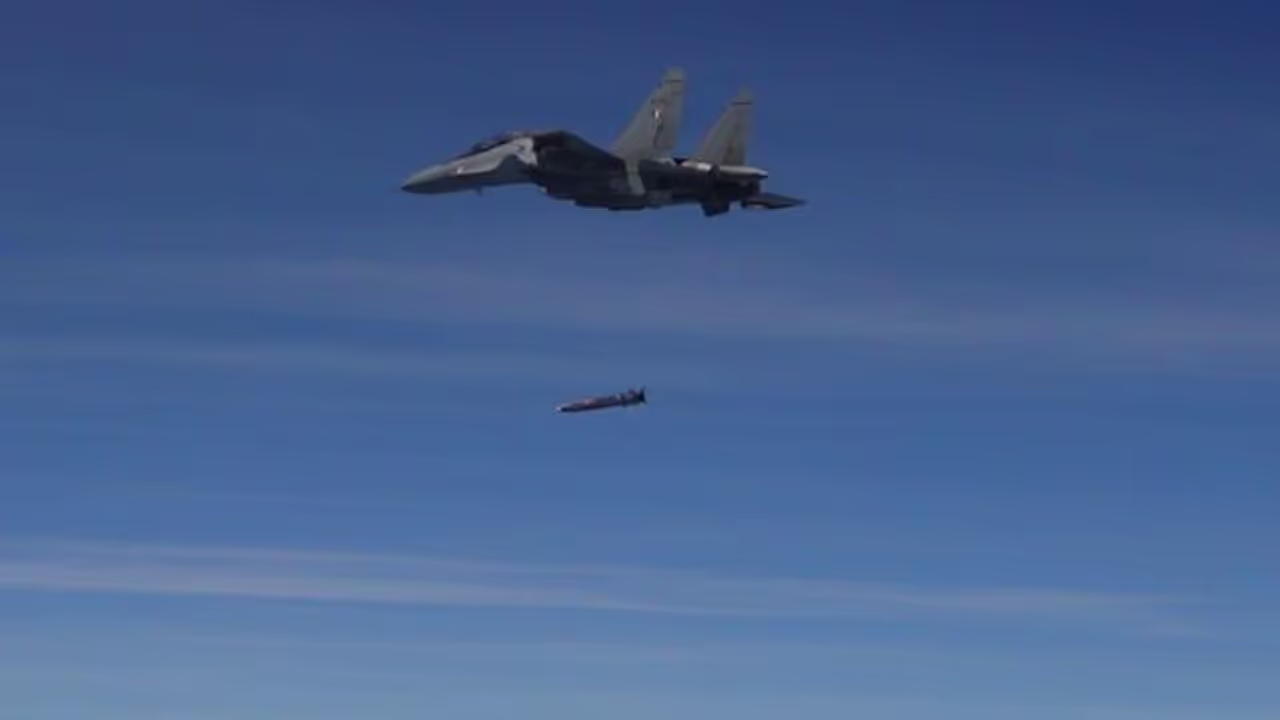
DRDO and the IAF successfully conducted flight tests of the RudraM-II air-to-surface missile from a Su-30 MKI fighter jet off the Odisha coast. The missile met all trial objectives, demonstrating precision targeting and validating its guidance and propulsion systems.
New Delhi: Defence Research & Development Organisation (DRDO) and the Indian Air Force (IAF) have conducted fresh flight tests of the RudraM-II air-to-surface missile, firing it from a Sukhoi Su-30 MKI fighter jet off the Odisha coast.
The test, conducted last week, met all trial objectives, validating the missile’s propulsion system and its control and guidance algorithm.
Telemetry data gathered by the Integrated Test Range (ITR) at Chandipur — using electro-optical systems, radar stations and an onboard ship — confirmed that the missile tracked and struck a predefined target with precision.
Related Articles

What is RudraM-II air-to-surface missile?
RudraM-II is a solid-propellant, air-launched missile intended for suppression of enemy air defences and ground attack.
Two variants are being developed: an anti-radiation missile designed to home in on radar emissions, and a dedicated ground-attack version. Both are intended to be operated from the Su-30 MKI and the Mirage 2000.
With a reported range of up to 300 kilometres and speeds approaching Mach 5.5, the missile carries a 200-kilogram payload and uses a dual-seeker system, combining passive homing and millimetre-wave guidance — to maintain accuracy even in adverse weather. Its lock-on-before/after-launch capability gives pilots flexibility to engage multiple targets in quick succession.
The weapon is intended as a domestic replacement for the Indian Air Force’s ageing Russian-origin Kh-31 anti-radiation missile.
It can detect enemy radio frequencies and radar signals from a range of 100 kilometres, keeping the launching aircraft well outside the reach of most surface-to-air missile systems.
The missile was developed primarily by Research Centre Imarat in Hyderabad, working in collaboration with the Defence Research and Development Laboratory, the High Energy Materials Research Laboratory, and the Armament Research and Development Establishment.
RudraM-II is part of a broader family of air-launched ballistic missiles under the Rudram series.
Unlike RudraM-I, which functions as a shorter-range anti-radiation weapon tested in 2020, RudraM-II and the planned RudraM-III will be air-launched ballistic missiles with ranges of 300 kilometres and more than 600 kilometres, respectively.
A fourth variant, RudraM-IV, is also in the pipeline — described by the DRDO chief as a long-range stand-off weapon exceeding RudraM-III’s range.
As of mid-2024, 40 Su-30 MKI jets had been modified to carry the RudraM-II, with plans to equip 84 more under the ongoing Super Sukhoi upgrade programme.
The defence minister, Rajnath Singh, said the tests demonstrated the growing maturity of indigenous defence technology, in keeping with the government’s push to reduce dependence on foreign arms suppliers. The DRDO chairman echoed those remarks, congratulating the teams involved.