
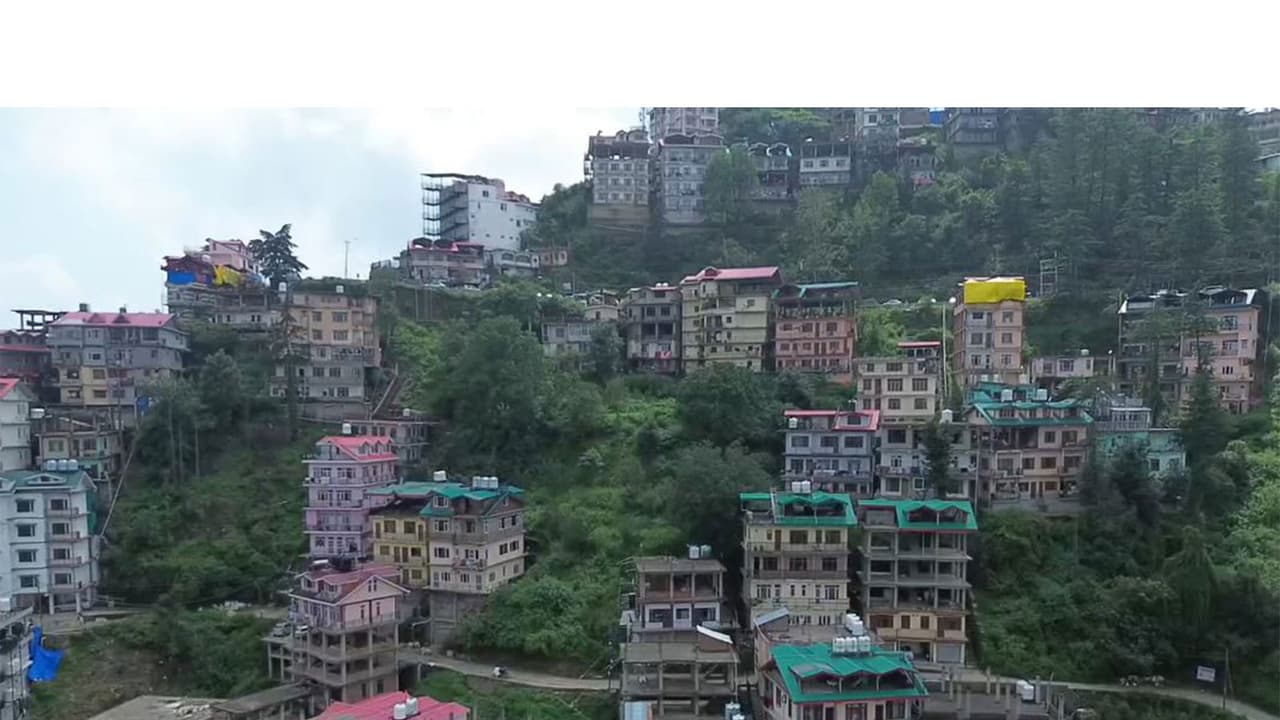
Residents of Shakrala village near Shimla are in fear after cracks appeared in houses and land. The district administration has sought a geological assessment from the GSI and other agencies to determine the cause and ensure safety.
Cracks appearing in houses and the surrounding terrain at Shakrala village near Himachal Pradesh's capital Shimla have triggered fear among residents, with the district administration seeking a detailed geological assessment even as environmental experts have called for a scientific evaluation of the area before attributing the issue to any particular cause.
Administration Seeks Geological Assessment
Shimla Deputy Commissioner of Shimla District administration, Anupam Kashyap said the administration had sought an assessment from the Geological Survey of India (GSI), besides approaching the State Disaster Management Authority and the Civil Engineering Department of Himachal Pradesh University for expert opinion. "Some cracks have been reported in houses, and they are also visible in the surrounding area. Officials of the district administration visited the spot and observed such cracks. Since any such development needs to be investigated on a wider scale, we have requested a team from the Geological Survey of India to visit the area," Kashyap said.
He said the administration was also examining the issue in coordination with the State Disaster Management Authority and other expert agencies. "We will open up the matter with all concerned departments according to their respective responsibilities and make every possible effort to ensure that the area does not suffer any damage. At the same time, my request to the people is that if there is any major development of this nature, they should immediately contact the DTM control room," he said.
Kashyap added that SDMs and tehsildars in the affected areas had been directed to remain vigilant and closely monitor the situation. "Our priority is to ensure that there is no loss of life or property. The situation is being monitored, and further action will be taken as soon as we receive recommendations from the expert agencies," he said.
The Deputy Commissioner said it would be premature to attribute the cracks to any particular activity, including ongoing infrastructure construction, until the expert assessment was completed. "There is no clear-cut reference establishing one particular cause. Sometimes there may be a geological reason, and sometimes there may be other contributing factors. The possibility of construction-related activity also cannot simply be ruled out. We will proceed according to the guidance and recommendations received from the agencies," Kashyap said.
He said geological conditions, groundwater-related factors and long-term deposition could potentially contribute to such developments, adding that similar instances involving cracks in roads and houses had been examined in the past.
Environmentalist Calls for Scientific Investigation
Former Shimla Deputy Mayor Tikender Singh Panwar, an environmentalist, told ANI that the situation warranted a comprehensive scientific investigation, particularly given the fragile geological character of the Himalayas. "I do not know the exact cause. The best people to establish that would be geomorphologists. Subsidence is quite common in this part of the Himalayas, and it can have several causes. What is important is that we scientifically identify the reason," Panwar said.
He cautioned against simplifying the issue by describing the affected area merely as debris on which a village had been built. "This is not as simple as saying that it is just debris and a village has come up on it. There could be shifts taking place. We have to understand the geological formation and the nature of the rocks in the area," he said.
Panwar said the impact of infrastructure activity, including four-lane construction and tunnelling, should also be scientifically examined rather than either blamed or ruled out without evidence. "In these mountains, there are shear rocks which can be very fragile. When you undertake excavation or use heavy machinery such as a JCB, you can disturb the movement of the rock mass. Whether this is connected to the four-lane project or something else needs to be scientifically identified," he said.
He said Shakrala was an old settlement and that any decision regarding displacement or rehabilitation should be based on a detailed scientific assessment.
Development vs Destruction in the Himalayas
Panwar said the Shakrala episode highlighted a wider concern over the manner in which development was being undertaken in the Himalayan region. "This is a challenging situation. While we are writing a story of development in the Himalayas, at the same time we are also writing a story of destruction. We have seen what happened in Sanjauli during tunnelling. We have seen the continuing instability around Chamiyana. These experiences should make us much more cautious," he said.
He said Himalayan development had to be planned around the region's watershed, hydrology and geology. "The story of development here cannot bypass the basic foundation of the Himalayas. That foundation is its watershed, hydrology and geology. Development has to be based on these three factors," Panwar said.
He also called for a dedicated commission or institutional mechanism to determine where and what kind of development should be permitted in the hills.
Panwar said the issue was not merely one of engineering solutions after construction had taken place, but of determining beforehand whether a particular site was suitable for construction. "Engineering comes later. The first question is whether something should be built there at all. That is the most important thing. Local knowledge is certainly important, but it is not enough. Geological and hydrological studies are equally necessary," he said.
He said areas with natural water sources or active drainage channels should be treated as highly vulnerable. "If water is flowing through an area or there are natural water sources, that place should not be disturbed. Such areas are inherently fragile," he said.
Referring to the past collapse of a temple structure in Shimla's Summer Hill area during heavy rains, Panwar said lessons from such incidents should not be ignored. "You cannot solve every Himalayan problem with steel and concrete. When a major flow of water comes, steel and other structures can also be washed away. The basic principle should be that if a place is not suitable for construction, then construction should not be allowed there," he said.
Subsidence a 'More Serious Concern'
Panwar also stressed the need to distinguish between subsidence and a conventional landslide. "Subsidence is a big issue. A lack of drainage may trigger a slide, but subsidence and sliding are two different things. If subsidence has started, it is a much more serious concern because it suggests that there could be geological activity beneath the ground or that some activity has triggered such a process," he said.
He said construction-related intervention could potentially act as a trigger, but only a proper scientific investigation could establish the connection.
Citing the example of Nathpa village in Kinnaur, Panwar said human activity had previously been linked to significant geological changes in the region. "Nathpa village has virtually disappeared because of geological activity that was triggered after the Nathpa-Jhakri project. Whether the activity at Shakrala has been triggered by the four-lane project or something else is something a good scientist can establish," he said.
Panwar suggested that a specialised scientific team should be given adequate time to conduct a detailed study of Shakrala.
Call for Hazard Mapping and Climate Preparedness
Panwar also called for comprehensive geological and hazard mapping of Shimla and other vulnerable Himalayan settlements. "There should be complete mapping. The State Disaster Management Authority has already given several recommendations, and those should be implemented. The government should scientifically identify which zones are vulnerable and which areas can sustain development," he said.
"Where development is scientifically possible, it can be permitted. Where it is not possible, construction should not be allowed. This decision should not be taken according to convenience but on the basis of science," he added.
He warned that climate change and increasing extreme weather events could further amplify risks in the Himalayan region. "The Himalayas are one of the world's hotspots, and Shimla is particularly vulnerable. Climate science is clearly telling us that extreme weather events are going to become more frequent. We have to prepare accordingly," Panwar said.
He also flagged blocked drains and unregulated parking along drainage channels in Shimla as additional risks that could worsen the impact of heavy rainfall. "If drains are blocked, they can become a serious threat. We are increasing our own vulnerability by blocking drainage channels with vehicles and other encroachments. This is happening in several parts of Shimla," he said.
Panwar said the Shakrala situation should therefore be viewed not as an isolated incident but as a warning about the need for a more scientific and ecologically sensitive approach to development in the Himalayan region. (ANI)
(Except for the headline, this story has not been edited by Asianet Newsable English staff and is published from a syndicated feed.)
