
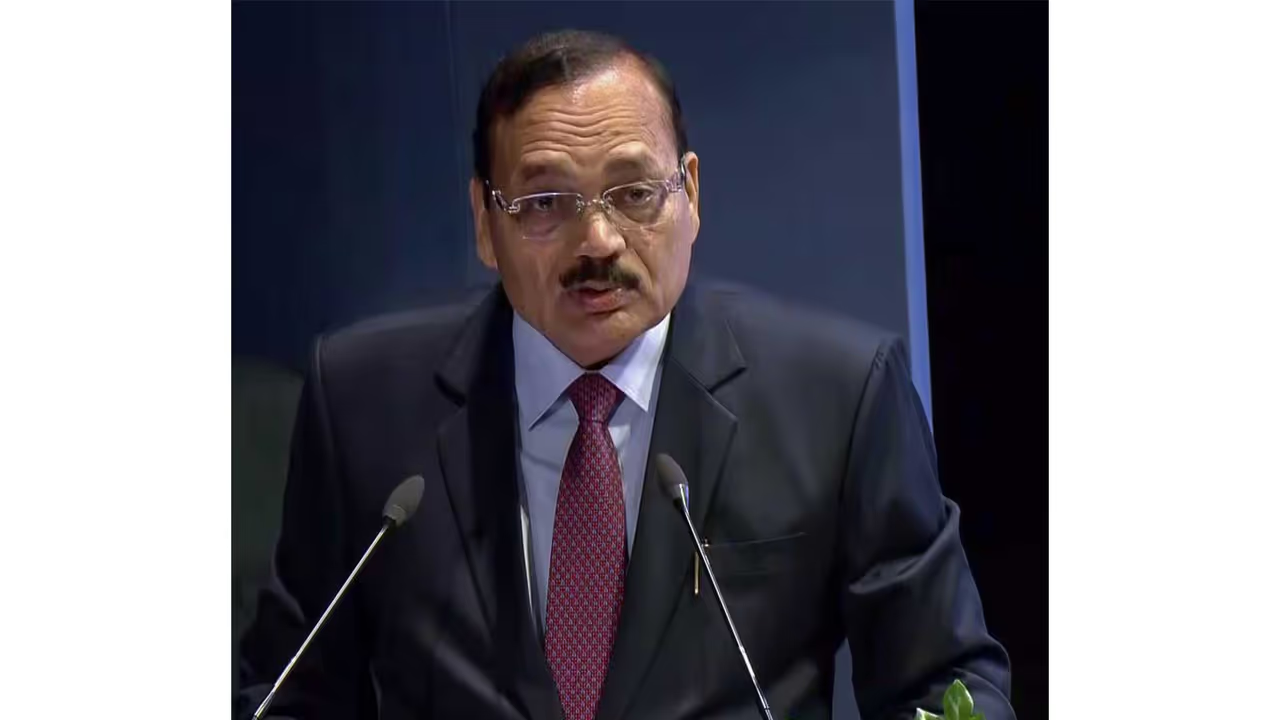
CJI Surya Kant advocated for specialised courts and time-bound trials to tackle case pendency. He noted that while a challenge, different cases need different timelines and urged litigants to approach High Courts before the Supreme Court.
CJI on Case Pendency and Time-Bound Trials
In an interview with DD News, CJI Surya Kant acknowledged that the backlog of cases from the Supreme Court to district and session courts remains a major challenge, despite improvements in the judicial system. "The pendency ... is certainly true. In this Bharatvarsh, the pendency of cases in the judiciary is a challenge for us. A lot of improvement has happened in it, but despite that improvement, the public expectation is completely right that the decision of every case should be in a definite time and quickly," the CJI said.
However, he cautioned against applying a uniform deadline to every category of case and said a committee has been constituted to determine appropriate timelines. "Every type of case cannot have the exact same time frame. But what this time limit should be, for that, we have constituted a committee. Whatever recommendations they make, based on that, we determine the time limit," Justice Surya Kant said.
Specialised Courts for Faster Disposal
The CJI highlighted the establishment of specialised courts as an important step towards faster disposal of cases, saying the judiciary, with government cooperation, had succeeded in establishing special courts within a year for trials involving several heinous crimes.
He also pointed to family courts for matrimonial and family disputes, commercial courts for commercial matters and specialised tribunals, saying the objective is to ensure cases are heard by courts with expertise in specific areas and decided within prescribed timelines. "Thus, specific tribunals have been created. Through these, our effort is that all cases - different types of cases - should be decided by different types of expert courts within a time limit," CJI Kant told DD News.
Judicial Appointments and Technology's Role
Justice Surya Kant acknowledged that the judiciary had not yet achieved complete success in reducing pendency, citing issues including judicial appointments and the need to increase the strength of judges in district courts. He also stressed that technology should support judges rather than replace judicial decision-making. "Our objective is that our officers should not start making decisions mechanically. Therefore, we have made use of technology, but technology should be used as an assistant to the judge rather than becoming the judge itself," he said.
'Go to High Court First': CJI Emphasises Constitutional Hierarchy
On petitions concerning specific states or regions being filed directly before the Supreme Court, the CJI emphasised the constitutional role of High Courts and urged litigants to approach the appropriate forum. He said matters with a nationwide impact could be dealt with by the Supreme Court, while cases concerning a particular state or region should ordinarily be taken first to the concerned High Court. "There are some lawsuits whose impact is felt across the entire Bharatvarsh, and they are not tied to any specific state or region. That is one category. The second category involves matters connected to a specific jurisdiction, a specific state, or a specific region. When petitions for those kinds of matters are filed directly in the Supreme Court, I have raised this point: why don't you go to the High Court first?" the CJI said.
Constitutional Powers of High Courts and Supreme Court
Justice Kant highlighted the importance of High Courts, stating, "In India's Constitution, the High Court plays a very significant role. Article 32 gives the Supreme Court its responsibilities as a constitutional court, and Article 226 gives High Courts their constitutional responsibilities." "If you analyse the provisions of both constitutions, I have no hesitation in saying that the power of High Courts under Article 226 is wider than the power of the Supreme Court under Article 32," he said.
He said the constitutional framework was designed to ensure access to justice closer to citizens, with a High Court in every state. "Our constitution-makers wrote that there will be a High Court in every state. Look at their vision, look at their perspective for the future. When we talk about "access to justice" - that justice comes to your doorstep - they brought that role of justice at your doorstep through the Constitution itself. They said there will be a High Court in every state. That means if your constitutional, legal, civil, or human rights - any kind of rights - are violated, you should go to the High Court of your own state, and they have been given all those powers," the CJI said, adding that, "So, when a system already exists in the state to fully protect an individual's rights, why should that lawsuit be brought to the Supreme Court?"
"To strengthen the judicial system, it is extremely essential that a case meant to be filed in district courts goes to the district court, a case meant for the High Court goes to the High Court, and a case specifically meant for the Supreme Court comes to the Supreme Court," the CJI said.
"This is the constitutional framework we have built, and we must respect it," he added. (ANI)
(Except for the headline, this story has not been edited by Asianet Newsable English staff and is published from a syndicated feed.)