
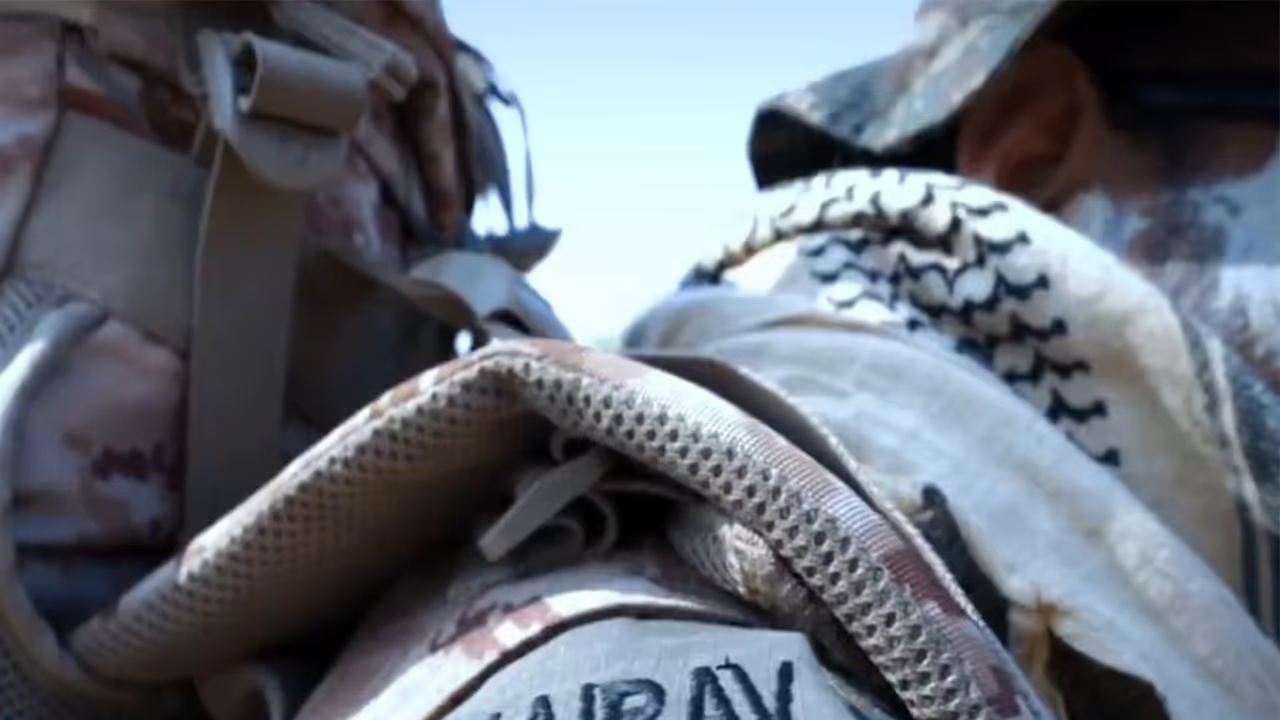
The Indian Army Day parade will be held in Jaipur, the first time outside a cantonment. The event will mark the public debut of the new Bhairav Battalion and will showcase a wide range of advanced weaponry, vehicles, drones, and defence systems.
The Indian Army Day parade to be held in Jaipur on Thursday will be the first time when the force will hold it outside the cantonment area. The event will take place in the city at Mahal Road, Jagatpura, and will be showcasing a wide range of weapons, vehicles, drones and defence systems. The parade will also mark the first public appearance of the Bhairav Battalion.
Bhairav Battalion Makes Public Debut
The unit has been raised as part of the Army's recent restructuring, drawing operational lessons from global conflicts, including its own Operation Sindoor. The Bhairav Battalion is positioned between the Para Special Forces and regular infantry units. The battalion was raised to meet modern warfare requirements to provide a quick and precise offensive solution against enemies' threats to the nation. This allows them to respond quickly across different terrains, including difficult and hostile areas.
Earlier, speaking to ANI, a commanding officer of 2 Bhairav Battalion said, "Modern warfare is changing at a very rapid pace. The conflicts of today are hybrid in nature, and one needs to be fully equipped with modern technology to be able to deal with the challenges... The Bhairav battalions have also been created as part of the force restructuring, which has been raised in line with the requirements of modern technology, new thought processes and the new operational requirements."
Artillery and Rocket Systems on Display
The parade will also display the army's artillery and rocket capabilities, with several missile and launcher systems on show. These include the BrahMos cruise missile, which can strike targets up to 800 kilometres away from land, sea or underwater platforms, according to the Army.
The Pinaka multi-barrel rocket launcher will also feature. It was recently tested with long-range guided rockets that have a range of up to 120 kilometres. Other systems on display will include the upgraded BM-21 Grad multi-barrel rocket launcher and the SMERCH system, which can fire 12 rockets of 300 mm calibre to ranges of up to 90 kilometres.
Artillery platforms such as the Advanced Towed Artillery Gun System and the M777 ultra-light howitzer will also be part of the display. Other gun systems too will be featured during the parade.
Air Defence and Launcher Systems
Air defence capabilities on showcase will include the indigenous Akashteer system with its medium-range surface-to-air missiles (SAM), which proved their effectiveness in a high-threat environment during Operation Sindoor by shooting down a variety of Turkish and Chinese-origin drone systems operated by Pakistan and have since drawn global interest as combat-proven platforms. The Igla man-portable air defence system will also be a part of the display.
The Universal Rocket Launcher System (URLS), also known as Suryastra, derived from the Israeli PULS, will also make an appearance during the parade.
Showcasing Manned-Unmanned Teaming and Drones
The army parade this year will also display how the army is integrating manned and unmanned systems on the battlefield. Soldiers will be seen alongside unmanned ground vehicles (UGVs) and drones for roles such as reconnaissance, precision strikes and logistics support. The now prevalent concept of manned-unmanned teaming (MUM-T) shows how the use of unmanned platforms can increase operational effectiveness while reducing risk to troops.
Kamikaze Drones and Loitering Munitions
Several kamikaze drones will also be displayed, including Mini Harpy, Harop, Peacekeeper, and Sky Striker. The Trinetra loitering munition system will also be on display. Based on lessons learnt from Operation Sindoor, the Indian Army has set plans to procure 850 kamikaze drones. These drones will be used by all three armed forces and the special forces. The Bhairav units are expected to make extensive use of these systems, as the battalion is specifically trained for drone-enabled and multi-domain operations. All operatives are trained to handle drones and use them in real combat situations, including targeting enemy bases and formations inside hostile territory. The Army has created a pool of over one lakh personnel with such drone-operating capabilities.
For the first time, the Army will also showcase its new solar-powered MAPSS unmanned aerial vehicle system. A medium-altitude drone will also be on display.
Unmanned Ground Vehicles (UGVs)
The robotic mules, also known as robo dogs, which have drawn attention in previous parades, will return this year as well. The recently introduced Sapper Scout unmanned ground vehicle, AEGMA ES 500, Airawat 1000 and other UGVs used for logistical support will also be featured.
Advanced Electronic Warfare Capabilities
Advanced electronic warfare and communication systems will also be featured. These include satellite communication vehicles, integrated drone identification systems, vehicle-mounted drone jammers, jammer stations known as Samyukta, the HimShakti electronic warfare system and Trishul tactical drone jammers. These systems in use by the Army strengthen counter-drone capability and improve situational awareness.
Specialised Vehicles and Armoured Platforms
An array of specialised vehicles will operate alongside soldiers during the parade. These include the new Electric All-Terrain Vehicle VEER and Advanced Light Strike Vehicles fitted with Milan anti-tank guided missiles. Other anti-tank mobile team vehicles will also be displayed to demonstrate the army's progress in tactical mobility.
Other equipment on display will include 81 mm mortars, modular bridge systems, the Sherp all-terrain vehicle, the Kalyani M4 armoured vehicle, also known as Nandighosh, Quick Reaction Fighting Vehicles and the T-90 Bhishma main battle tank, among others.
Army's Aviation Might on Display
Apache and Prachand Helicopters
This year, the Army will also feature its latest Apache attack helicopters, among other rotary-wing aircraft. The final batch of three Apache helicopters arrived in December, completing the delivery of all six. These helicopters have been inducted into the Army's 451 Army Aviation Squadron, which is based in Jodhpur.
The Apache is among the Army's latest additions and plays a key role in specialised missions, including anti-armour operations. It is equipped with a wide range of weapon systems. One of its key features is the Longbow fire control radar, which provides 360-degree coverage. The helicopter also has a nose-mounted sensor suite that supports target acquisition and night-vision operations. The Indian Army operates the latest variant of the Apache attack helicopter.
The homegrown Light Combat Helicopter (LCH) Prachand will also tag team with it. The Indian Army is set to receive 90 of these indigenous attack helicopters.
Significance of Army Day
Every year, January 15 is commemorated as 'Army Day' to remember the occasion when General (later Field Marshal) KM Cariappa took over the command of the Indian Army from General FRR Bucher, the last British Commander-in-Chief, in 1949 and became the first Indian Commander-in-Chief of Independent India. (ANI)
(Except for the headline, this story has not been edited by Asianet Newsable English staff and is published from a syndicated feed.)