
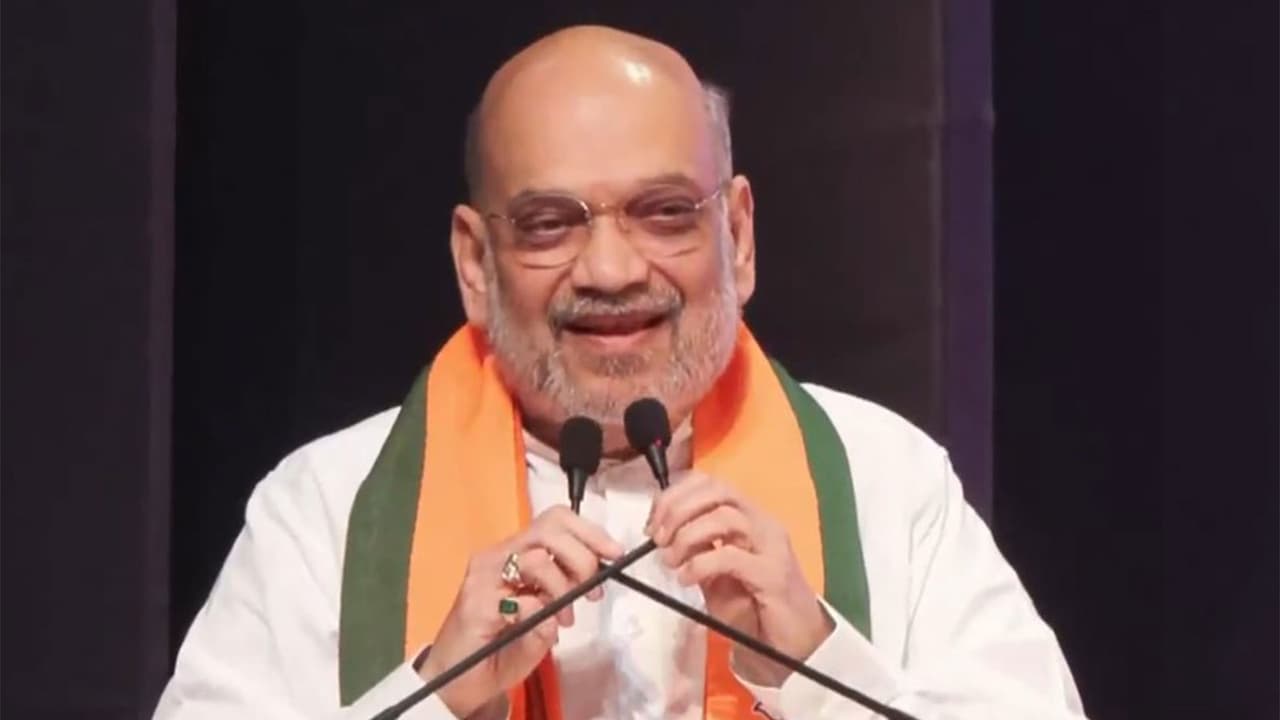
Union Home Minister Amit Shah embarks on a two-day visit to Chhattisgarh from May 18, his first since the 'Naxal-free' declaration. The trip will focus on security outreach in Bastar and high-level inter-state policy deliberations.
Union Home Minister and Minister of Cooperation Amit Shah is set to embark on a significant two-day visit to Chhattisgarh beginning from Monday, marking his first visit to the state after the Centre's announcement of achieving the goal of a "Naxal-free India" on March 31 this year.

Officials said the visit on May 18-19 will combine security-focused outreach in Bastar with high-level inter-state policy deliberations.
Security and Community Outreach on Day One
On the first day of his visit, on May 18, Shah will begin his engagements in Raipur by flagging off new vehicles under the Emergency Response Support System (Dial 112) at the Parade Ground of the Police Training School. The initiative is aimed at strengthening emergency response capabilities and improving public safety infrastructure in the state.
Later in the day, the Home Minister will travel to Bastar, one of the regions historically affected by Left Wing Extremism (LWE), where he will inaugurate a 'Jan Suvidha Kendra' at Bastar's Netanar region. The centre is expected to enhance the last-mile delivery of essential public services and governance benefits to local residents.
Shah will pay tributes to martyrs at Amar Vatika in Jagdalpur later in the day, acknowledging the sacrifices made by security personnel and civilians in combating Naxal violence.
Following this, the Home Minister will participate in an interaction session at Badal Academy in Jagdalpur, where he will meet families of martyrs, personnel from Central Armed Police Forces (CAPFs), state special forces, police officials, Naxal-affected victims, and representatives of various community groups. The outreach programme is seen as part of the Centre's continued effort to consolidate peace and development gains in areas once affected by insurgency.
In the evening, Shah will attend the 'Bastar Ke Sang' folk cultural programme, showcasing the rich tribal traditions and cultural vibrancy of the region.
Central Zonal Council Meeting on Day Two
On May 19, the Home Minister's itinerary will turn toward governance as he presides over the 26th Central Zonal Council meeting in Chhattisgarh. The council, which includes Chhattisgarh, Madhya Pradesh, Uttarakhand, and Uttar Pradesh, serves as an important platform for enhancing coordination and cooperation among states.
The Central Zonal Council meeting is expected to deliberate on over a dozen key issues, including strengthening inter-state coordination, expediting investigations into crimes against women and children, improving rural banking connectivity, and enhancing the implementation of welfare schemes. Chief Ministers of the member states, along with two senior ministers from each state, will attend the meeting. Senior officials, including Chief Secretaries and representatives from the Central government, are also expected to participate.
The meeting is being organised by the Inter-State Council Secretariat under the Ministry of Home Affairs, in collaboration with the Chhattisgarh government. Zonal Councils were constituted under the States Reorganisation Act, 1956, to provide a structured platform for dialogue and cooperation among states and between the Centre and states.
The Union Home Minister serves as the chairperson of these councils, while Chief Ministers and other senior representatives form part of the membership. Prime Minister Narendra Modi has consistently emphasised the importance of cooperative and competitive federalism for achieving holistic national development. In this context, Zonal Councils serve as an important mechanism for addressing shared challenges and promoting coordinated policy action.
The previous, 25th meeting of the Central Zonal Council was held on June 24, 2025, in Varanasi. Over the past eleven years, dozens of such meetings have been held, reinforcing the Centre's focus on collaborative governance.
Shah's visit to Chhattisgarh, following the declaration of a Naxal-free India, highlights the government's shift in focus from security operations to long-term development, dialogue, and stronger institutional coordination in erstwhile affected regions. (ANI)
(Except for the headline, this story has not been edited by Asianet Newsable English staff and is published from a syndicated feed.)