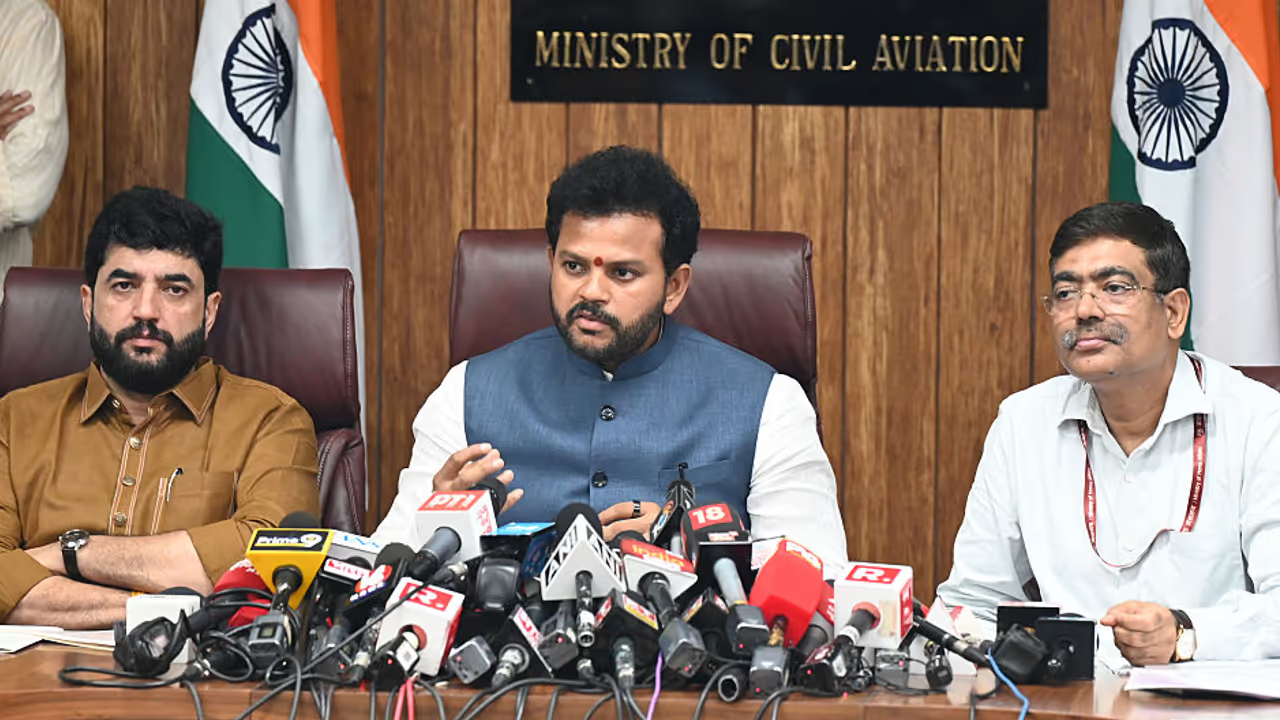
“India has some of the best pilots and crew in the world,” Ram Mohan Naidu said, adding that their welfare remains a priority for the government. The comment comes after AAIB published a preliminary report on the Air India crash.
New Delhi: Following the Aircraft Accident Investigation Bureau (AAIB)'s report in to the Ahmedabad Air India plane crash, Union Civil Aviation Minister Kinjarapu Ram Mohan Naidu spoke in favour of the pilots on Saturday, July 12. Speaking to reporters , he said that no conclusions should be drawn from the preliminary report and wait for the final report.
“India has some of the best pilots and crew in the world,” he said, adding that their welfare remains a priority for the government. He called for patience until the final investigation report is released, noting that the pilots and crew form the backbone of the civil aviation sector. Ram Mohan Naidu also said that it was premature to comment on the report, and ”something concrete" had to come.
Meanwhile, Minister of State for Civil Aviation Murlidhar Mohol also called for restraint and said that the AAIB preliminary report was not the final report. "Until the final report comes out, we should not arrive at any conclusion. AAIB is an autonomous authority, and the ministry does not interfere in their work," he added.
Related Articles

Engine fuel cutoff may have caused crash
On Friday, India's Aircraft Accident Investigation Bureau (AAIB) released the preliminary report into the tragic crash of Air India flight AI171, a Boeing 787-8 aircraft, which crashed shortly after takeoff from Ahmedabad's Sardar Vallabhbhai Patel International Airport on June 12. BJP MP Rajiv Pratap Rudy also said that further investigation into the crash will reveal more about the incident.
"The AAIB report states that the aircraft took flight normally, meaning it was capable of getting airborne. The jet fuel switch was in its required position. Later, the pilots reported engine power decreasing. Further probing will bring out why the engines had 'flamed out.' Captain Sabharwal and his co-pilot, using their years of experience, tried to relight the engines... How and why this happened will be known through further investigation," he said.
The crash killed 260 people, including 229 passengers, 12 crew members, and 19 people on the ground. The report outlines a harrowing sequence of events that unfolded within 90 seconds of takeoff, as both engines of the aircraft shut down unexpectedly during the initial climb, leading to a catastrophic loss of thrust and rapid descent.
Flight data recovered from the aircraft's Enhanced Airborne Flight Recorder (EAFR) revealed that the fuel cutoff switches for both engines were inadvertently moved from RUN to CUTOFF, one after the other within a 1-second interval, at an altitude just moments after liftoff. One pilot was heard asking the other, "Why did you cut off?" to which the response was, “I did not.” This uncommanded shutdown triggered the deployment of the Ram Air Turbine (RAT), and the aircraft began losing altitude almost immediately, unable to sustain powered flight.
According to the AAIB, the pilots re-engaged the fuel switches in an attempt to relight both engines. Engine 1 showed signs of recovering thrust, but Engine 2 failed to stabilise. The aircraft, which had briefly reached a speed of 180 knots, was already descending and failed to regain altitude. The final distress call -- a "MAYDAY" -- was transmitted at 08:09 UTC, just seconds before the aircraft crashed into residential buildings outside the airport perimeter.
The aircraft struck several buildings, including the BJ Medical College hostel, causing significant structural and fire damage across five structures. The Emergency Locator Transmitter (ELT) did not activate, and emergency services were mobilised within five minutes of the crash.
(With inputs from ANI)