
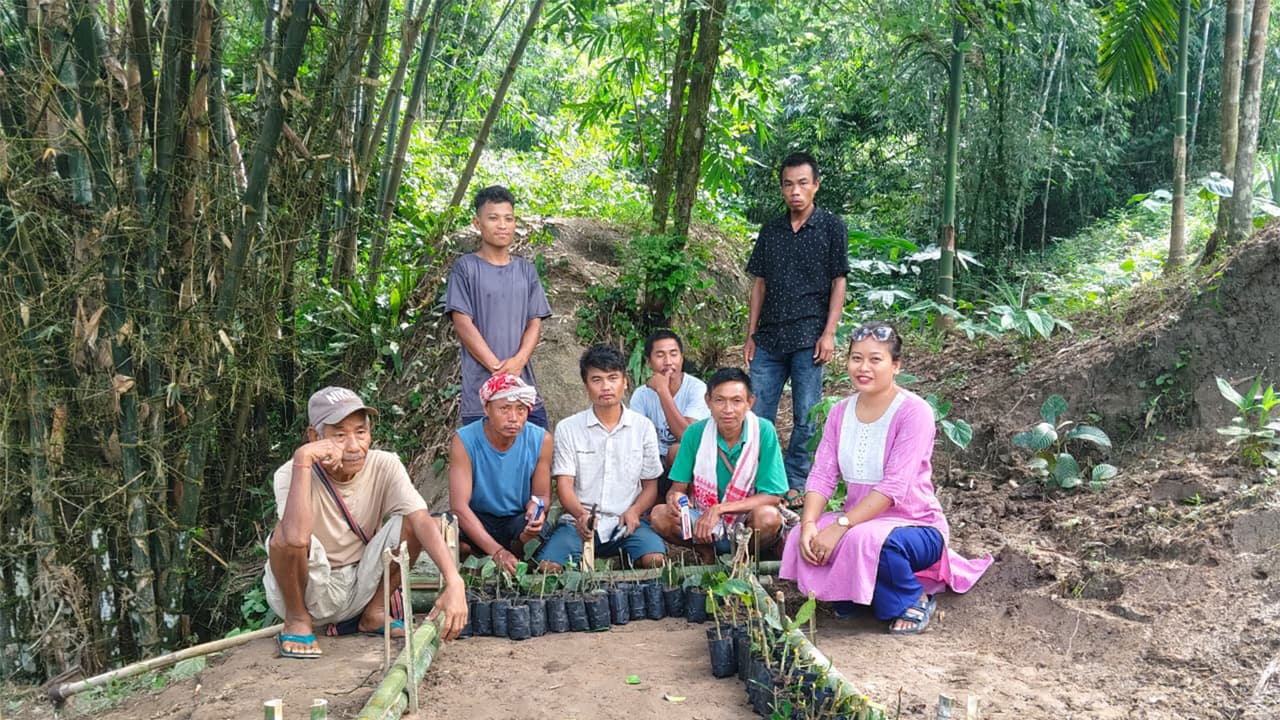
Aaranyak organised a one-day training for six marginalised farmers in Assam's Kohora River Basin, focusing on Assam lemon and black pepper cutting propagation and backyard nursery management to provide a low-investment supplementary income source.
Six marginalised farmers from the Kohora River Basin received hands-on training in Assam lemon and black pepper cutting propagation and backyard nursery management, opening up a low-investment pathway towards supplementary household income and sustainable livelihoods. Organised recently by the conservation organisation Aaranyak at Englepathar village, the one-day training focused on practical skills that farmers can apply directly at home to produce quality planting materials and develop small-scale nursery enterprises.
Progressive farmer Phumen Terang served as the resource person, demonstrating the selection of suitable mature shoots and runners, preparation of soil mixtures, filling of polybags, preparation and planting of cuttings and subsequent nursery care and maintenance.
A Pathway to Sustainable Livelihoods
For communities that largely depend on subsistence farming, seasonal agricultural work and daily-wage employment, backyard nurseries can provide an additional livelihood option requiring relatively low investment and space. By building on crops already familiar to local households, the training seeks to turn existing agricultural knowledge into a practical entrepreneurial opportunity.
Farmers' Perspective
Dorsing Engti of Englepathar village said, “Earlier, we mostly propagated plants from seeds and had limited knowledge of using cuttings. Through this training, I learned how to prepare and plant Assam lemon and black pepper through cutting techniques and manage a nursery. I hope to apply these techniques at home and sell the saplings to PIRBI, creating an additional source of income for my family.”
Market Linkages and Future Opportunities
The training also introduced participants to potential market linkages with PIRBI, a community-based business initiative in the Kaziranga–Karbi Anglong Landscape. Aaranyak’s Larbeen Teronpi discussed opportunities around homestead cultivation, backyard nursery enterprises, value addition and market demand, encouraging farmers to begin small and gradually develop their nursery activities. She also highlighted PIRBI’s Community Food Processing Centres in the Diring River and Kohora River Basin regions, which support communities in processing and adding value to locally produced turmeric, ginger, tapioca, black pepper, moringa and other products. (ANI)
(Except for the headline, this story has not been edited by Asianetnews Editorial staff and is published from a syndicated feed.)