Pluto Was Once the 9th Planet. Why Did Scientists Change That?
Pluto was once the ninth planet of our Solar System, but on August 24, 2006, that changed. The International Astronomical Union reclassified Pluto as a dwarf planet after introducing a new definition of what qualifies as a planet
Why Was Pluto Removed From the Planet List?
For 76 years, Pluto was officially recognised as the ninth planet. Discovered in 1930 by American astronomer Clyde Tombaugh, the distant world quickly became one of the most familiar objects in astronomy.
But as telescopes improved and astronomers discovered more objects in the distant regions of the Solar System, Pluto's status became increasingly complicated.
The debate eventually forced scientists to answer a seemingly simple question: What exactly is a planet?
The answer lies in the definition adopted by the International Astronomical Union (IAU) in 2006.
According to the new definition, a full-fledged planet must meet three conditions. It must orbit the Sun, have enough mass for its gravity to make it nearly round, and have cleared the neighbourhood around its orbit.
Pluto satisfies the first two conditions.
It orbits the Sun and is massive enough to have become nearly spherical under its own gravity.
However, it does not satisfy the third condition.
Pluto exists in the Kuiper Belt, a distant region beyond Neptune filled with icy bodies and other remnants from the early Solar System. Unlike the eight recognised planets, Pluto does not gravitationally dominate the region around its orbit.
That became the key reason for its reclassification.


Pluto Did Not Actually Change
One of the biggest misconceptions surrounding Pluto's "demotion" is that something physically happened to the dwarf planet. It didn't.
Pluto did not become smaller. Its orbit did not suddenly change. Scientists did not discover that Pluto was somehow fake.
Instead, astronomers changed the classification system used to define planets.
The decision was largely driven by discoveries being made in the outer Solar System. As more Pluto-like objects were identified, astronomers faced a major problem.
If Pluto remained a planet, should similar objects also receive planetary status?
The discovery of Eris, an object comparable in size to Pluto, intensified the debate. Astronomers had to decide whether the Solar System should potentially have dozens of planets or whether a clearer definition was needed.
The IAU ultimately voted for the latter approach.
Why Pluto Is Different From Earth
Pluto and Earth may both be round worlds orbiting the Sun, but their environments and sizes are dramatically different.
Pluto has a diameter of about 2,377 kilometres, making it roughly one-fifth the width of Earth.
It is also incredibly far from the Sun. Pluto's average distance from the Sun is around 5.9 billion kilometres, or approximately 39 times Earth's average distance from the Sun.
That enormous distance contributes to its extreme conditions.
Pluto's orbit is also highly elliptical and tilted compared with the nearly circular orbits of the major planets.
And then there is Pluto's extraordinary year.
A Year on Pluto Lasts 248 Earth Years
Pluto takes approximately 248 Earth years to complete one orbit around the Sun.
That means Pluto has not even completed one full orbit since its discovery in 1930.
Its distance from the Sun varies considerably during its journey. Pluto can travel as close as roughly 30 astronomical units from the Sun and as far away as about 49 astronomical units.
An astronomical unit is the average distance between Earth and the Sun.
Pluto's unusual orbit is one of the reasons the dwarf planet has remained such a fascinating object for astronomers.
Pluto Is Part of the Kuiper Belt
Another major clue to Pluto's classification is its location.
Pluto lies in the Kuiper Belt, a vast region beyond Neptune containing countless icy objects left over from the formation of the Solar System.
This makes Pluto different from the eight planets, which are considered the dominant bodies in their respective orbital regions.
Pluto's neighbourhood is crowded with other objects, meaning it does not gravitationally dominate its orbit in the way Earth, Jupiter or Neptune does theirs.
This distinction is central to understanding why Pluto is classified as a dwarf planet.
The Pluto Debate Did Not End in 2006
The IAU's decision settled the official classification, but the scientific debate did not completely disappear.
Some planetary scientists have challenged the IAU's definition, arguing that planetary classification should focus more on the physical characteristics of a world than on whether it has cleared its orbital neighbourhood.
NASA's New Horizons mission also transformed the way scientists view Pluto.
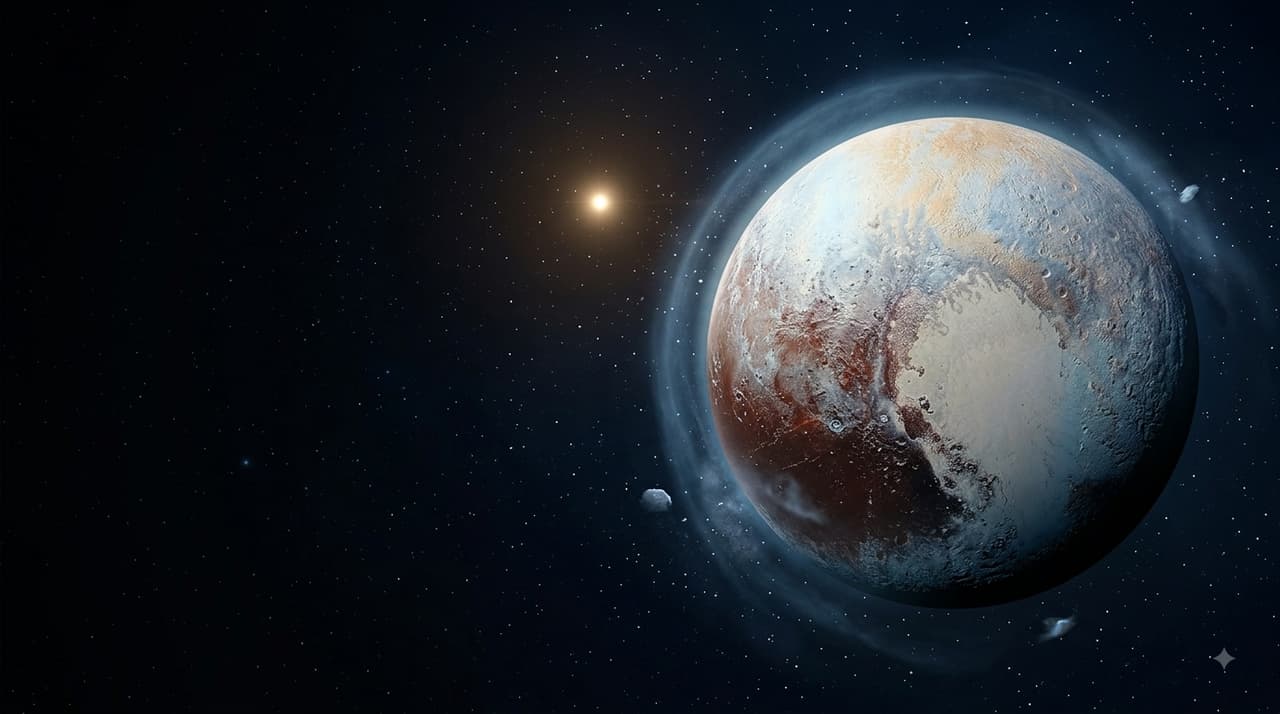
When New Horizons flew past Pluto in July 2015, it revealed a surprisingly complex world with mountains, plains, valleys and glaciers. The spacecraft also photographed Pluto's famous heart-shaped region, making the distant world more recognisable than ever.
Pluto Has Five Known Moons
Pluto is not travelling through space alone.
The dwarf planet has five known moons: Charon, Nix, Hydra, Kerberos and Styx.
Its largest moon, Charon, is particularly unusual because it is enormous compared with Pluto itself. The two bodies orbit a common centre of gravity located outside Pluto, making the Pluto-Charon system quite different from the typical planet-moon systems found elsewhere in the Solar System.
So, Is Pluto Still a Planet?
Officially, no.
Under the International Astronomical Union's 2006 definition, Pluto is classified as a dwarf planet rather than one of the Solar System's eight planets.
But calling Pluto a "demoted planet" can be misleading.
Pluto remains a fascinating planetary world. Its reclassification did not make it less important or less scientifically interesting. Instead, it became part of a broader category of dwarf planets that helps astronomers distinguish between the dominant planets and smaller worlds in the Solar System.
Why Pluto's Demotion Still Matters
Pluto's story is ultimately about more than one distant icy world.
Its reclassification demonstrated how scientific definitions can change as new discoveries challenge old assumptions.
For generations, people learned that the Solar System had nine planets. Today, students learn that there are eight.
But Pluto itself has not changed.
What changed was our understanding of what it means to be a planet.
And that may be the most interesting part of Pluto Demoted Day: the world that lost its planetary title in 2006 continues to be one of the most intriguing places ever explored beyond Neptune.
Explore the latest Lifestyle News covering fashion, wellness, travel, Food and Recipes, and more. Stay updated with trending Health News, fitness tips, and expert insights to inspire your daily living. Discover personalized lifestyle trends that keep you stylish and informed. Download the Asianet News Official App from the Android Play Store and iPhone App Store for everything that adds value to your everyday life.