- Home
- India
- Delhi Weather LATEST Update: IMD Issues Orange Alert as Fog, Cold Wave and Poor Air Quality Grip Capital
Delhi Weather LATEST Update: IMD Issues Orange Alert as Fog, Cold Wave and Poor Air Quality Grip Capital
Delhi Weather LATEST Update: Delhi continues to reel under winter chill as IMD forecasts falling temperatures, dense fog and cold wave conditions over the next few days. An Orange alert is in place, while poor air quality adds to commuters’ concerns
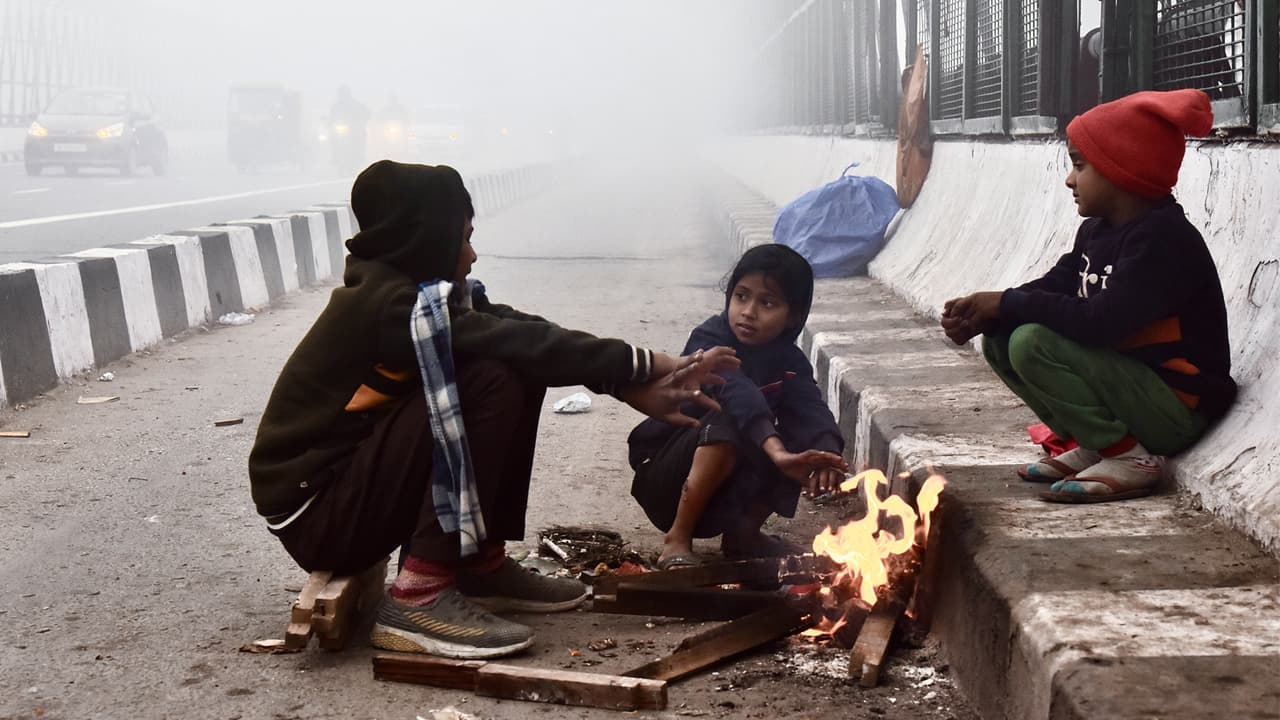
Falling Temperatures, Fog and Weather Alerts in Delhi
Delhi experienced a mild winter day on January 1, with temperatures staying slightly below normal, even as fog continued to affect visibility in several parts of the city. The India Meteorological Department (IMD) has forecast a drop of around 2 to 4 degrees Celsius over the next three days, with minimum temperatures likely to remain below normal before gradually returning closer to average levels.
The sky is expected to remain partly cloudy to cloudy on January 2, with moderate fog at many places and dense to very dense fog at a few locations during morning hours. Similar fog conditions are likely on January 3, followed by shallow to moderate fog on subsequent days. An Orange alert has been issued for January 2, while a Yellow alert is in place for January 3.
For the coming week, IMD has predicted mainly clear skies, though morning fog is expected to persist. Day temperatures are likely to range between 16 and 20 degrees Celsius, while night temperatures could dip to 6 to 9 degrees Celsius by early next week. Commuters have been advised to exercise caution during early morning travel due to poor visibility, especially on highways and open roads.
IMD has also warned of cold wave conditions at isolated places in Delhi between January 2 and January 5. As per IMD norms, a cold wave is declared when minimum temperatures fall 4.5 to 6.5 degrees Celsius below the normal average. Similar cold wave conditions have been forecast across Rajasthan, Punjab and Haryana during this period.


Visibility Drops, Drizzle and Temperature Readings Across Delhi-NCR
Several parts of Delhi and the National Capital Region witnessed moderate to dense fog, with visibility dropping to as low as 500 metres at Safdarjung and Palam. Visibility at Safdarjung remained at 500 metres from 10.30 pm on December 31 till 8.30 am on January 1, improving slightly to 600 metres by 9 am. Palam recorded similar conditions, with visibility remaining at 500 metres till 8 am.
Very light rain or drizzle was reported at isolated locations, while calm winds and high humidity levels contributed to prolonged foggy conditions. Relative humidity stood at 97 per cent in the morning and 87 per cent in the evening.
At Safdarjung, Delhi’s base weather station, the maximum temperature settled at 17.3 degrees Celsius, about 2 degrees below normal, while the minimum was recorded at 10.6 degrees Celsius, which remained above the seasonal average. Across Delhi-NCR, maximum temperatures ranged between 14.8 degrees Celsius and 17.3 degrees Celsius, remaining below normal at most stations.
Safdarjung recorded a maximum of 17.3 degrees Celsius, Palam 15.9 degrees Celsius, Lodhi Road 15.8 degrees Celsius, Ridge 16.6 degrees Celsius, while Ayanagar logged the lowest maximum temperature at 14.8 degrees Celsius. Minimum temperatures ranged between 9 and 10.6 degrees Celsius, with Palam recording 9 degrees Celsius and Ayanagar 10.3 degrees Celsius.
IMD scientist Naresh Kumar explained that an active western disturbance over north Pakistan triggered light to moderate rain and snowfall over the western Himalayan region, with very light rainfall also occurring over the NCR. Low temperatures, light winds and high moisture levels have allowed fog to persist and cold conditions to linger.
Delhi also recorded its coldest December day in six years on December 31, with the maximum temperature plunging to 14.2 degrees Celsius, about 6.2 degrees below normal. The last colder day was recorded on December 31, 2019, when the maximum temperature dropped to 9.4 degrees Celsius.
Very Poor Air Quality Persists Amid Unfavourable Weather Conditions
Alongside the cold and fog, Delhi’s air quality remained a major concern. The city’s 24-hour average Air Quality Index (AQI) stood at 380, placing it firmly in the ‘very poor’ category, according to data from the Central Pollution Control Board (CPCB).
The CPCB’s SAMEER app showed that 26 monitoring stations were in the ‘very poor’ category, while 11 stations fell under the ‘severe’ category. Anand Vihar recorded the worst air quality, with an AQI of 423.
Officials attributed the poor air quality to an unfavourable ventilation index below 6,000 square metres per second, along with low wind speeds that prevented the dispersion of pollutants. Data from the Decision Support System indicated that transport contributed about 11 per cent to pollution levels, followed by industries and construction at 1.3 per cent, residential sources at 2.9 per cent and road dust at 0.7 per cent.
Among NCR districts, Bulandshahr emerged as a major contributor at 9.8 per cent, followed by Gautam Buddha Nagar at 6.6 per cent and Faridabad at 4.1 per cent. The Air Quality Early Warning System has forecast that air quality is likely to remain in the ‘very poor’ category till January 4, with similar conditions expected over the following six days.
As per CPCB classification, an AQI between 0 and 50 is considered ‘good’, 51 to 100 ‘satisfactory’, 101 to 200 ‘moderate’, 201 to 300 ‘poor’, 301 to 400 ‘very poor’ and 401 to 500 ‘severe’.
Stay updated with the Breaking News Today and Latest News from across India and around the world. Get real-time updates, in-depth analysis, and comprehensive coverage of India News, World News, Indian Defence News, Kerala News, and Karnataka News. From politics to current affairs, follow every major story as it unfolds. Get real-time updates from IMD on major cities weather forecasts, including Rain alerts, Cyclone warnings, and temperature trends. Download the Asianet News Official App from the Android Play Store and iPhone App Store for accurate and timely news updates anytime, anywhere.