
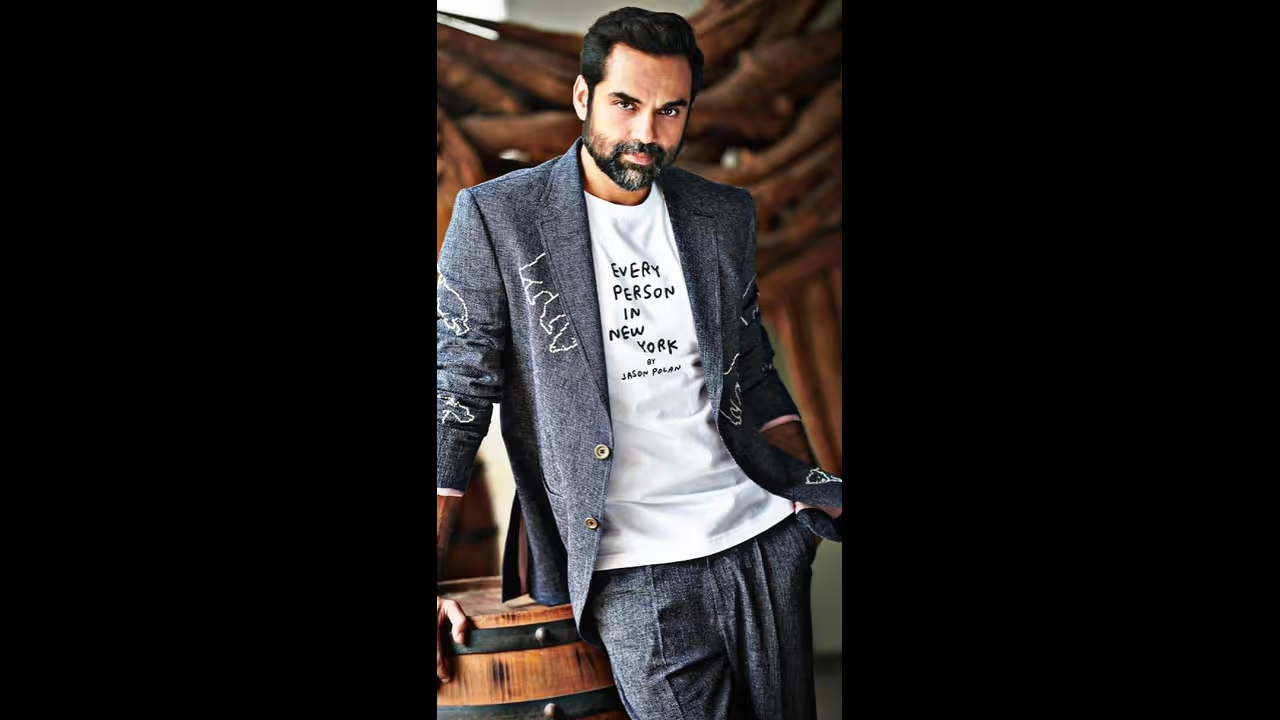
Abhay Deol chose integrity over formula long before Bollywood was ready. This feature explores how his unconventional roles, outspoken views and refusal to conform made his career feel misunderstood but ultimately ahead of its time.
Abhay Deol never chased the version of stardom Bollywood was ready to give him. And that, perhaps more than anything else, explains why his career has always felt slightly out of sync with the industry’s expectations.
Born into one of Hindi cinema’s most recognisable families, Abhay Deol had every reason to follow the safest possible path. The Deol surname came with a built in audience, a template for masculinity, and a well tested route to mainstream success. Instead, he consistently chose roles that resisted easy categorisation, often at the cost of box office momentum and conventional fame.
When Abhay Deol made his debut with Socha Na Tha, the film itself signalled his instincts. It was a romantic story, but not one designed around swagger or spectacle. His performance was understated, conversational, almost deliberately unheroic for a debutant from a star family. In an era dominated by loud romantic leads and formula driven launches, this quiet introduction already set him apart.
What followed only reinforced that pattern. Films like Ahista Ahista, Honeymoon Travels Pvt Ltd and Oye Lucky Lucky Oye showed an actor interested in character over image. He played men who were uncertain, morally ambiguous, emotionally awkward or outright flawed. These were not roles designed to generate whistles. They were roles that asked audiences to sit with discomfort.
At the time, this made Abhay Deol difficult to place. Bollywood had not yet built an ecosystem that rewarded such choices. Independent cinema existed, but it did not have the visibility, distribution or cultural cachet it would later acquire through streaming platforms. Actors were still expected to choose between mass appeal and critical respect, with little room for overlap.
Abhay repeatedly chose the latter.
His decision to work in films like Dev D was particularly telling. The film dismantled traditional ideas of romance, masculinity and redemption, and Abhay’s performance reflected that disruption. He played a deeply flawed protagonist without attempting to soften him for sympathy. The film eventually became a cult classic, but at the time, it was a risky move for a leading man still establishing himself.
That risk taking extended beyond content into public stance. Abhay Deol was one of the few actors of his generation who openly spoke about body image, fairness standards and the superficiality of the industry. His refusal to conform to expected grooming norms and his criticism of film award politics made him an outlier. In an industry that rewards compliance, his candour was not easily forgiven.
It is important to recognise the timing here. Conversations about representation, colourism and creative autonomy were not mainstream when Abhay raised them. Today, these topics dominate panels, interviews and social media discourse. Back then, they marked him as difficult.
Even his shift toward international and independent projects followed this logic. Films like Shanghai and Zindagi Na Milegi Dobara showed different sides of him, but neither repositioned him as a conventional star. In Zindagi Na Milegi Dobara, despite being part of a blockbuster ensemble, he did not emerge as the film’s romantic or commercial centre. He remained the introspective presence, the one who seemed more interested in internal change than external victory.
As streaming platforms gained prominence years later, the industry began celebrating precisely the kind of choices Abhay had made all along. Nuanced storytelling, morally complex characters and unconventional narratives became desirable rather than risky. Actors who arrived later were praised for bravery and experimentation. Abhay had already been there, long before the ecosystem could support him.
This temporal mismatch shaped the perception of his career. Instead of being seen as a pioneer, he was often labelled inconsistent or difficult. Instead of being recognised for foresight, he was measured against box office benchmarks he never seemed interested in chasing.
Yet, looking back, there is coherence in his choices. Abhay Deol was not rejecting cinema. He was rejecting performance as obligation. He was not uninterested in success. He was uninterested in success that required self erasure.
In many ways, his career functions as a quiet critique of how Bollywood defines achievement. It asks uncomfortable questions. What happens to actors who prioritise integrity over visibility? What does longevity look like when it is not tied to constant reinvention or relentless output? And who gets to decide whether a career has worked?
Abhay Deol’s filmography may not follow a traditional upward arc, but it carries something rarer. Intent. Each choice reflects a conscious negotiation between craft, politics and personal values. That kind of clarity often comes at a cost, especially in an industry built on consensus.
Today, as the industry celebrates risk and applauds unconventional narratives, Abhay Deol’s earlier decisions feel less like missteps and more like premature arrivals. He did not fail to adapt to Bollywood. Bollywood simply took longer to catch up.
In that sense, his career is not a cautionary tale. It is a reminder. Sometimes, being ahead of your time means being misunderstood until time catches up.
