
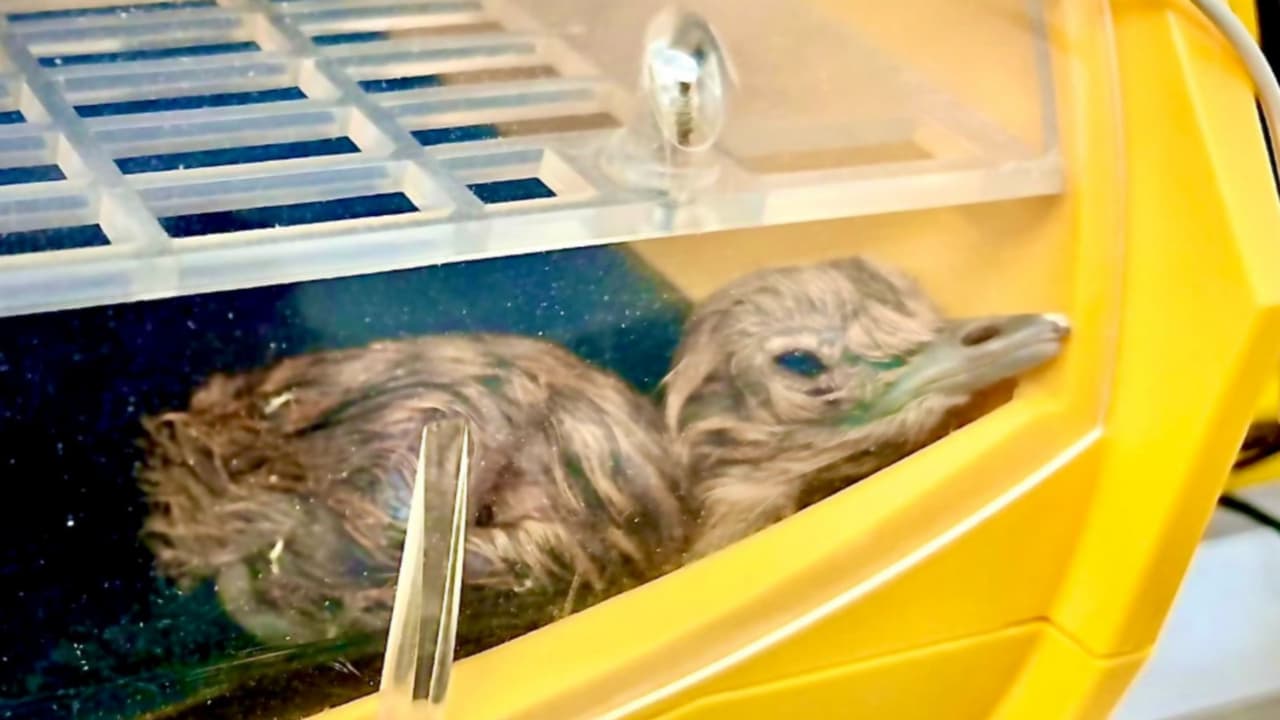
India's Project Great Indian Bustard achieved a milestone with two new chicks hatching at a Rajasthan breeding centre, bringing the captive population to 70. Union Minister Bhupender Yadav announced the success, noting one was from artificial insemination.
India's conservation efforts for the critically endangered Great Indian Bustard have reached a significant milestone with the hatching of two new chicks at the Conservation Breeding Centre in Rajasthan this week.
The development takes the captive population of the species to 70 birds for the first time since the launch of the breeding programme.
Project GIB's Fourth Year Success
Announcing the update on Friday, Union Environment, Forest and Climate Change Minister Bhupender Yadav described the moment as a proud achievement under Project Great Indian Bustard (GIB), which has now entered the fourth year of its captive breeding initiative.
According to the ministry, the two chicks hatched through different methods, one through natural mating and the other through artificial insemination.
"Another milestone achieved in Project GIB," Bhupender Yadav wrote in a post on the social media platform X, noting that the latest development reflects steady progress in the programme.
With the addition of the two chicks, the total number of Great Indian Bustards currently under captive care has reached 70.
Another milestone achieved in Project GIB! Project Great Indian Bustard entered into the fourth year’s of its captive breeding with two new chicks hatched at the Conservation Breeding Centre of Rajasthan this week, one from natural mating and the other from artificial… pic.twitter.com/s0UGu38RT5 — Bhupender Yadav (@byadavbjp) March 13, 2026
Next Steps and Conservation Methods
The minister also said that the next phase of the project will involve the "soft release" of some captive-bred chicks into the wild later this year. This step is expected to mark a new and challenging stage in the conservation effort, aimed at strengthening the species' population in its natural habitat.
Bhupender Yadav congratulated officials from the Rajasthan Forest Department for their work in achieving the milestone, acknowledging their role in implementing the conservation programme.
Images shared alongside the announcement illustrate the careful methods used in captive rearing. They include a newly hatched chick inside an incubator, a handler using a feeding puppet to care for a young bird, and a freshly laid egg at the facility. These techniques, based on peer-reviewed avian conservation practices, have helped improve survival rates by 20-30 per cent in comparable breeding programmes, as per a press release shared by the Ministry of Environment, Forest and Climate Change.
The project operates under the broader environmental vision supported by Prime Minister Narendra Modi, with officials expressing confidence that continued scientific management will help secure the future of the Great Indian Bustard in India. (ANI)
(Except for the headline, this story has not been edited by Asianet Newsable English staff and is published from a syndicated feed.)