
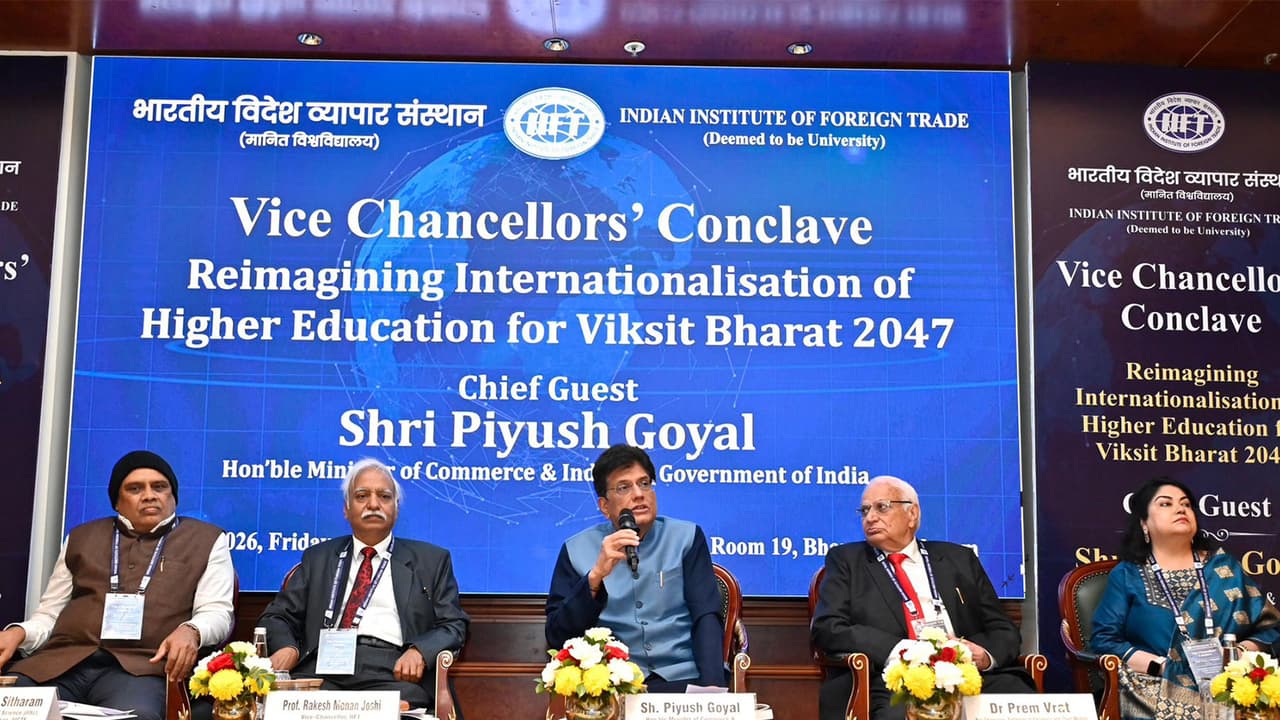
Commerce Minister Piyush Goyal said education as a service can boost India's export earnings. He called for internationalising higher education for Viksit Bharat 2047, attracting foreign students, and updating curricula with global trends.
Commerce Minister Piyush Goyal on Friday said that education as a service has significant potential to contribute to India's export earnings and help take high-quality Indian education to the rest of the world.
Addressing the Vice Chancellor's Conclave on "Reimagining Internationalisation of Higher Education for Viksit Bharat 2047" today, Goyal expressed happiness that the Ministry of Commerce and the Indian Institute of Foreign Trade (IIFT) under the Ministry is taking a lead in exploring the potential that education as a service holds for India's export earnings as well as for expanding the global reach of Indian education. The conclave provided a platform for thematic discussions and expert dialogues on key aspects of internationalising higher education, including international partnerships, student mobility, regulatory frameworks and dual degree programmes. Participants also deliberated on strategies to enhance the global competitiveness of Indian Higher Education Institutions, while examining emerging global trends in education mobility and exploring opportunities for India to strengthen its presence in the expanding global education services market.
India's Growing Global Clout and FTAs
He said that the future growth engines of the world are likely to be countries that are less developed or developing, such as India. Therefore, exposure to India would help students from developed countries in their future careers.
Goyal said he sees growing recognition of this trend while negotiating services chapters in Free Trade Agreements (FTAs). He noted that the nine FTAs finalised by the government led by Prime Minister Narendra Modi have all been with developed economies.
According to him, nearly two-thirds of global trade is now covered by India's FTAs because the country has engaged with more developed and evolved economies. He said this reflects a shift in India's approach to global engagement, noting that the country no longer negotiates from a weak position or a colonial mindset. Instead, India now engages with the world with confidence and from a position of strength.
The Minister said that if India is currently contributing around 20 per cent of global growth and has emerged as an engine of growth, then in the future the younger generations across the world will increasingly need to work with countries such as India.
Driving Change with National Education Policy 2020
The Minister said that a comprehensive effort to reform India's education system was undertaken through extensive consultations with educationists across the country in drafting the National Education Policy 2020 under the leadership of Prime Minister Narendra Modi. He noted that the policy was formulated after wide-ranging consultations and inputs from stakeholders across the country and overseas. Nearly three lakh inputs and feedback were received, each of which was given due importance and carefully considered before finalising the policy.
He said that the policy emerged after years of deliberation and reflects Prime Minister Narendra Modi's style of working. Goyal said that the policy has opened India's thinking to aspire for international standards in education, expand educational institutions to meet India's growing needs, and attract students from across the world.
The Minister said the policy has permitted international campuses to come and set up in India and has enabled universities to collaborate with Indian institutions to offer dual degrees. It has also encouraged cross-border student exchanges so that Indian students can gain exposure to education systems in developed and other countries, while international students can also experience India's education system.
A Call to Attract Students from Developed Nations
Goyal noted that there is now a need to encourage students from developed countries to come and study in India. He suggested models such as a three-year programme where students could spend one year in India and two years in their original institution, or split their time equally between both institutions.
According to him, such dual degree programmes would help students from developed countries understand how developing countries think, work, and engage with culture and society.
Modernising Curriculum and the Role of Educators
Addressing the Vice Chancellors present at the conclave, Goyal described them as architects of India's future, noting that they play a crucial role in shaping the minds of young Indians. He said that each Vice Chancellor carries a significant responsibility as they prepare students to face the challenges of tomorrow and lay the foundations of a modern, developed nation.
He said that higher education institutions must evolve with changing times and that teachers should undergo retraining and relearning so that they remain current with modern curriculum and future-oriented knowledge while teaching students. The Minister stressed that students cannot be prepared for the future through outdated curricula. He said that institutions and teachers must remain agile and understand emerging opportunities that the future holds.
Goyal highlighted the importance of internationalisation of India's trade, manufacturing and services sectors as well as engagement with modern technologies such as artificial intelligence, quantum computing and machine learning. He said these will become increasingly important if India is to continue growing at the current pace, become one of the top three economies in the world and emerge as a global technology powerhouse. He said educational institutions will need to reassess their curriculum and teaching styles accordingly.
He emphasised that subjects such as international trade and India's Free Trade Agreements should be included in academic curricula so that students understand the opportunities available in the global economy. The Minister expressed confidence that students who understand international law, trading rules and the benefits emerging from Free Trade Agreements will play an important role in taking India towards Viksit Bharat during the Amrit Kaal.
Vision for 2047: A Global Education Hub
Goyal said that as institutions adopt modern teaching techniques, upgrade facilities, and improve teachers' understanding of global trends, Indian students will increasingly choose to study in India rather than abroad. At the same time, India will begin attracting students from across the world. He expressed hope that in the coming years, the present ratio of 28 Indian students going abroad for every one international student coming to India would be reversed, and that India would attract around 1.3 million foreign students to study in its institutions, while only a small number of Indian students go abroad.
The Minister concluded by encouraging greater collaboration between academia, government and industry to realise the vision of internationalising higher education and transforming India into a global education destination by 2047. (ANI)
(Except for the headline, this story has not been edited by Asianet Newsable English staff and is published from a syndicated feed.)