As retaliation looms and global anxiety intensifies, a chilling question now haunts Americans: What if this conflict spirals into a nuclear strike on US soil?
The United States and Israel have launched their most aggressive military offensives in decades, sharply escalating tensions with Iran and igniting fears of a broader regional war that could spiral beyond control. As retaliation looms and global anxiety intensifies, a question now haunts Americans: What if this conflict spirals into a nuclear strike on US soil?
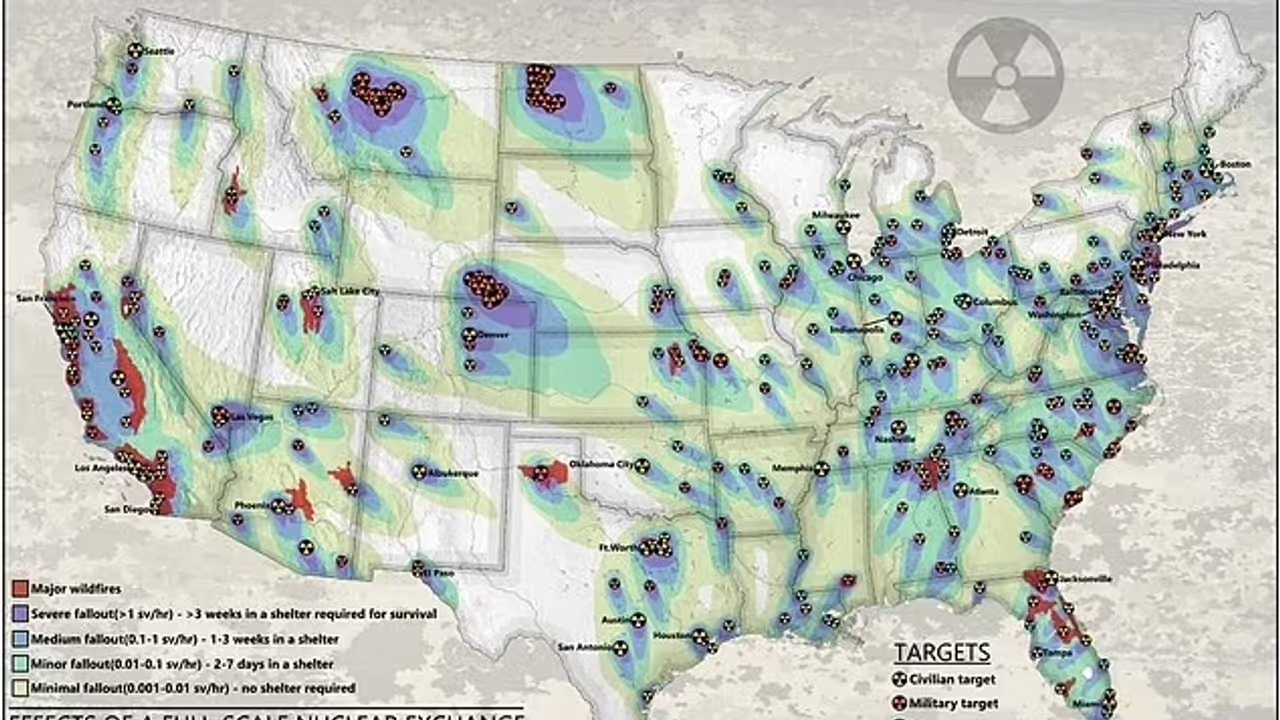
Using advanced modeling, a map lays bare the catastrophic consequences of a large-scale nuclear assault on major US population centers. The analysis suggests that as many as 250 million Americans nearly 75 percent of the population could perish if strategic cities across the East Coast, West Coast, Midwest and South were targeted.
Related Articles

The projection shows vast stretches of California, most of the Eastern Seaboard and critical Midwestern corridors blanketed in lethal radioactive fallout. Survivors in heavily affected areas would be forced to shelter in place for more than three weeks to avoid deadly radiation exposure.
Only parts of western Texas, sections of Nevada, and isolated areas in Michigan and Wisconsin appear outside the immediate blast zones. But even those regions may not escape unscathed. Scientists warn that a prolonged “nuclear winter” following a large-scale exchange could render wide swaths of the country uninhabitable.
The model was built using data from the Federal Emergency Management Agency (FEMA), incorporating projected blast radii, fallout dispersion patterns and radiation exposure levels based on likely detonation points and population density.
US President Donald Trump has repeatedly insisted that Iran must never acquire nuclear weapons. He claimed to have “obliterated” Tehran's nuclear program in strikes last June, but said this week that it had attempted to rebuild it.
'Just imagine how emboldened this regime would be if they ever had and actually were armed with nuclear weapons as a means to deliver their message,' he said on Saturday.
Western powers argue there is no credible civilian justification for Iran’s uranium enrichment levels, and the International Atomic Energy Agency has raised serious concerns. No other country has enriched uranium to such levels without eventually producing nuclear weapons.
Though Iran does not currently possess a nuclear arsenal, analysts warn that escalation involving nuclear-capable states could unleash consequences far beyond the Middle East with devastating implications for the United States.
To visualize those risks, the map created by Halcyon Maps models how a sweeping nuclear strike might unfold across American soil. Fallout clouds would not remain confined to city limits. Instead, radiation would rapidly spread, transforming targeted metropolitan hubs into sprawling contaminated regions. Millions could face death from radiation sickness.
Symptoms would vary depending on exposure levels but could include nausea, fatigue, vomiting, diarrhea, severe skin damage, seizures and even coma. At high enough radiation doses, these symptoms can emerge within minutes — and prove fatal.
Major cities including New York, Los Angeles, Philadelphia, Houston and Washington, DC would likely be among the first targets. The rationale is strategic and chilling: crippling these urban centers would strike at the heart of America’s economy, leadership and workforce.
Severe fallout would stretch from Boston through New York City and Philadelphia to Chicago, engulfing millions in radioactive debris. Dangerous contamination zones also appear along the California coast and near key military installations.
Surrounding these red zones are medium-risk areas, where residents would need to shelter for up to three weeks. By contrast, parts of Georgia, Mississippi and Arkansas show minimal fallout in the model, suggesting residents there might avoid prolonged confinement.
The United States maintains strategically positioned nuclear forces nationwide, assets that would themselves become prime targets in any full-scale exchange. That includes intercontinental ballistic missile (ICBM) silos, naval bases, air force installations and nuclear storage depots.
More than 100 military facilities including ICBM sites in Montana, Colorado, Wyoming and North Dakota — would likely face direct strikes. Scientists have long speculated that the 450 ICBM silos could serve as epicenters in a nuclear exchange, given their central role in America’s defense strategy.
The model also highlights potential strikes on approximately 150 military sites, including the North American Aerospace Defense Command (NORAD) in Colorado, the Pentagon and naval bases in California and Washington.
Critical infrastructure including power plants, oil refineries, transportation hubs and major communication centers especially across Texas, California and the Midwest are marked as high-value targets. The Mississippi River region, vital for commerce and transport, also appears vulnerable.
John Erath, senior policy director for the Center for Arms Control and Non-Proliferation, warned of the indiscriminate nature of nuclear fallout.
'While those who live near military facilities, ICBM silos in the Midwest or submarine bases along the coasts might bear the most immediate and severe consequences of a nuclear attack, there's no question: Any nuclear war or weapons detonation would be bad for everyone.
'Nowhere is truly 'safe' from fallout and other consequences like contamination of food and water supplies and prolonged radiation exposure.'