On January 1, 1912, China formally ended imperial rule and declared itself a republic. The moment carried enormous weight. After centuries of emperors and dynasties, the idea of a government based on citizens rather than rulers appeared within reach.
New Delhi: On January 1, 1912, China formally ended imperial rule and declared itself a republic. The moment carried enormous weight. After centuries of emperors and dynasties, the idea of a government based on citizens rather than rulers appeared within reach. Sun Yat-sen, the republic’s leading figure, spoke of nationalism, democracy, and the welfare of the people as the foundations of the new state. That promise did not survive the century. Modern China is not the outcome of that republican vision. It is its opposite. The system that governs China today did not grow out of the ideals of 1912; it replaced and erased them. Tibet’s experience after 1949 shows this failure more clearly than any political speech or party document.
A Republic That Failed to Take Shape
The fall of the Qing dynasty was meant to free China from autocratic rule and foreign interference. The republic was supposed to give people a voice in how they were governed. Power, at least in principle, was to flow upward from society rather than downward from a throne. This vision never had time to settle. Internal divisions, warlord politics and external pressures weakened the republican system. By the time the Chinese Communist Party emerged victorious in 1949, the republican experiment had already collapsed. What followed was not a revival of popular rule. The new state concentrated power even more tightly. Political authority moved from emperors to a single party that allowed no challenge. Independent institutions disappeared. Political disagreement was treated as a threat. Citizenship came to mean loyalty rather than participation.
Today, the ideas of democracy and popular consent that defined 1912 hold no real space in mainland China’s political life.
Related Articles

Tibet and the End of Self-Rule
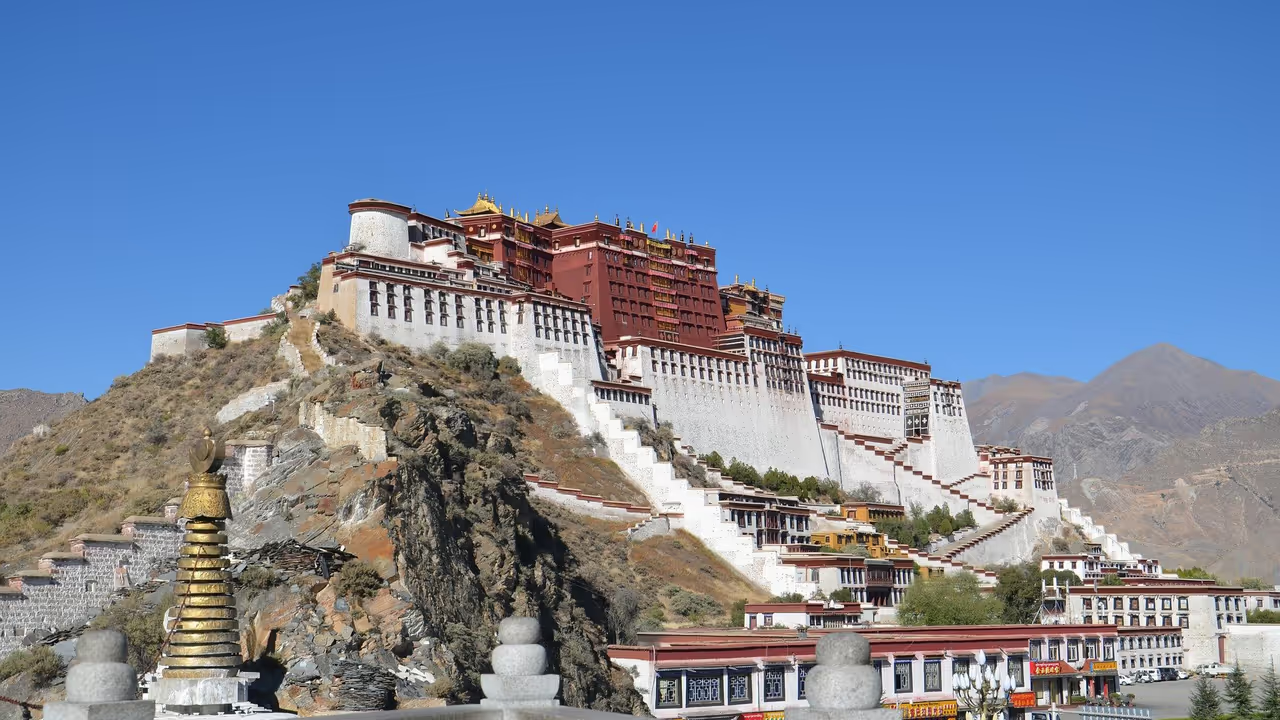
Tibet exposes the distance between China’s early republican ideals and its later actions. Before the arrival of the People’s Liberation Army, Tibet governed its own internal affairs through institutions shaped by its history, religion, and social structure. Its political status was complex, but it was not administered as a modern Chinese province.
In 1950, Chinese troops entered Tibet. Beijing described this move as “liberation.” Tibetans experienced it as the loss of control over their own future. Decisions about governance, culture, and religion were transferred to authorities far removed from Tibetan society.The justification for this takeover echoed the same logic used by empires everywhere: that a stronger power knew better than the people being ruled. This thinking directly contradicted the principles the 1912 republic had claimed to stand for. The right of people to govern themselves was replaced by state authority enforced through military presence. Tibet thus became both a victim and a symbol. It showed how easily the promise of self-rule could be abandoned when power was centralised.
A Shared Denial of Freedom
Tibet’s loss of autonomy mirrors China’s own political history. Just as Tibet was denied the right to choose its path, Chinese citizens were denied the chance to shape their political system after 1949. Both were brought under a system that values control above consent.
The Chinese state treats territory as something to be held, not as communities with distinct voices and needs. Cultural difference is viewed with suspicion. Political uniformity is enforced through surveillance and punishment.
The pressure placed on Tibetan language, religion, and identity reflects a broader pattern. The same fear of independent thought that limits political debate in Beijing also drives repression in Tibet. The problem is not only about borders. It is about power.
Remembering 1912, Living with 1949
On the Chinese mainland, the founding of the republic is largely absent from public life. It is not celebrated as a guiding moment. Instead, 1949 is presented as the true beginning of modern China.
That date represents stability and state authority, but it also marks the end of political pluralism. The ideals of 1912—representation, accountability, and participation—were set aside. What replaced them was a system that demands obedience and discourages questioning.
Tibet’s continued resistance, quiet and largely peaceful, challenges this narrative. Despite decades of pressure, Tibetans have maintained their cultural identity and their belief that self-rule matters. Their struggle is not abstract. It concerns daily life, faith, language, and dignity.
An Unfinished Reckoning
Tibet’s experience forces a wider question about China’s political path. The failure to honor Tibetan self-determination reflects the same choice that ended China’s own republican experiment. Both point to a rejection of diversity and shared power.
The ideals proclaimed in 1912 were not fulfilled. They were abandoned. The consequences are visible not only in Tibet but across Chinese society.
Until China confronts this history honestly, the republic declared more than a century ago will remain a lost possibility. And Tibet will remain a reminder of how that loss continues to shape lives long after the slogans have faded.