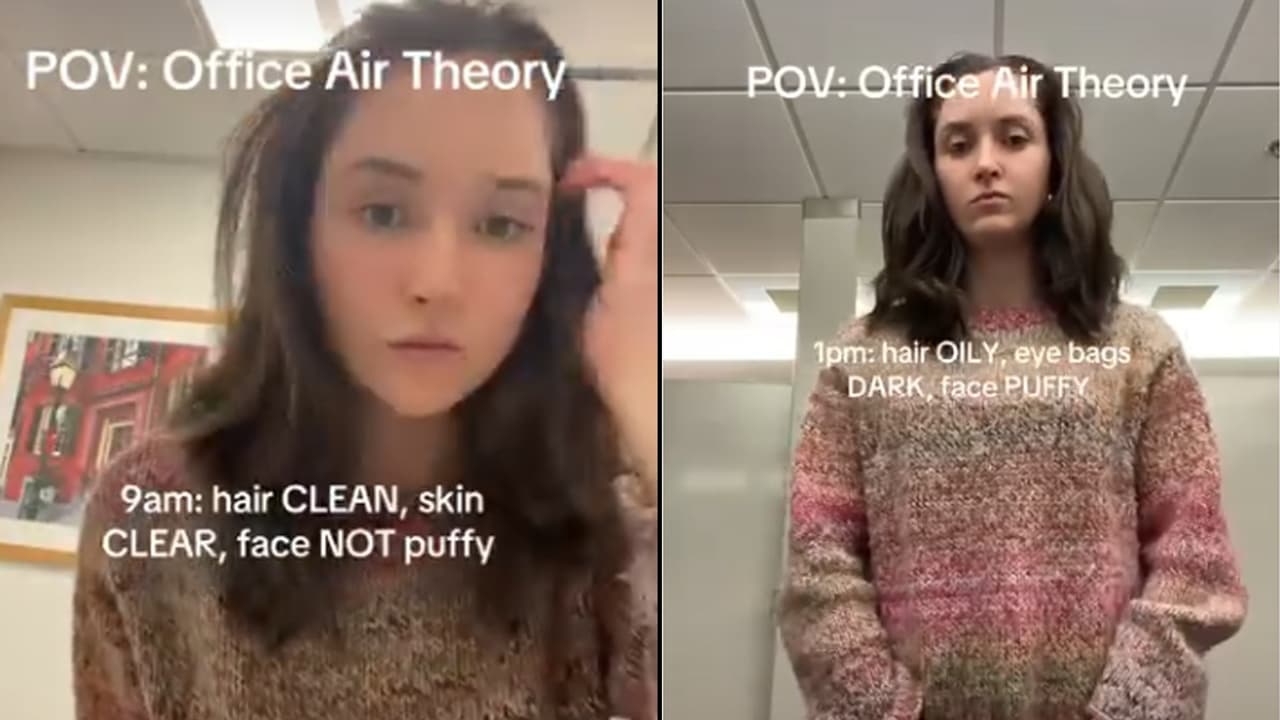
A woman named Noa Donlan has gone viral for claiming that 'office air'—comprising fluorescent lights, blue light, and poor circulation—is damaging her skin and hair. Her video has resonated with many who experience similar issues, blaming the office environment for symptoms like dryness, dullness, and irritation.
Offices are where individuals spend a large amount of time each day. But how does the office atmosphere effect your skin? Well, one lady swears it does. According to People, a lady named Noa Donlan is concerned about the effects of "office air" on her complexion, hair, and overall look. She claims that her skin feels fresh when she wakes up, but it deteriorates by the end of the day.
She blames the office air, implying that fluorescent lights, blue light from screens, and poor air circulation common in office environments impair workers' physical appearance over the course of a workday. Donlan stated her friends and relatives who work in corporate environments agree that being at work may make you feel and look bad.
Watch Viral Video
Related Articles

“Almost everyone I know who works a job has been stressed at their job at some point, and I think it definitely contributes to how they feel,” she explained.
Social Media Reactions
Her videos rapidly went viral, with many viewers leaving comments to relate their own experiences. One person commented, "That's so true." Another said, "I assumed it was just me." A third stated, "My hair gets so oily by lunchtime, but it doesn't appear like that at work. "I develop allergies."
Common symptoms include dryness, dullness, and irritation, which is aggravated by air conditioning and low humidity. Meanwhile, flat, dry hair can be caused by extended exposure to workplace air. Air pollution can also cause wrinkles, fine lines, and age spots. It has been shown that pollutants can block pores and cause acne, eczema, and psoriasis. Air pollution comprises particulate matter (PM2.5), nitrogen dioxide, and ozone, which can enter the skin and cause oxidative stress and inflammation. This can cause skin damage, accelerated ageing, and even skin cancer.