
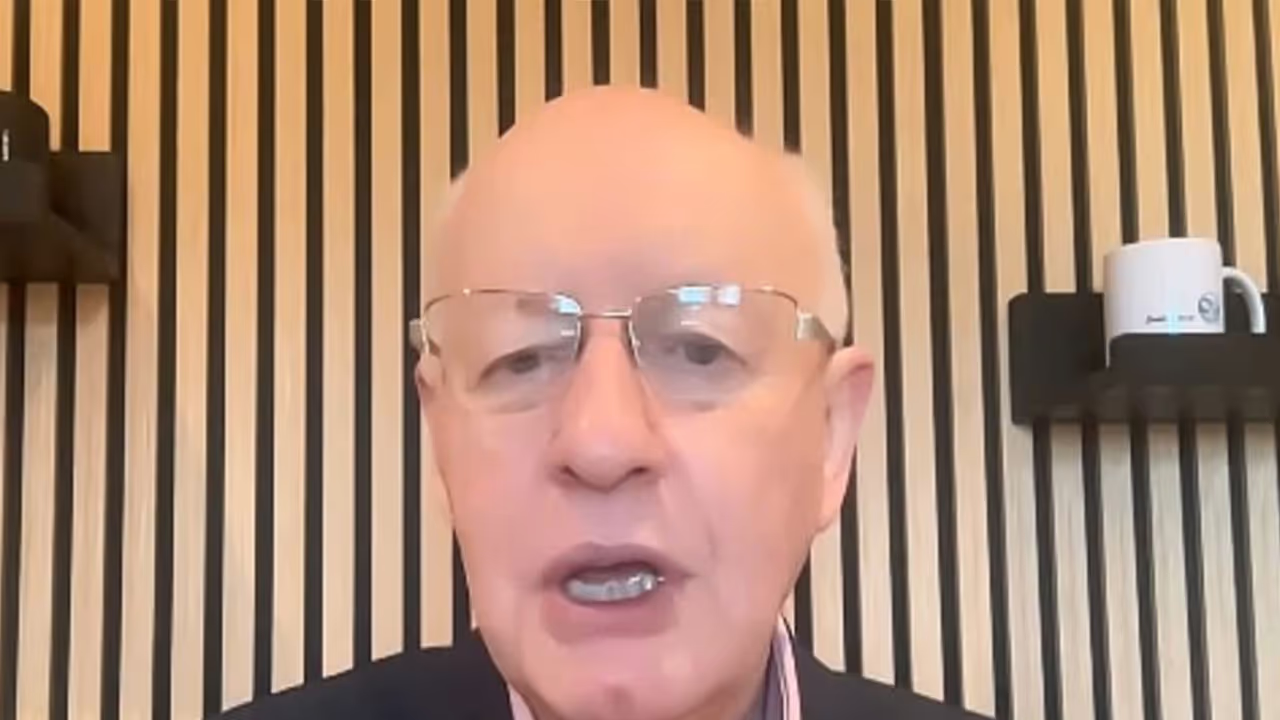
British writer David Vance voices deep skepticism about the US-Iran talks in Islamabad, predicting no positive outcome as the parties are "so far apart." He also questions Pakistan's role as mediator and highlights the talks' global energy implications.
British political commentator and writer David Vance on Saturday has expressed deep skepticism over the ongoing high-level talks between the United States and Iran in Islamabad, warning that a meaningful breakthrough is unlikely given the two parties seem "so far apart".
Speaking to ANI, Vance said the world is closely monitoring the negotiations due to their potential impact on global energy markets. " The world will watch very closely because, obviously, the big factor is things like global energy costs," he noted. However, he added that unlike past diplomatic engagements, he does not expect a positive outcome. " I honestly can't see how there is going to be an outcome because the parties seem so far apart," he said.
The talks are being led on the American side by US Vice President JD Vance, marking a rare instance of direct high-level engagement between Washington and Tehran after weeks of escalating conflict.
Distrust Over Venue and Legitimacy
Vance also questioned the choice of Pakistan as the venue and the mediator. " I find that very, very strange. I mean, if they wanted to have a neutral arbitrator, it could have been India. I don't understand why it's Pakistan," he said, adding that the setting undermines his confidence in the talks.
He said, "So that's another reason that I'm very distrustful of these talks. It's being held in the wrong place and in many regards on the wrong principles."
Raising concerns over the broader implications of any agreement, he asked, "What is a positive outcome you might equally ask? Is it just to say let's have a form of peace and abandon the Iranian people who rose up and were slaughtered in their thousands? Is that a positive outcome? I don't think so."
He further alleged that the negotiations risk legitimizing both Islamabad and Tehran. He said, "So I've got major questions with this one. And also, you know, just as it legitimizes Pakistan, which shouldn't be legitimized in my view anyway, just as it does that, it also gives Iran credibility which it shouldn't have."
Regional Tensions Weaken Prospects
On regional tensions, particularly involving Hezbollah in Lebanon, Vance argued that ongoing hostilities weaken the prospects of a durable agreement. He said, "When it comes to Lebanon, this is Israel attacking Hezbollah. Hezbollah is basically, as you know, a proxy for Iran. So what this demonstrates to me is that the US was right to attack Iran because Iran has all these global terrorist proxies in Lebanon, in South Yemen, in Gaza, they've got them all over the place. And so I think Israel's right to attack Hezbollah because Hezbollah is a threat to Israel. But now that Iran is saying that that's a precondition, that there can be no attacks."
"The parties are so far apart. And I don't see how a deal's going to happen," he said, adding that any agreement would likely be short-lived. " I don't believe it's going to hold anyway. And that even might be the objective of this," he said.
Trump's 'Maximum Pressure' Approach
Highlighting the strategic importance of the Strait of Hormuz, Vance stressed that control over the vital shipping route has become a major flashpoint. "The whole world, and I'm sure it's same with you as well, we're all being held ransom over energy costs. And that has to be sorted out, " he said.
He also backed the US administration's dual approach of diplomacy and military pressure under US President Donald Trump. He said, "But I don't think you sort it out by having negotiations. I think you sort it out militarily. And that's what President Trump needs to do."
He added, "What President Trump is doing, he's leveraging maximum pressure on the Iranian regime. They know that the military might of the US is continuing to gather in the region. And therefore, if they walk away from any talks without giving Trump what he wants, then there could be a terrible onslaught against them. So I think Trump is just doing a very good negotiation from his point of view. And obviously, the threat of US military power is significant."
China's Role in the Power Struggle
On the geopolitical dimension, Vance suggested the crisis reflects a broader power struggle. "China is also a party we have to watch. China is re-arming Iran as far as I can understand as we speak. So China's re-arming Iran. So in a way, you know, this is China versus America and Iran's just a proxy," he claimed.
Delegations Arrive for High-Level Talks
As the world watches with bated breath the slippery ceasefire talks, a US aircraft carrying a team for negotiations with Iran has landed in Pakistan's Islamabad, Al Jazeera reported, citing its sources.
The Iranian delegation arrived after midnight, led by Parliament Speaker MB Ghalibaf. The US team comprises lead negotiator Vice President JD Vance with Special Envoy Steve Witkoff and President Donald Trump's son-in-law, Jared Kushner, as per Al Jazeera.
After the ceasefire announcement last week, Iran's Supreme National Security Council said on April 8 that talks could continue for up to 15 days. (ANI)
(Except for the headline, this story has not been edited by Asianet Newsable English staff and is published from a syndicated feed.)