
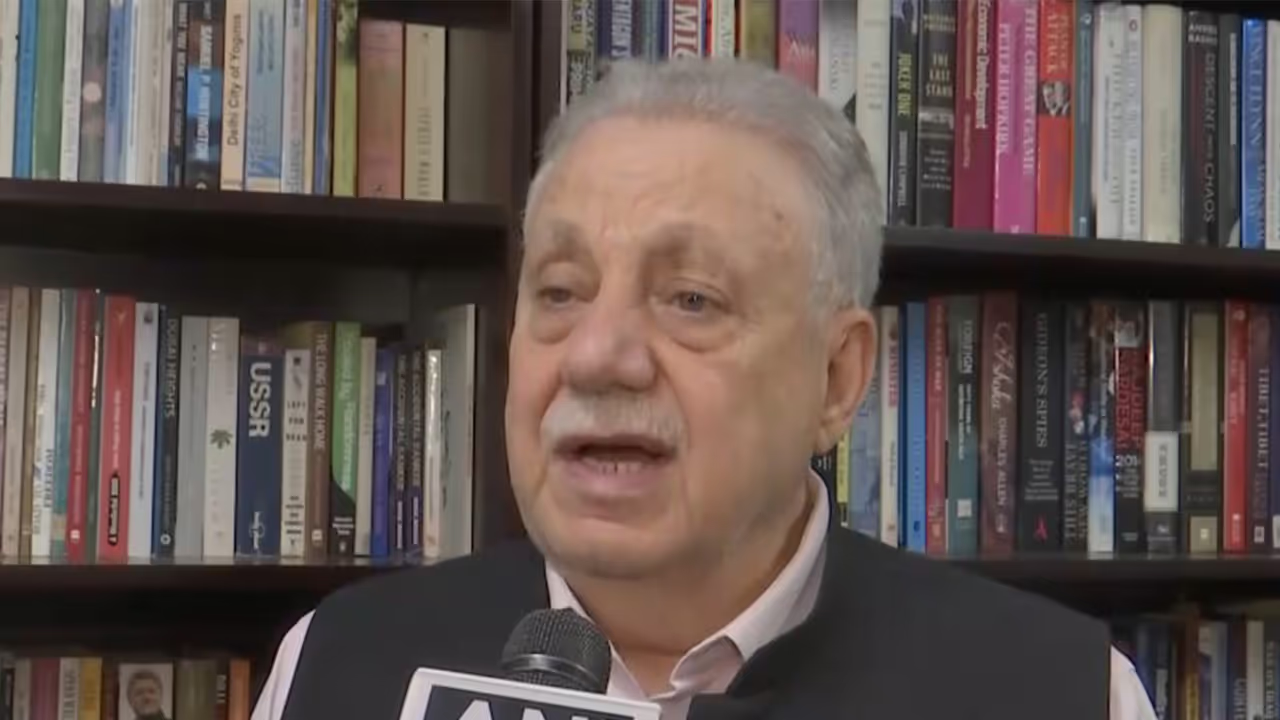
Foreign affairs expert Waiel Awwad says the scale of delegations at the US-Iran peace talks in Islamabad indicates both sides are serious about an agreement, despite ongoing tensions over the strategic Strait of Hormuz.
As high-stakes US-Iran peace talks unfold in Islamabad, foreign affairs expert Waiel Awwad on Saturday said the scale and composition of delegations signal that both sides are "serious about reaching a sort of an agreement", even as tensions remain over key issues like the Strait of Hormuz.
Signs of Seriousness in Talks
Speaking to ANI, Awwad said, "Well, I think today, all eyes are in Islamabad to find out what will be the outcome of this discussion. For two reason: either the Iranian delegation which is composite of around 71 persons including the the Chairman of the Majlis-e-Shura in Iran, Mohammad Baqer Qalibaf. He is the one in charge of the discussion and he was given the full authorities of the government of Iran to continue the discussion; either he should be able to reach to an agreement or pull out of that agreement."
He added that the presence of senior American leadership reflects similar seriousness from Washington. "So I think the American also, led by their Vice President himself, including Witkoff and Kushner also, and a huge American delegation give you an indication that both sides are serious about reaching a sort of an agreement," he said.
Tensions Over Strait of Hormuz
Responding to concerns about the fragile situation and disagreements, particularly regarding the strategic Strait of Hormuz, Awwad linked the current tensions to broader geopolitical developments. "See, before the war on, there was no question of this Strait of Hormuz. Strait of Hormuz was open, there was no need for the discussion, there was no need for this war. And Iran have agreed for the nuclear issues to deal with the United States and the enriched uranium to be downgraded and that they have agreed on that on Geneva. But yet the United States went for a war only because of the Prime Minister of Israel dragged the United States President into this war," he said.
Global Pressure and Shifting US Focus
He further claimed that growing global pressure and domestic political challenges for US President Donald Trump have influenced Washington's approach." Now, with the global pressure on the United States and President Trump falling popularity in the ground and in US and the pressure increasing on him, definitely he realized that closing of Strait of Hormuz was not a good indication and that was in the hands of the Iranian, which is partially closed," Awwad stated.
He added, "And now he's focusing mainly on the opening of the Strait of Hormuz. Nothing else he was talking about: the uranium issues, the regime change, because militarily, they have failed to achieve their aim."
Iran's 'Pressure Tactics'
On reports suggesting Iran may have difficulty locating seas mines in the Strait, Awwad dismissed the claims as strategic messaging. "No, I think Iran already made it very clear that it is partially closed. Definitely they know where about. But I think that's also a pressure tactic on the United States that they should be able to reach to a sort of an agreement," he said.
Critique of US Negotiating Style
He also criticized Washington's negotiating style, adding, "United States is in a very short temper, President Trump, he wanted immediate answer from the Iranian. Do it or die, that's his policy. He is bullying all every country he discussed with." (ANI)
(Except for the headline, this story has not been edited by Asianet Newsable English staff and is published from a syndicated feed.)